
Why Do Stars Twinkle? The Real Answer Behind Pip's Blinking Star
A small fox sees his star blink and is afraid it is going out. The answer is in the last moments of the light's journey, and it is the same answer that makes astronomers build telescopes on mountains and fire lasers at the sky.
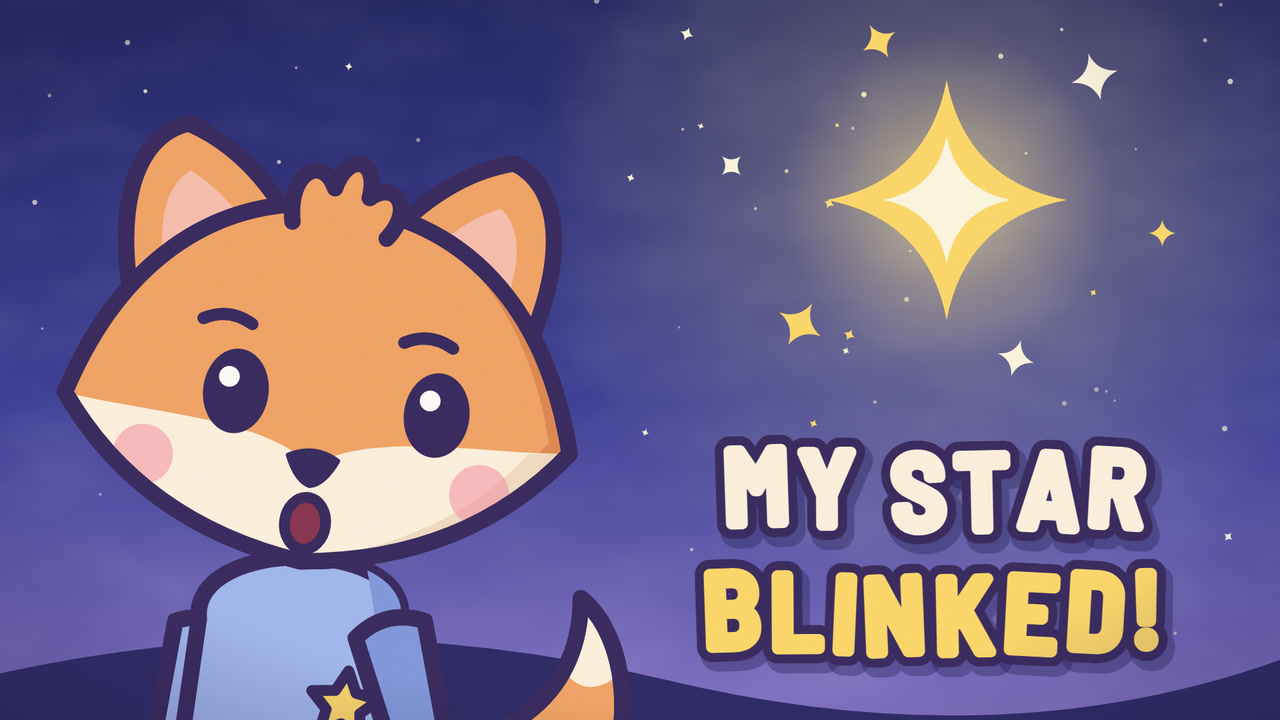
Pip and his star, from Episode 1 of Pip & the Little Sky, “The Star That Blinked”. Space Radar (MIT)
Stars twinkle because of our air, not because of anything the star is doing. The light leaves the star steady and stays steady across the whole distance between the stars. Only at the very end does it cross the Earth's atmosphere, where moving air bends it a little, first one way and then another. What reaches your eye is a point of light that shivers and changes its brightness. The star, as NASA puts it for children, is “shining with a steady light”.
That is the whole idea of our new cartoon episode, and it is a good question to take seriously, because a small child who sees a star flicker can reasonably think something is wrong with it. In The Star That Blinked, Episode 1 of Pip & the Little Sky, a young fox says good night to his star, as he does every night, and the star blinks back. Then it blinks again, and again. “Is my star going out?” he asks.
The film is 3 minutes 11 seconds long and written for children of about 3 to 5. This piece is for the grown-up on the sofa beside them: the same answer at full size, what the film leaves out, and three things to try together afterwards.
What moving air does to a point of light#
Air is not one even block of glass. It is a restless mixture of warmer and cooler parcels, rising, sinking and sliding past each other. NASA's Ask an Astrophysicist service describes them as little pockets of air whose density, temperature and humidity differ from the air around them. Light changes direction slightly when it passes from one density to another. That is refraction, the same effect that makes a straw look broken in a glass of water.
Each pocket bends the starlight by a tiny angle. The pockets drift across your line of sight all the time, so the bending is different from one moment to the next. The star's image jumps about by an amount far too small to see as movement, and more or less of its light lands in your pupil from one instant to the next. The eye reads that as a flicker in brightness. Astronomers call it scintillation; everybody else calls it twinkling.
You have seen the same thing at a larger scale on a summer road, where the air above hot tarmac makes distant cars wobble. The night sky does it far more gently, but a star gives it away, because a star is the hardest test there is: it is so far off that it is a single point with no width at all to the eye. Every bit of its light comes down through the same thin thread of air.
The pebble stayed just the same. Only the water moved.
Why the lowest stars twinkle the most#
Near the end of the film the narrator tells Pip to look low, near the trees: “Those stars twinkle the most.” This is true, and the reason is simple geometry. A star overhead is seen through the shortest possible path of air. A star near the horizon is seen through a long slanting path, so its light meets far more of those moving pockets. StarChild says there is “a lot more atmosphere” between you and a star near the horizon than one higher up.
Low, bright stars do one more thing that the film does not show. The Royal Observatory in Greenwich notes that a twinkling star may appear to change colour as it twinkles. Air bends blue light slightly more than red, so near the horizon the colours of a star can be pulled apart for an instant and flash in turn. People regularly report a bright winter star low in the sky as something strange for exactly this reason.
Why planets hold steady#
Here is the most useful trick in naked-eye astronomy: if it twinkles, it is probably a star; if it shines with a calm, steady light, it may be a planet.
The reason is size on the sky. A planet looks like a point, but it is really a very small disc. NASA's fact sheet gives Jupiter an apparent diameter of between 30.5 and 50.1 seconds of arc, depending on how far away it is. A second of arc is 1/3600 of a degree. The blurring caused by the air is of the order of one second of arc: half a second at the best sites, two on a night a professional would call bad. So Jupiter's disc is many times wider than the disturbance. Light from one side of the disc comes through different pockets of air than light from the other side, and the ups and downs cancel. As the same NASA answer says, the turbulent effects are averaged out.
A star has no such luck. Even the nearest ones are so distant that their discs are far smaller than the blur, so there is nothing to average. The rule is not perfect: Greenwich says planets “generally” do not twinkle, and one very low on the horizon can shimmer. But on most nights it works.
- 30.5 to 50.1″Jupiter's width on the sky in seconds of arc (NASA). Wide enough for the air's effects to average out.
- about 0.5″The blur from the air, called seeing, on a good night at the best observatory sites (NASA, Ask an Astrophysicist).
- 1/3600°One second of arc. A star's disc is far smaller than this, which is why it twinkles.
The same air is why telescopes sit on mountains#
What is charming to the eye is a serious problem for a telescope. Over a long exposure the dancing image smears into a blur, which astronomers call seeing. The NASA answer puts it at about half a second of arc at the best sites on Earth and says two seconds would be a bad night for a professional. However large the mirror, the air sets the limit.
There are three ways round it, and each one is the film's idea turned into engineering.
- Go where the air is calm and thin. Big observatories are built on high, dry mountains, above as much of the atmosphere as possible.
- Undo the bending as it happens. The European Southern Observatory writes that turbulence makes stars twinkle “in a way that delights poets but frustrates astronomers”. Its telescopes use adaptive optics: a reference star is watched, the distortion is measured, and a flexible mirror is reshaped by computer in real time to cancel it. Where there is no bright star nearby, a laser makes an artificial one high in the atmosphere.
- Leave the air behind. NASA says the Hubble Space Telescope was put above the atmosphere to avoid these effects, and that from there it sees “steady, unwavering light”. In space, stars do not twinkle at all.
So when Pip's narrator says, “Your star is not going out, Pip. It shines all the time,” she is describing what an astronaut would see through the window.
What the film simplifies#
Every episode comes with a list of where it bends the truth, and for whom. This is the one for Episode 1.
- The air is drawn. In the film, moving air appears as pale wavy bands so that a child can see it. Real air is invisible, and its movements are much finer and faster.
- The blink is big and slow. Pip's star almost goes out. A real twinkle is quicker and smaller, and near the horizon it can flash colours. The film shows brightness only.
- The bowl of water is a likeness, not the sky. Wisp drops a yellow pebble in a bowl and blows on the water, and the pebble seems to blink. Ripples bend light as moving air does, but when Pip asks whether there is water in the sky the narrator says plainly, “No, Pip. But there is air.”
- “It shines all the time” is true for a child's night. Stars do end, after a very long time, and some stars really do vary. The film says neither. StarChild itself says “most” stars shine steadily.
- The film gives one idea. It says the starlight comes down through moving air. It does not use the words bend or refraction, and it leaves the planets out. Those are for you.
- Wisp is magic and says so. The cloud plays and gets things wrong; it never explains the science. Pip, his tree house and his star are made up, and the star is not a real named one.
Three things to try with a child#
- The pebble in the bowl. Put a coin or a bright pebble in a bowl of water and wait until the water is still. Look at it together. Then blow gently across the surface. Ask: “Did the pebble move, or only the water?”
- Low star, high star. On a clear evening find one star just above the rooftops or trees and one high overhead. Which one twinkles more? You do not need to explain why. Noticing is enough at four.
- Find the one that does not twinkle. If there is a bright “star” that shines calmly while its neighbours flicker, it may be a planet. The map link at the end of this page shows which planets are up tonight.
How it was made: drawn in code, no generated video#
Like our other cartoons, this one uses no text-to-video and no image-to-video model. Pip, Wisp, the bedroom and the sky are vector drawings built by a program, and every movement is a function of time, rendered one frame after another. That keeps Pip the same fox in every shot, and it means a fact can be corrected or a line translated without redrawing the film.
The voices are synthetic text to speech, and the credits say so. Each line was recorded separately, transcribed by a second program and compared with the script before anything was drawn; the finished film was transcribed again. The music-box lullaby and every small sound are synthesised by us. The pace is deliberate: 259 spoken words in 27 shots, about 81 words a minute, with no shot shorter than six seconds. Small children need time to look.
The science was read on the page before it was written into the script, and the sources are listed below.
Where to watch#
- The series page: video.spaceradar.ai/series/pip-and-the-little-sky, with captions and a transcript.
- YouTube: the Pip & the Little Sky playlist, in episode order. Episode 1 is scheduled there for 28 November 2026 and is published as Made for Kids.
- A 34-second cut for phones follows on YouTube Shorts and Instagram.
If a child in your house watches it, we would like to hear what they asked afterwards. Space Radar is open source, and the place to tell us is our GitHub or any of our channels.
And when you go outside to look for the star that does not twinkle, the map will tell you which planet it is.
Questions people ask
Why do stars twinkle?
Because their light passes through the Earth's moving air on its way to your eye. Pockets of air of slightly different temperature and density bend the light a little, and the bending changes from moment to moment, so the star seems to shiver and change its brightness. The star itself shines steadily.
Is a twinkling star flickering or going out?
No. NASA's StarChild page says most stars shine with a steady light. The twinkle is made in the last part of the journey, in our own atmosphere. Some stars do truly vary, which is why NASA says “most”, but that is not what you are seeing when a star twinkles.
Why don't planets twinkle?
Planets are close enough to show a tiny disc, even if the eye cannot see it as one. Light from different parts of that disc comes through different pockets of air, and the effects average out. A star is so far away that it is a single point, so there is nothing to average. A planet very low in the sky can still shimmer a little.
Why do stars near the horizon twinkle more?
Their light crosses much more air before it reaches you than the light of a star overhead. More air means more bending. Low, bright stars can also seem to flash different colours as they twinkle.
Do stars twinkle when you are in space?
No. Above the atmosphere there is no moving air in the way. NASA says the Hubble Space Telescope sees steady, unwavering light because of where it is.
What is Pip & the Little Sky, and what age is it for?
It is a calm animated bedtime series from Space Radar for children of about 3 to 5. Each episode is one small surprise in the night sky, one feeling named out loud, and one true idea. Episode 1, The Star That Blinked, runs 3 minutes 11 seconds and is free to watch.
Is the cartoon made with AI video?
No. Every frame is drawn by code: the characters and sets are vector drawings posed by a program and rendered one frame at a time. No generated video or generated images are used. The voices are synthetic text to speech, and the credits say so. The music and sounds are synthesised by us.
Sources
- Why do stars twinkle? (StarChild, Question of the Month) NASA Goddard Space Flight Center Moving air bends starlight slightly; most stars shine with a steady light; stars near the horizon twinkle more. Read 24 November 2026.
- Ask an Astrophysicist: the night sky (why stars twinkle and planets do not) NASA, Imagine the Universe Turbulent cells of air, refraction, 'seeing' of about 0.5 second of arc at the best sites, and why a planet's disc averages the effect out.
- What was that bright object I saw in the sky last night? Royal Museums Greenwich Planets generally do not twinkle; a twinkling object that may seem to change colour is probably a star.
- Adaptive optics European Southern Observatory The same turbulence blurs telescope images; deformable mirrors and laser guide stars correct for it.
- Why have a telescope in space? NASA Science Shifting pockets of air cause the twinkling; Hubble was put above the atmosphere to avoid it.
- Jupiter fact sheet NASA Space Science Data Coordinated Archive Apparent diameter from Earth: 30.5 to 50.1 seconds of arc.
- Pip & the Little Sky, the series page Space Radar
Explore on Space Radar
Keep reading
What Is in the Sky Tonight? Relearning to Look Up
What is in the sky tonight, seen from an ordinary city balcony, is a short list. Almost nobody is taught it any more. It takes one evening to learn.
ISS pass tonight? Ask the sky over your own street
Most sky apps assume you know the constellations. The Tonight view in Space Radar assumes you know which way is south. What it works out for one street on one evening, and what it admits it cannot know.
Orbit Crew: A Space Cartoon for Kids Where the Science Is Real
A satellite goes silent, a captain reaches for the biggest wrench on the station, and a robot shouts at space. Our first cartoon episode is 70 seconds long and teaches one true thing about radio.