
Space Radar in 11 Languages: The Map and Its Pages in Spanish, Hindi, Arabic and More
The pages of the free 3D map that search engines read are now in Spanish, French, German, Brazilian Portuguese, Russian, Ukrainian, Simplified Chinese, Hindi, Hebrew and Arabic, as well as English. They are machine translations that a second program checked, and no native speaker has read them yet. Here is what is translated, what is not, and how you can help.
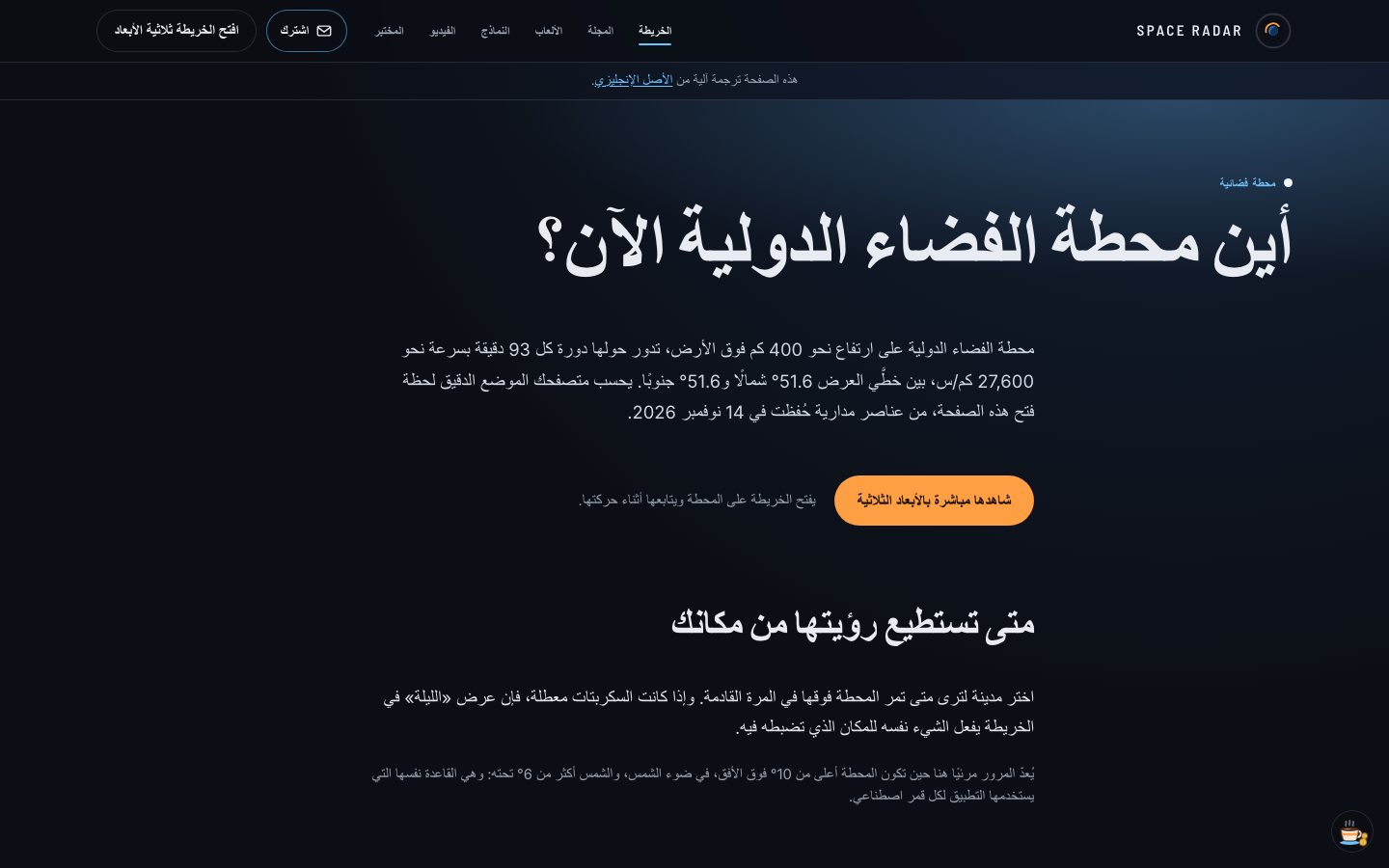
The International Space Station page in Arabic, which reads right to left. Every translated page says at the top that it is a machine translation.
Yes: the Space Radar map and the pages around it now speak ten languages besides English. They are Spanish, French, German, Brazilian Portuguese, Russian, Ukrainian, Simplified Chinese, Hindi, Hebrew and Arabic. The map opens in your browser's language, and about 653 pages in each language, from the home page to Jupiter to the space station, have an address of their own. One caution comes first: every translation was made by a program, and no native speaker has read them yet.
That is the honest state of it, and the pages say it too. A translated page opens with one line in its own language: this page is a machine translation, checked against the English original, with a link to the English. We would rather you knew that than trusted it blindly.
What you can read now#
The pages that search engines read exist once in each language, under a folder named for it: /es/, /fr/, /de/, /pt/, /ru/, /uk/, /zh/, /hi/, /he/ and /ar/. In each language there are about 653 pages: the home page, the pages for objects such as planets, moons, spacecraft and stars, the guided trips, the Lab, the countries, the events and the static pages.
- www.spaceradar.ai/fr/o/jupiter.html: Jupiter, in French
- www.spaceradar.ai/ar/: the home page, in Arabic
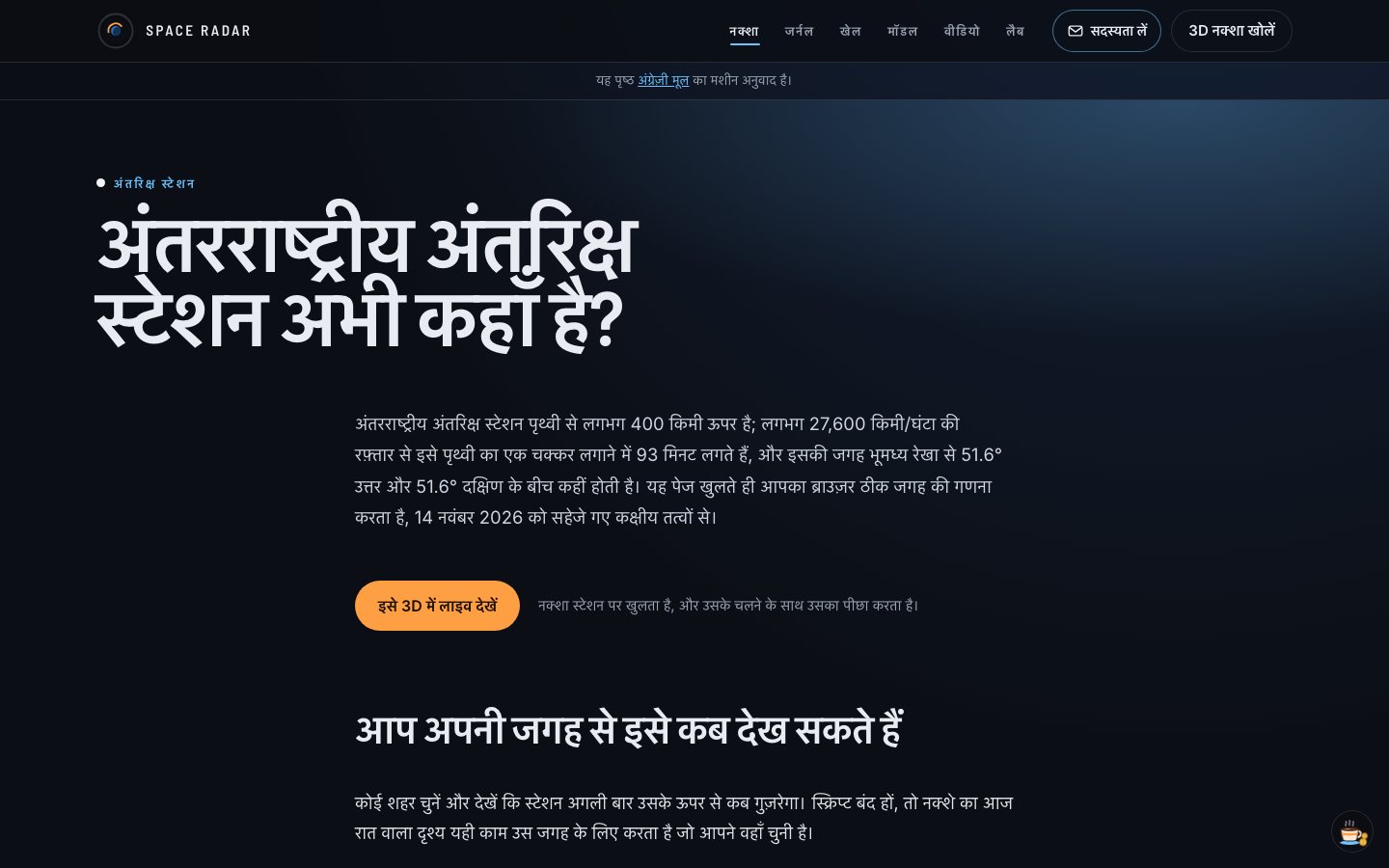
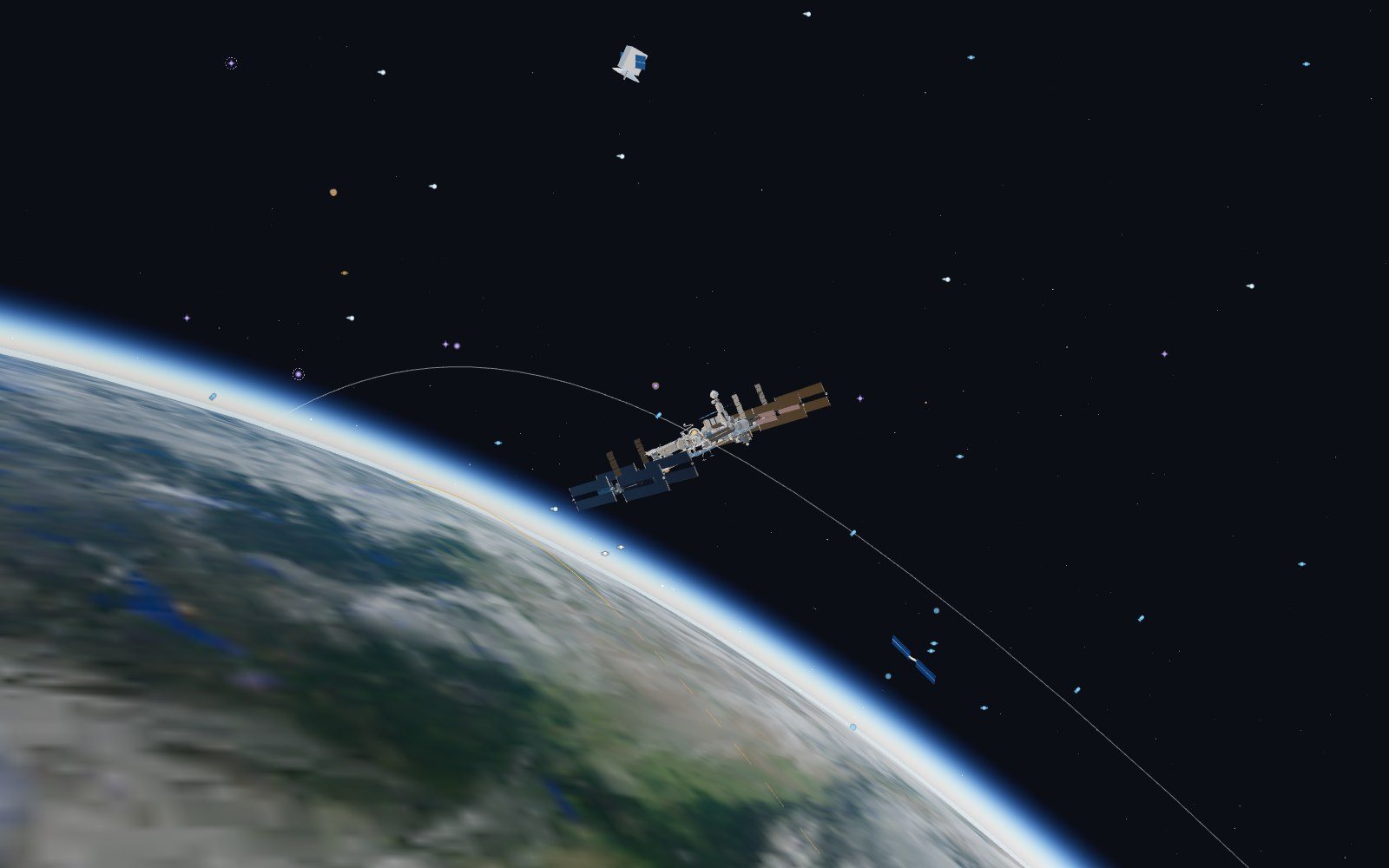
- www.spaceradar.ai/hi/iss/: where the space station is now, in Hindi
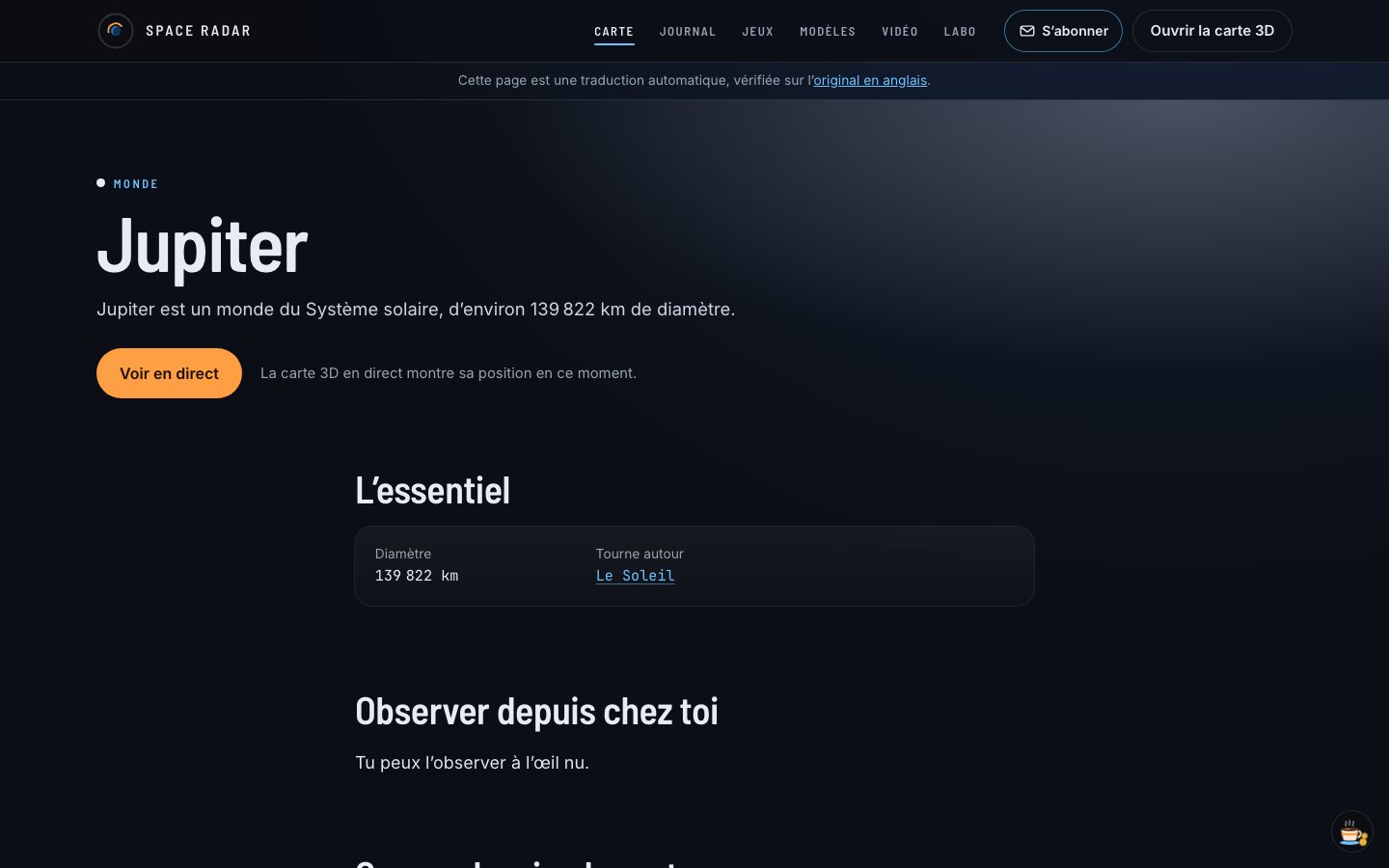
Hebrew and Arabic read from right to left, so those pages are laid out the other way round: the menu starts at the right edge and the text runs from the right. The page declares its language and direction, so a screen reader and a browser both know.
The map itself#
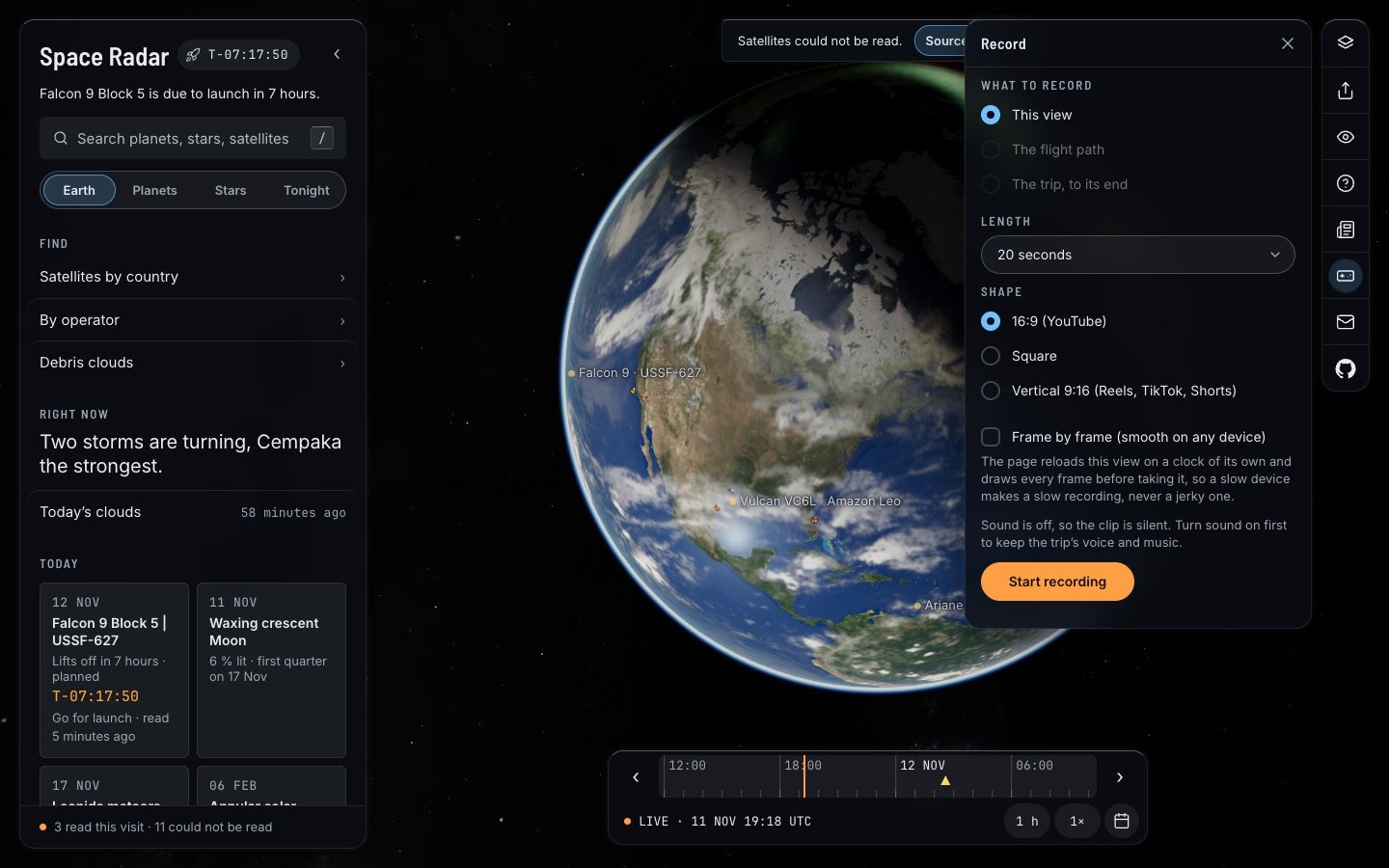
The app opens in your browser's language when it is one of the ten. You can also choose it yourself: open a language folder such as www.spaceradar.ai/de/, or add ?lang=de to the address. ?lang=en brings the English back. Menus, buttons, the cards for each object, the short explanations of terms and the Moments are translated. Where a single string is missing, the map shows it in English rather than leaving a gap.
What is not translated yet#
Quite a lot, and it is better to say so plainly.
- The live sentences that say where something is right now, or when the station will next pass over your city, are still written in English.
- Tonight's planets page is English only, because its sentences are worked out afresh for each night.
- The pictures made for sharing are the English ones, and so is their alt text.
- The narrated voice of the trips is English. A translated trip has captions and no voice.
- The journal, games, models and video sites are in English.
A few catalogue phrases, such as the type of a galaxy, still come from the data in English in most languages.
Native speakers wanted#
The translations are drafts. They were written by a program from the English, then each was re-read against the English by a second automated reviewer, string by string, for terms, numbers, units and names. That catches a lot. It does not catch what a person who lives in the language would catch: a stiff phrase, a word that is right but nobody says, a joke that does not travel.
If you can write well in two languages, you can help, and you do not need to write any code. The guide docs/TRANSLATING.md in the public repository explains what there is to translate, how to start, how to check your work and where to report one wrong phrase. Reading a language through and telling us what sounds wrong is already a real contribution. If a step needs a tool you do not have, say so and a maintainer will do that step for you. Translators are named in the release notes.
For the curious: how it is built#
The pages are made at every deploy from one catalogue of the English the pages say. Three rules keep it tidy.
- hreflang between every version. Each page links to all its other language versions, and to the English as the default, and the versions link back. A search engine can then show a French reader the French page and a Hindi reader the Hindi one.
- One sitemap per language. The sitemap index at
sitemap.xmllistssitemap-pages.xmlfor English and a file such assitemap-pages-fr.xmlfor each of the ten languages, then the sitemaps of the journal, games, models and video sites. Each language sitemap carries the same alternates. - Whole pages only. A page is published in a language only when 100 % of its own text is translated. One missing sentence and that page is not built in that language at all, so there is never a half-English page pretending to be Spanish. A missing string in the shared header or footer is the one exception: it shows in English.
The build checks all of this, so a language page with a wrong canonical, a missing alternate or a missing machine-translation notice stops the deploy. The details are in docs/SEO_SITEMAPS.md.
Space Radar is free, runs in your browser and needs no account. Pick your language and look up.
Questions people ask
Is Space Radar available in Spanish?
Yes. The map opens in Spanish if your browser's language is Spanish, or at www.spaceradar.ai/es/ or with ?lang=es. About 653 pages are also published in Spanish, each at its own address, such as /es/o/jupiter.html. The Spanish was machine-translated and checked by a second program, and no native speaker has read it yet.
Which languages does Space Radar support?
English, Spanish, French, German, Brazilian Portuguese, Russian, Ukrainian, Simplified Chinese, Hindi, Hebrew and Arabic. Hebrew and Arabic are shown right to left.
Is there a satellite tracker in Hindi?
Yes. Space Radar is a free live 3D map of satellites, the space station, planets and stars, and it opens in Hindi at www.spaceradar.ai/hi/. The page for the space station in Hindi is at www.spaceradar.ai/hi/iss/. The Hindi is a machine translation that has not been read by a native speaker yet.
Is there a live map of the ISS in Arabic?
Yes. The page www.spaceradar.ai/ar/iss/ is in Arabic, written right to left, with a button that opens the live 3D map. Its live sentences, such as when the station will next pass over your city, are still in English.
How good are the translations?
Every translation was made by a program and then re-read against the English by a second program. No native speaker has reviewed any of them yet, and each page says so, with a link to the English original. Expect some stiff or wrong phrases, and please tell us about them.
How can I help translate Space Radar?
If you can write well in two languages you can help, and you do not need to program. The guide docs/TRANSLATING.md in the public repository explains how, and there is a form for reporting one wrong phrase.
How do I change the language of the map?
The map opens in your browser's language if it is one of the ten. To choose, open a language folder such as www.spaceradar.ai/de/, or add a language code to the address, such as ?lang=uk. Use ?lang=en for English.
What is not translated yet?
The live where-is-it-now sentences, the page of planets tonight, the pictures made for sharing, the narrated voice, and the journal, games, models and video sites. All of those are in English.
Sources
- Translating Space Radar (docs/TRANSLATING.md) github.com
- Sitemaps: one index for every Space Radar site (docs/SEO_SITEMAPS.md) github.com
- The sitemap index spaceradar.ai
- Tell search engines about localized versions of your page (hreflang) Google Search Central
Explore on Space Radar
Keep reading
One Design for the Space Radar Map and Every Site: Bigger Targets, Clearer Choices
Every button, choice and panel on the 3D map now comes from one small set of controls, the same set the journal, games, models and video sites use. Here is what changed for you: targets a finger can hit, a focus ring you can see, motion that stays still when you ask, and one orange button that tells you what to do next.
Where is the ISS right now? Two addresses in the sky
Ten people live off the planet this week, in exactly two homes. What their days are like, why the stations fly where they do, how to watch one cross your own street, and what happens when the bigger one comes down.
A live satellite map that tells you when it is guessing
Space Radar draws everything in orbit where it really is, for people who have never heard of an orbital element. Why I think a map of space has to be honest and kind at once, what that costs, and why it is free and open.