
Eclipse of 2 August 2027: Will I See It From Here?
Type a town and the map works out what the Moon’s shadow does there on 2 August 2027: total or partial, how much of the Sun goes, when it starts and ends, and how high the Sun stands. Here is how to use it, and how about twenty numbers from NASA hold a whole eclipse.
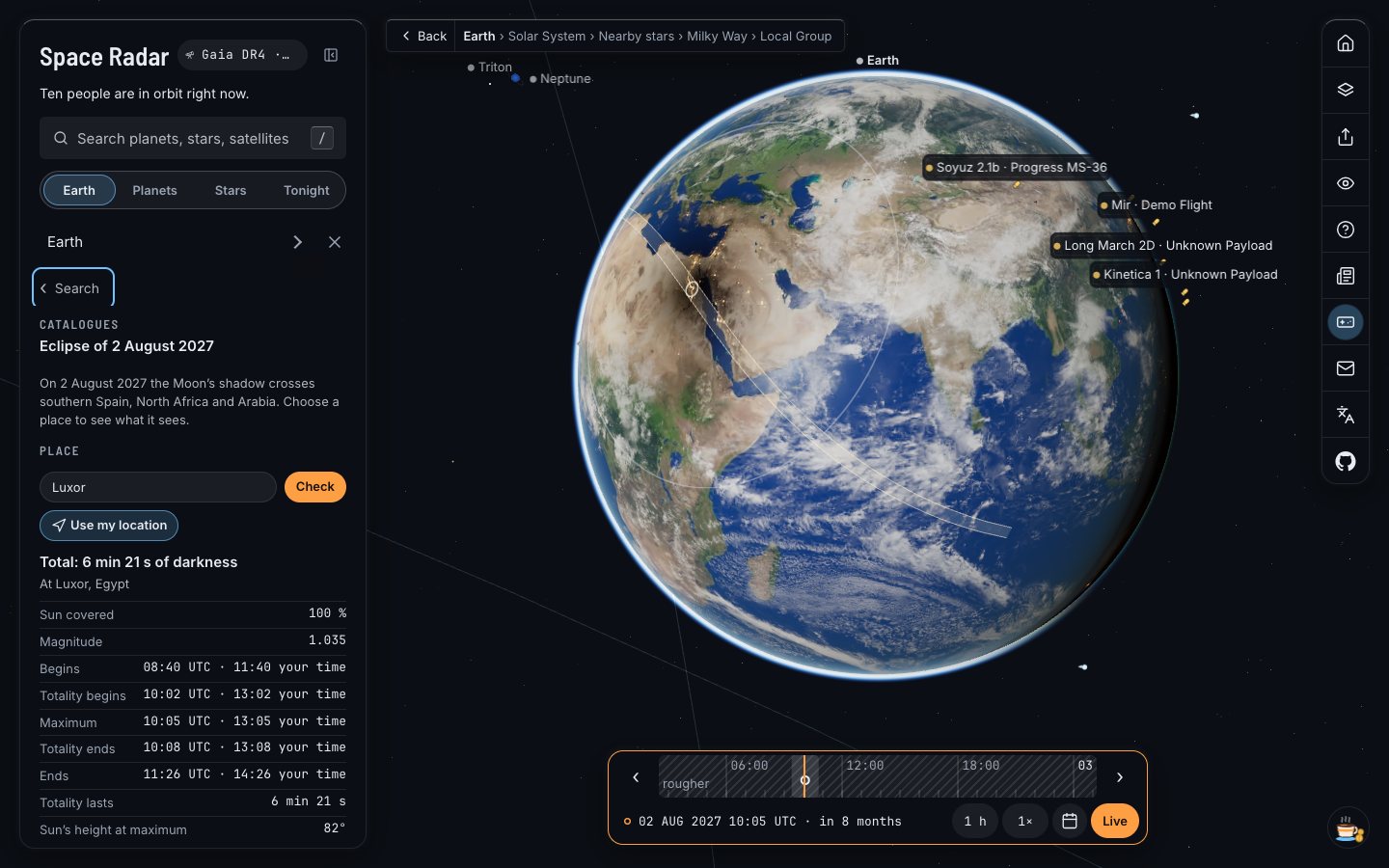
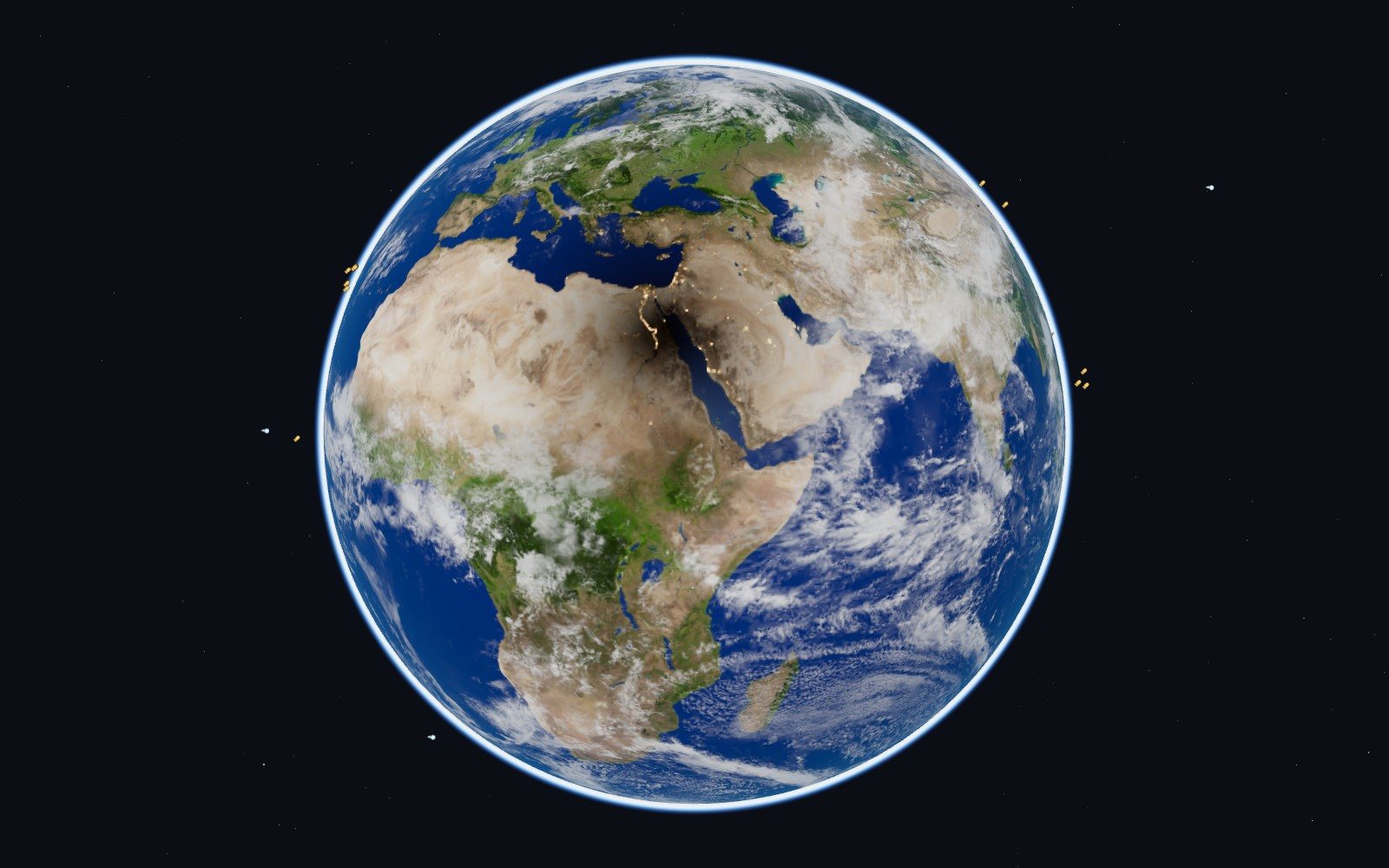
The checker’s answer for Luxor, and the globe at its maximum, 10:05 UTC on 2 August 2027: the Moon’s shadow on the Nile valley, inside the band of the path. Every number is worked out in your browser from NASA’s Besselian elements. Space Radar (MIT). Eclipse: NASA GSFC Besselian elements, eclipse predictions by Fred Espenak. Places: Natural Earth (public domain).
Only people inside a band about 258 kilometres wide will see the Sun wholly covered on Monday 2 August 2027. It runs from the Strait of Gibraltar along the coast of North Africa, across Egypt and the Red Sea, and down through Saudi Arabia and Yemen. Everyone else from Lisbon to Mumbai sees part of the Sun bitten away. Most of the Americas, East Asia and Australia see nothing at all; eastern Canada catches only the end of a partial eclipse at sunrise. To find out which of those you get, open Space Radar’s eclipse checker, type a town and press Check.
It answers at once, with the numbers an eclipse chaser wants: total or partial, how much of the Sun is covered, the moment the Moon first touches the Sun, the start and end of totality, the maximum, the last contact, how long the darkness lasts and how high the Sun stands. Luxor gets 6 minutes 21 seconds of totality. London gets 42 per cent of the Sun covered. New York gets nothing.
We wrote about the day itself, the cities and why people cross the world for it, in six minutes of night at noon. This article is about the tool: how to use it, why a town 180 kilometres from Luxor gets no totality at all, and how about twenty numbers from NASA hold a whole eclipse.
Where the shadow goes#
The Moon’s dark shadow touches the Earth at sunrise in the Atlantic and lifts off at sunset in the Indian Ocean. In between it crosses land for about two hours. Totality grows longer as it goes east, because the Sun climbs higher and the ground is nearer the Moon, and it is longest in southern Egypt. NASA’s path table gives the shadow a width of 206 km where it first touches the Earth and 258 km near the greatest eclipse.
These are the twelve places on the path that the eclipse’s page on Space Radar lists, west to east, as the checker gives them. The time of the maximum is in Universal Time, cut to the minute as the checker shows it.
| Place | Maximum (UTC) | Totality | Sun’s height |
|---|---|---|---|
| Cádiz, Spain | 08:46 | 2 min 53 s | 37° |
| Málaga, Spain | 08:49 | 1 min 53 s | 39° |
| Gibraltar | 08:47 | 4 min 28 s | 38° |
| Tangier, Morocco | 08:47 | 4 min 51 s | 38° |
| Oran, Algeria | 08:53 | 5 min 8 s | 43° |
| Sfax, Tunisia | 09:11 | 5 min 39 s | 56° |
| Benghazi, Libya | 09:30 | 6 min 9 s | 68° |
| Sohag, Egypt | 10:01 | 6 min 22 s | 81° |
| Luxor, Egypt | 10:05 | 6 min 21 s | 82° |
| Jeddah, Saudi Arabia | 10:25 | 5 min 55 s | 76° |
| Mecca, Saudi Arabia | 10:26 | 5 min 6 s | 76° |
| Sanaa, Yemen | 10:45 | 2 min 18 s | 67° |
Outside the path the same calculation gives the partial eclipse: 98 per cent of the Sun covered in Seville, 92 in Lisbon, 86 in Madrid, 81 in Jerusalem, 75 in Rome, 51 in Paris, 42 in London, 34 in Berlin and 9 in Moscow. Mumbai sees 32 per cent and Karachi 30, in the afternoon. Our figures for Spain differ by a few seconds from those Spain’s National Astronomical Observatory publishes, because each calculation uses a slightly different point for each town.
How to use the checker#
- Open it. On the Tonight tab, under Catalogues, choose “Eclipse of 2 August 2027: will I see it?”. Or use a link:
#cat=eclipse:Cadiz,#cat=eclipse:Jeddah, any town in its lists. - Choose a place. Type a town and press Check, or pick one from the suggestions as you type. The checker knows the map’s own cities and 587 places from Natural Earth in and around the eclipse, with accents and capitals ignored. If a village is missing, try the nearest larger town.
- Or press Use my location. Your browser asks first. The answer is rounded to 0.1 degree, about 11 km, before the checker uses it.
- Read the answer. A headline (“Total: 6 min 21 s of darkness”, “Partial: 42 % of the Sun covered”), then Sun covered, Magnitude, Begins, Totality begins, Maximum, Totality ends, Ends, Totality lasts and the Sun’s height at the maximum. It warns you when the Sun is low, rises with the eclipse already under way, or sets before it is over.
- See it on the globe. The button sets the map’s clock to your maximum and flies to the Earth, with the Moon’s shadow where it will be.
Two details are worth knowing. Each time is given twice: in UTC, and in your time, which means the time zone of the device you are reading on, not the time zone of the place you typed. If you are planning a trip from home, convert to the local time there. And the second figure, magnitude, is not the same as “Sun covered”. Magnitude is the share of the Sun’s diameter the Moon covers, the figure astronomers quote; “Sun covered” is the share of its area, which is what the light on the ground follows. In London the magnitude is 0.518 but 42 per cent of the disc is covered.
Why 99.99 per cent is not enough#
Near the edge of the path the answer changes fast. Aswan, 181 km up the Nile from Luxor, is just outside the southern limit. The checker gives it a partial eclipse with 99.8 per cent of the Sun covered, and no totality: on the line of longitude through the town, the path ends about 19 km to the north. Algiers is in the same position on the other side, at 99.8 per cent.
Tripoli in Libya is closer still. Natural Earth’s point for the city lies about 2 km south of where totality begins. The checker’s headline reads “Partial: 100 % of the Sun covered”, which looks like a contradiction and is not: the Moon covers 99.99 per cent of the Sun’s disc, the magnitude is 0.999, and there are no rows for totality, because there is none. The word that matters is the first one, Partial.
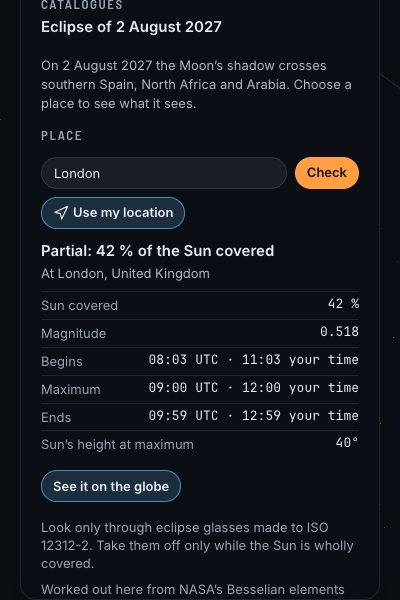
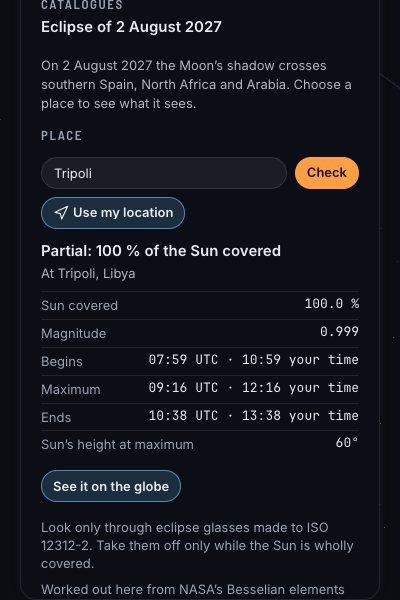
That last hundredth matters more than any other. The Sun’s corona, the pale crown you see only in totality, is roughly as bright as a full Moon, so even a sliver of the Sun’s surface drowns it, and the sky stays blue. Our first article has the whole argument. If you are near an edge, move towards the centre line: there, totality is longest and a small error in where you stand costs nothing.
One more honest limit. The checker treats the Moon as a smooth ball and leaves out the bending of sunlight by the air. The real Moon has mountains and valleys on its edge, which shift the limits of the path slightly and let the last beads of sunlight through. For a spot within a few kilometres of a limit, use the detailed maps in NASA’s path table rather than any single number.
Twenty numbers that hold an eclipse#
How does a page work out six times to the second for any town, with no server? The answer is a trick astronomers have used since the nineteenth century, named after the German astronomer Friedrich Bessel: the Besselian elements.
Imagine a flat sheet through the centre of the Earth, held square to the line from the Sun through the Moon, like a screen in a cinema. The Moon’s shadow is a cone, and where it meets the screen it makes two circles: a wide one for the partial shadow and a small one for the full shadow. Seen on that screen, the eclipse is simple. The centre of the shadow slides across in an almost straight line, and the two circles barely change size.
So instead of describing the Sun and the Moon, NASA describes the screen. Six quantities are enough: x and y, where the shadow’s centre is on the screen, in Earth radii; l1 and l2, the radii of the partial and full shadow there; and d and μ, which say how the screen is turned against the spinning Earth. Each is a short polynomial in time, valid from 07:00 to 13:00. With the two angles of the shadow cone, the whole table for 2 August 2027 is 21 numbers.
- 21numbers in NASA’s table of Besselian elements for this eclipse, valid for six hours
- 0.545Earth radii an hour: how fast the shadow’s centre crosses the screen (the x term)
- 71.7 sΔT, the predicted difference between the table’s steady clock and clock time set by the Earth’s turning
- 587places from Natural Earth the checker knows, besides the map’s own cities
To answer for a town, the checker puts the town on the same screen. From its latitude, longitude and the shape of the Earth it works out where the town is on the sheet, and how far towards the Moon it sits, because the shadow cone narrows as it goes. Then it compares two distances, minute by minute: how far the town is from the shadow’s centre, and how wide the shadow is at that height. Closer than the wide circle, the town is in partial eclipse. Inside the small one, it is in totality. The maximum is the moment the distance is smallest; each contact is the moment the distance equals a radius. All of it takes a few iterations of arithmetic.
One number in the table is a prediction rather than a measurement. ΔT is the difference between the steady time the elements are written in and ordinary clock time, which follows the Earth’s rotation. The Earth’s spin wanders slightly, so ΔT for 2027 is an estimate, 71.7 seconds in NASA’s table. If the Earth turns a little faster or slower than expected, every time on the ground shifts by the same small amount.
How we know it is right#
A tool like this is only as good as its checks, so the map’s tests hold the checker to NASA’s own published numbers, and to independent ones. Run on 25 November 2026, the test gives:
- NASA’s greatest eclipse. 10:06:37.7 UT at 25°30.3′ N, 33°11.0′ E, with 6 min 22.6 s of totality and the Sun 81.7° up. The checker’s time is 0.1 s from NASA’s and its duration 0.1 s.
- NASA’s central line. Seven rows of the path table, from the Atlantic to Libya: every duration within 0.1 s.
- NASA’s two limits. At each of those times both edges of the path come out as a graze, with the Moon’s width matching the Sun’s to within 0.3 per cent.
- Four cities. Luxor, Cádiz, Jeddah and London against the times published by timeanddate.com, which are rounded to the minute: every contact within 53 seconds. Luxor’s totality is 1.2 s shorter than theirs, Cádiz’s 3.1 s, and London’s magnitude, 0.518, is the same.
- A second method. Astronomy Engine, the map’s own astronomy library, works the same four cities out from first principles with its own ephemeris. It agrees on the kind of eclipse and on the maximum to within 6 seconds.
Every eclipse in your calendar#
The checker sits next to a second new catalogue, the sky calendar. It shows the dated events of the sky events pages one month at a time, worked out with the map’s own astronomy: eclipses, meteor showers at their peak, full Moons, planets close together, solstices and mission dates, plus the launches the map knows about. Each row opens the map at that moment.
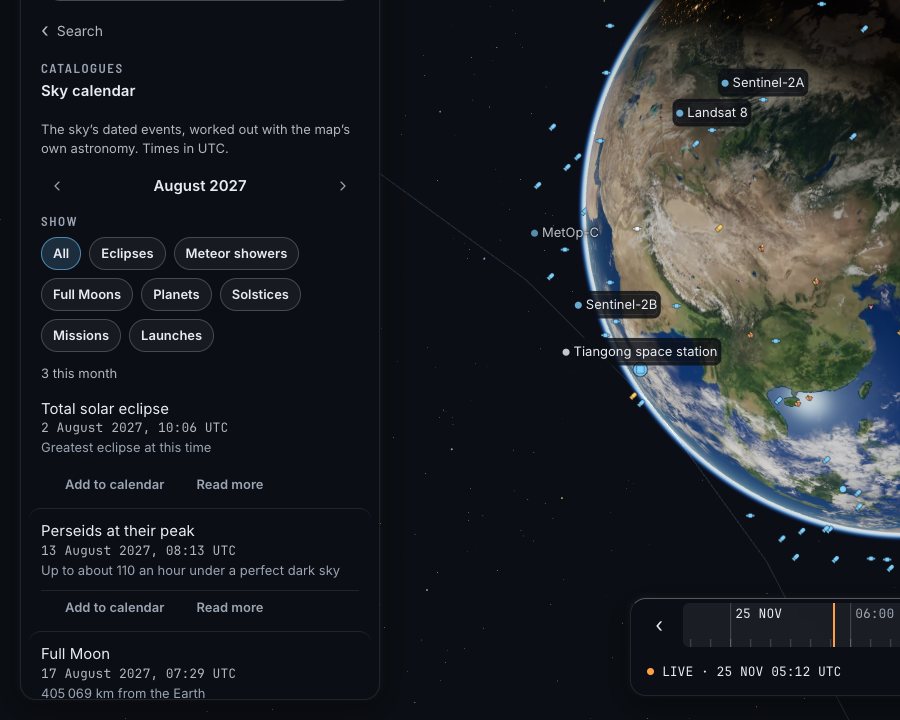
Add to calendar saves one event as an .ics file your calendar app can open. Subscribe goes further: each kind of event has a feed that a calendar app checks once a day, so new eclipses and showers appear by themselves. There are feeds for every sky event, for eclipses, and for meteor showers, full Moons, planets, solstices and missions. Nothing in them is personal; they are the same files for everyone.
The calendar and the checker are free, work in your browser and need no account. You can also watch the shadow’s whole crossing from the hour before it arrives in the guided trip Chasing the solar eclipse.
Questions people ask
Will I see the total solar eclipse of 2 August 2027?
Only if you are inside the path of totality, a band about 258 km wide at its middle that runs from the Strait of Gibraltar along the North African coast, across Egypt and the Red Sea, and through Saudi Arabia and Yemen. Most of Europe, North and East Africa, the Middle East and western India see a partial eclipse. Most of the Americas, East Asia and Australia see nothing. Space Radar’s eclipse checker answers for any town in its lists.
How long does totality last in 2027?
Up to 6 minutes 22.6 seconds at the point of greatest eclipse in southern Egypt, according to NASA. The checker gives 6 min 21 s for Luxor, 5 min 55 s for Jeddah, 4 min 28 s for Gibraltar and 2 min 53 s for Cádiz. Near the edges of the path it falls to seconds.
What is the difference between magnitude and “Sun covered”?
Magnitude is the share of the Sun’s diameter the Moon covers; “Sun covered” (the obscuration) is the share of its area. They differ for a partial eclipse: in London the magnitude is 0.518 but only 42 per cent of the Sun’s disc is covered.
Does the checker send my location anywhere?
No. A typed name is looked up in lists that come with the map. Use my location asks your browser only when you press it, rounds the answer to 0.1 degree, and uses it on the page. Only a listed place’s name can go into the page’s address, never a position.
What are Besselian elements?
A short set of polynomials that describe an eclipse in a flat plane through the Earth’s centre, square to the Moon’s shadow: where the shadow’s axis crosses that plane, how wide the shadow is there, and how the plane is turned against the Earth. NASA publishes them for every eclipse, and any place’s times and coverage can be worked out from them.
Sources
- Besselian Elements for the Total Solar Eclipse of 2027 Aug 02 NASA GSFC (eclipse predictions by Fred Espenak) The elements the checker uses, the greatest eclipse at 10:06:37.7 UT and ΔT of 71.7 s. Read 25 November 2026.
- Path of the Total Solar Eclipse of 2027 Aug 02 NASA GSFC The central line, the two limits and the path width (258 km near greatest eclipse) minute by minute. Read 25 November 2026.
- sky/besselian.js, the checker’s arithmetic Space Radar (MIT) The local-circumstances method of the Explanatory Supplement to the Astronomical Almanac (1961), chapter 9, as set out in J. Meeus, Elements of Solar Eclipses 1951–2200 (1989); its tests are tests/test_eclipse_2027.mjs.
- Total solar eclipse on 2 August 2027 timeanddate.com The city times the checker is tested against (Luxor, Cádiz, Jeddah, London), to the minute. Read 24 November 2026.
- Eclipse total de Sol del 2 de agosto de 2027 Observatorio Astronómico Nacional (IGN, Spain) Spain’s official times and durations for Spanish towns. Read 25 November 2026.
- Natural Earth 1:10m populated places, v5.1.2 Natural Earth The 587 places the checker knows besides the map’s own cities. Public domain.
- Astronomy Engine Don Cross The map’s own astronomy library, used as an independent check and for the sky calendar.
- Eye safety during a total solar eclipse NASA Read 25 November 2026.
Explore on Space Radar
Keep reading
Solar Eclipse 2027: Six Minutes of Night at Noon
The solar eclipse of 2027 will put Luxor in the dark for more than six minutes, the longest totality anyone will stand under until 2114. Here is the day, minute by minute, and where the shadow does and does not reach.
A solar eclipse simulator, and a clock you can drag
Drag the clock on a map of space and the Moon’s shadow, the seasons and the planets all move to where they will be. The satellites move too, and the map tells you to trust those less. On honest time travel.
What Is in the Sky Tonight? Relearning to Look Up
What is in the sky tonight, seen from an ordinary city balcony, is a short list. Almost nobody is taught it any more. It takes one evening to learn.