
A virtual space tour that begins with a family photo
A map with a legend tells you everything at once. A guide tells you one thing, then the next. On the 26 narrated trips in Space Radar, how they are written, and three of them retold.
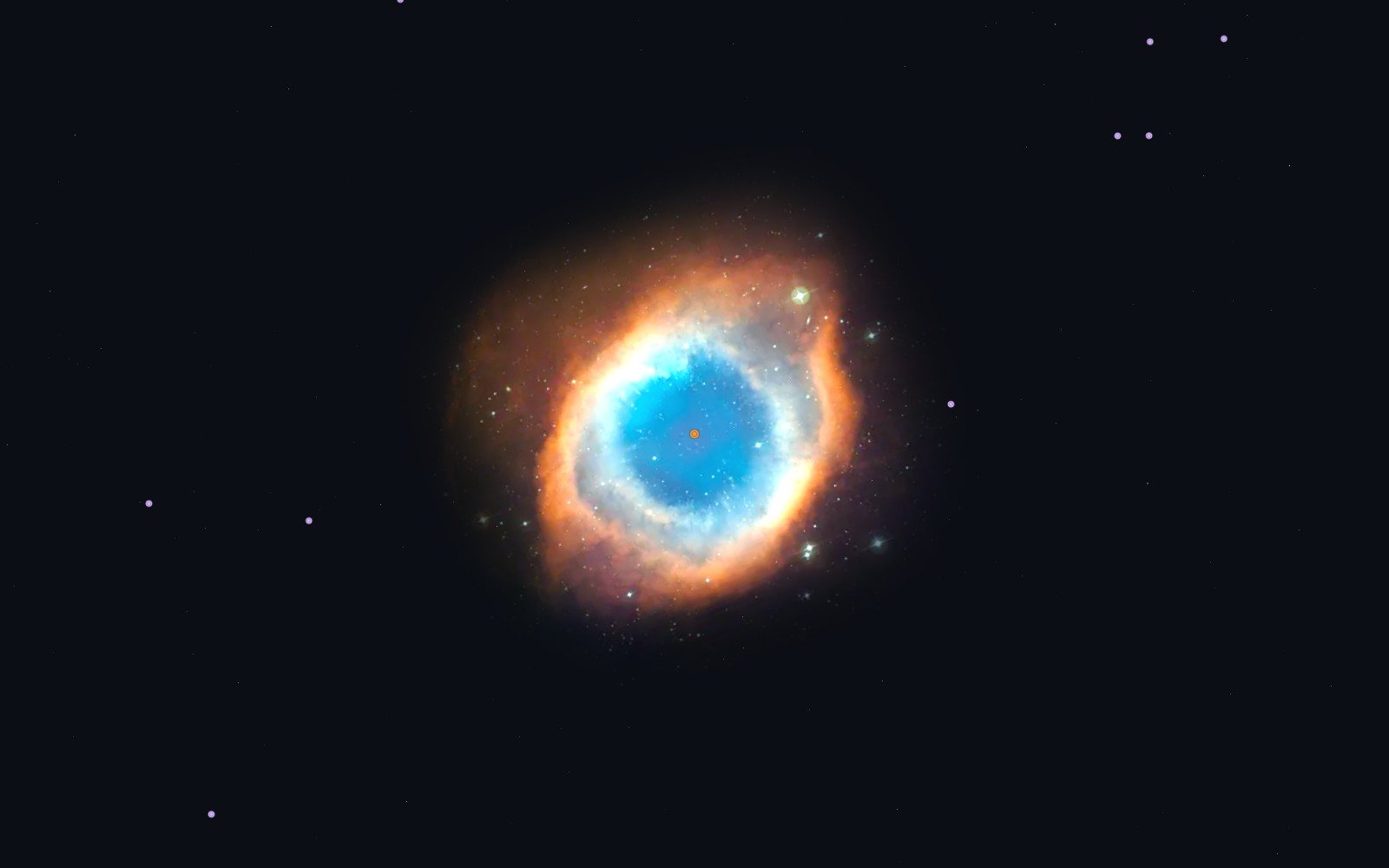
The Helix Nebula, 650 light-years away, at stop six. It is a real photograph by the European Southern Observatory, placed where the nebula is in the sky.
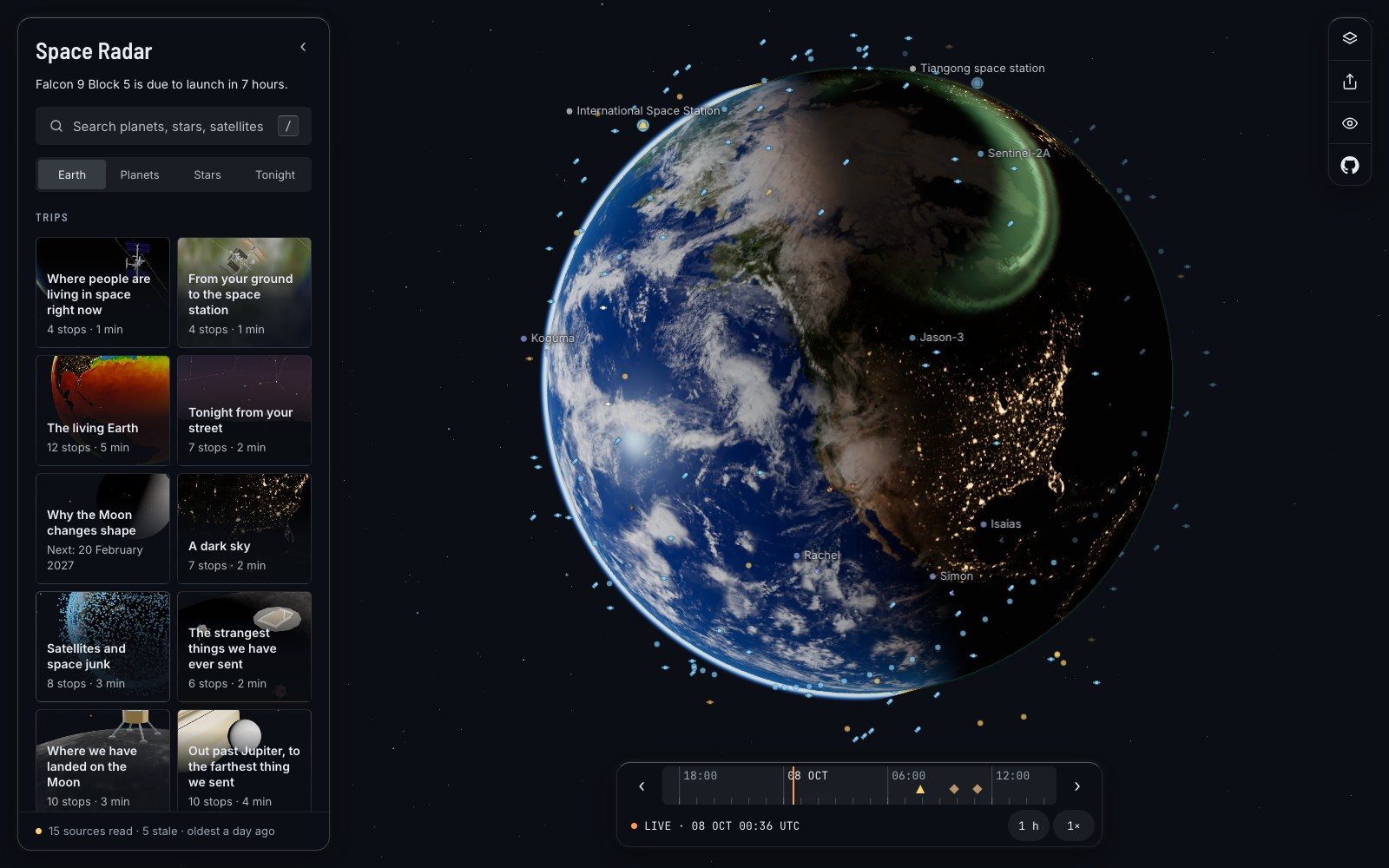
In April 1972 an astronaut called Charlie Duke walked a little way from his lunar module and left a photograph of his family lying on the ground. They had signed the back and pressed their thumbprints into it. Under the signatures it says: “This is the family of Astronaut Duke from Planet Earth, who landed on the Moon on the twentieth of April 1972.”
It is still there. Nobody has been back to look at it, and its exact spot has never been surveyed. But the lander it lies beside has been located to within three metres, and you can go and stand over the spot.
That is how one virtual space tour I know begins. It is the first stop of a trip called “The strangest things we have ever sent”, one of 26 guided, narrated journeys in Space Radar, the live map of space I work on. This piece is about why the map teaches that way. A legend can tell you what the orange dots are. It takes a guide to make you care about one of them.
The oldest trick in the dome#
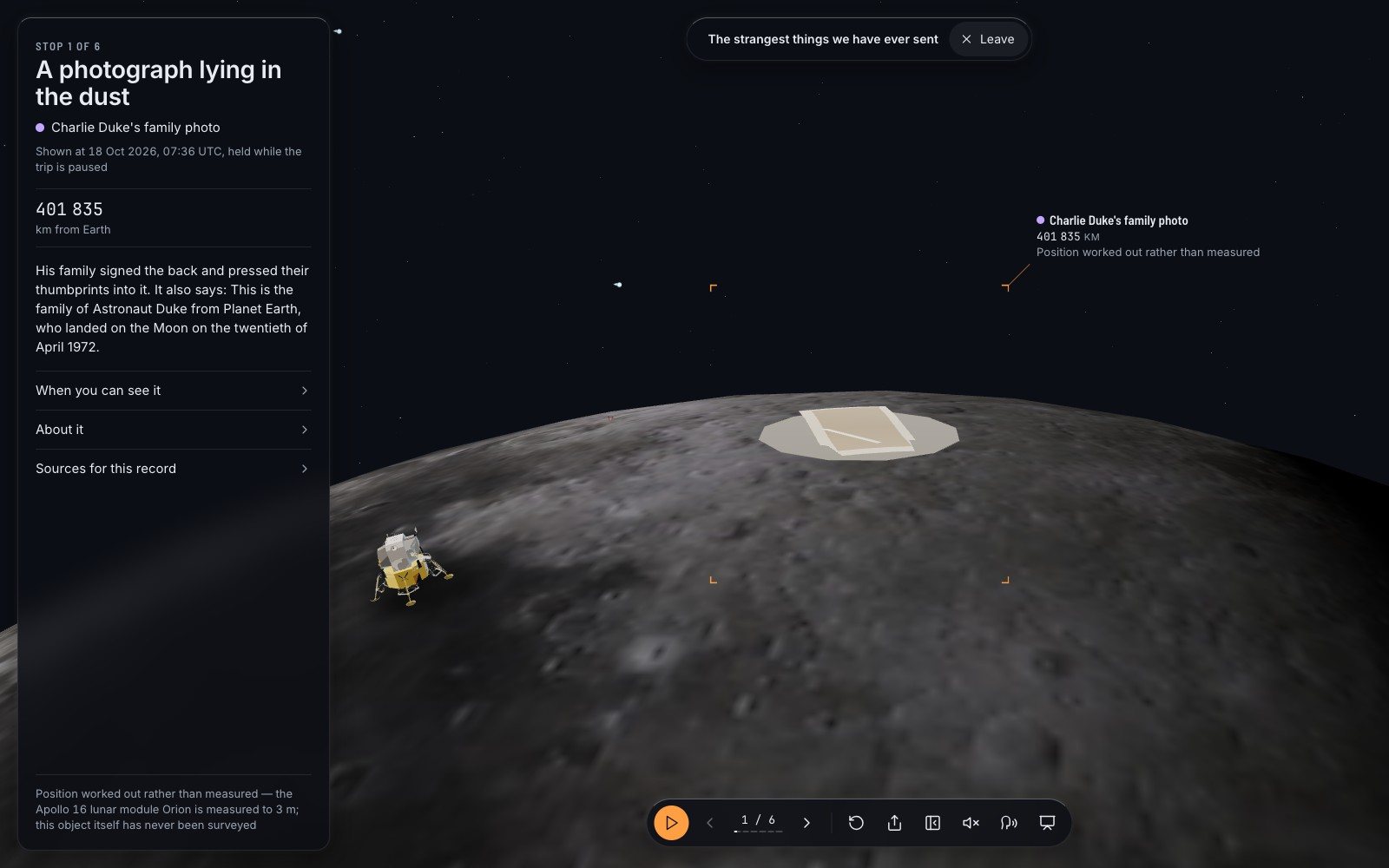
On 7 May 1925 the Deutsches Museum in Munich opened a room to the public in which a machine by Carl Zeiss threw about 4,500 stars onto the inside of a dome. The machine was the wonder. What made it a lesson was the person standing beside it in the dark with a pointer, deciding where a roomful of people looked, and in what order.
That is the trick. A sky, or a map of everything in orbit, gives you all of it at once, and a beginner faced with all of it sees none of it. A guide removes almost everything. Look here. Now here. Now turn round.
So Space Radar has trips. A trip is a chain of stops. At each one the camera flies to a real place, a short card appears, and a voice reads it. There are 205 stops across the 26 trips, and a little over an hour of narration in all. The shortest take a minute. None takes more than five.
Six things we left out there#
Back to the strange things. From Duke’s photograph the camera lifts and crosses to another part of the Moon, where in 1971 Alan Shepard hit two golf balls with a six-iron head fixed to a sampling tool. The card corrects a legend in passing: they went “twenty-four and forty yards, not the miles everybody repeats”.
Third stop: the wreck of Beresheet, the Israeli lander that hit the Moon in 2019 carrying a disc library of thirty million pages and some dried tardigrades. Nobody knows where in the wreck the discs ended up, the card says, or whether the tardigrades survived.
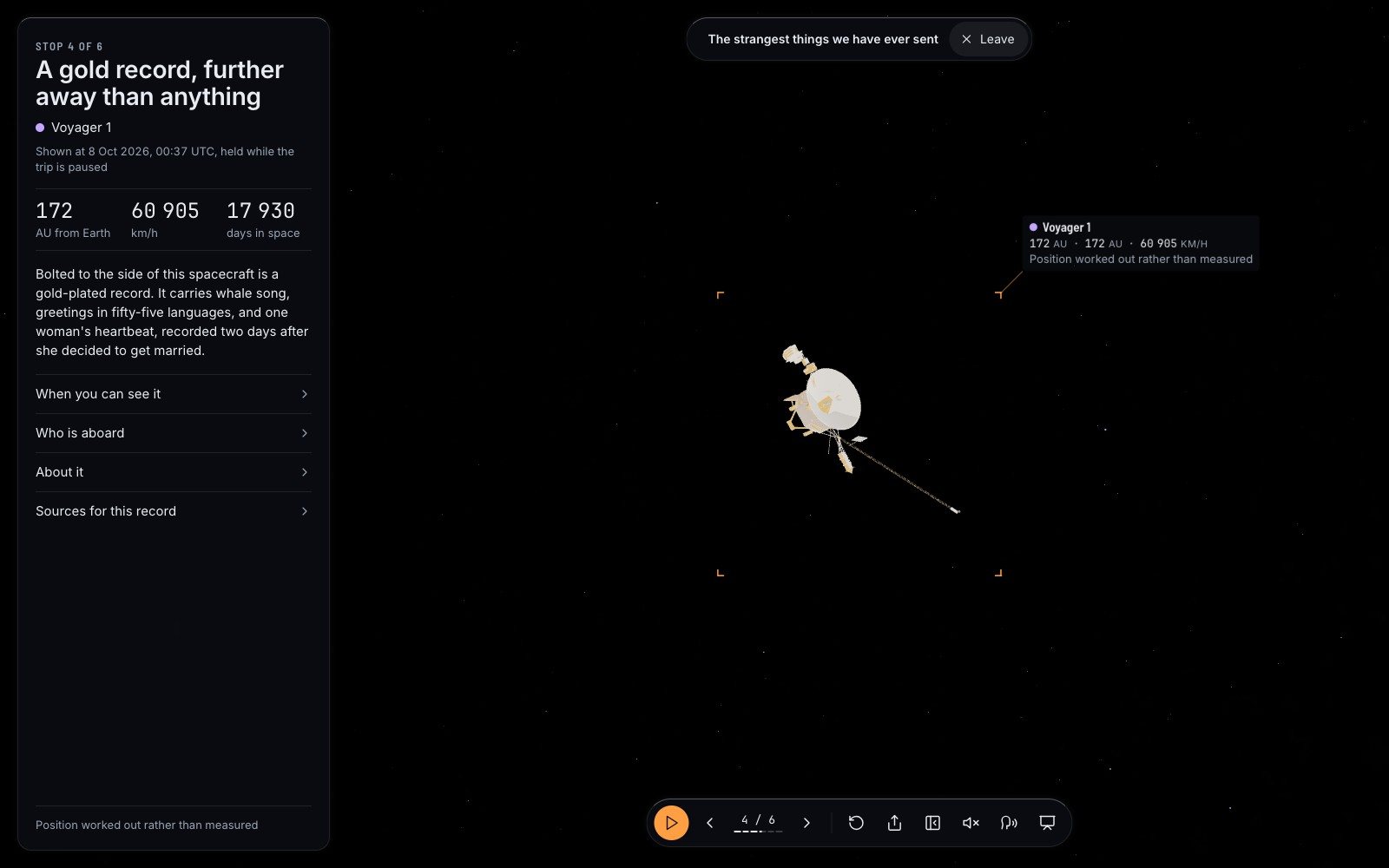
Then the camera leaves the Moon altogether and goes a very long way, to Voyager 1 and the gold record bolted to its side. The card picks three things from what is on that record: whale song, greetings in fifty-five languages, “and one woman’s heartbeat, recorded two days after she decided to get married”.
After that, a car going round the Sun with a towel in its glovebox. And then the stop the whole trip was built for: the camera pulls back until the Earth is a point. “Every one of those things was made by people standing on that. From out here you cannot pick it out of the dark.”
Six stops, about two minutes, and not one of them is a lesson in orbital mechanics. But at the end of it you know that the Moon has places, that Voyager is far in a way you can feel, and that all of it started in one spot. A table could not have done that.
Why the Moon changes shape, in seven stops#
The second trip I want to retell is the one I would show a class first. Ask why the Moon changes shape and the tempting answer is the Earth’s shadow. It is a reasonable guess, and it is wrong; one of the stops is named for the mistake.
The trip does not say so straight away. It takes you far above the north pole and shows the Moon’s whole path as a ring, with the Sun off to one side lighting the same half of both worlds, all the time. Then it drops you to where the Earth is and runs the clock at ten hours a second. A thin edge of light appears on the Moon and grows. Nothing is covering it. You are simply seeing more of its day side each evening as it moves round.
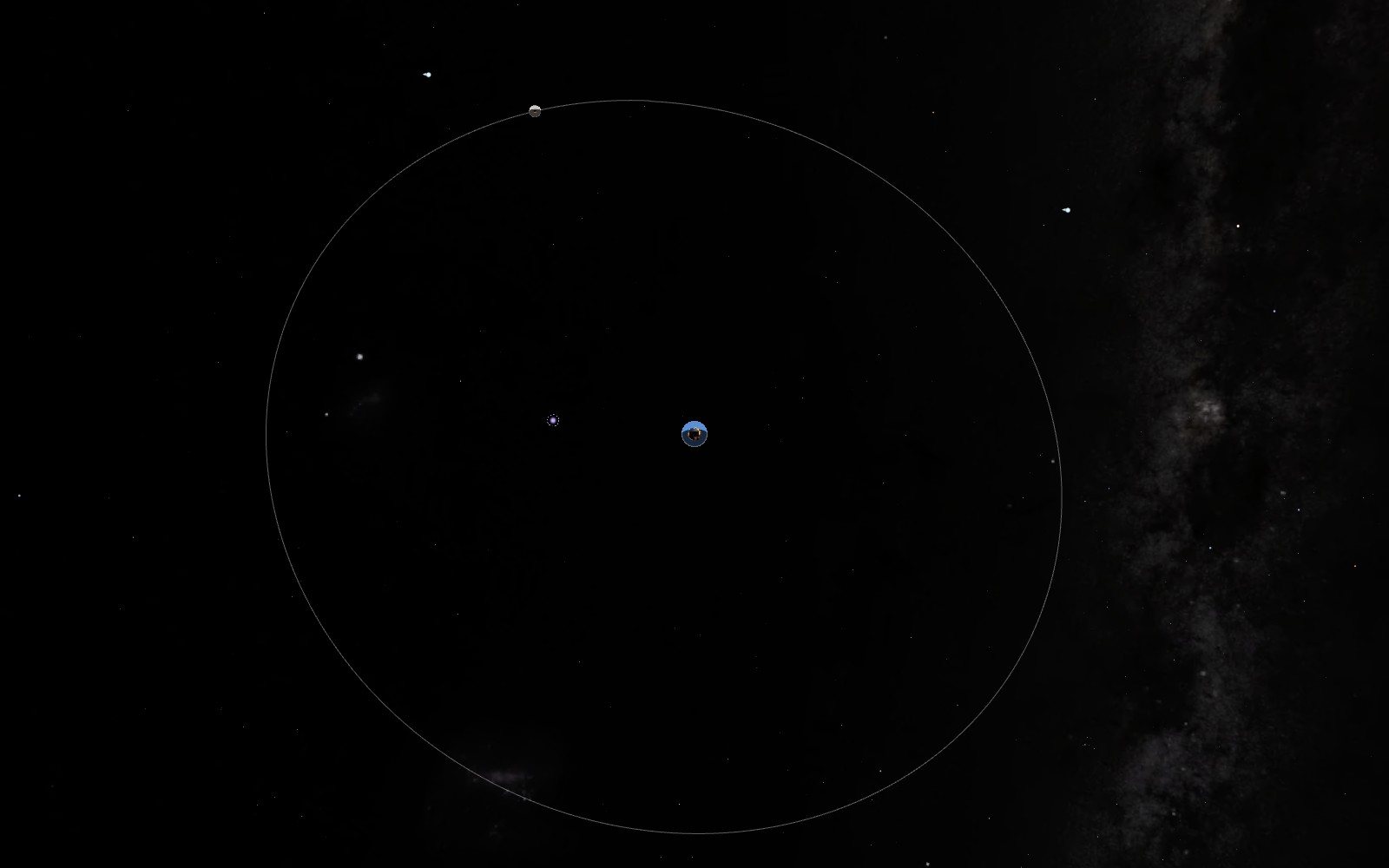
Only at stop six does the shadow come in. The clock jumps to the next total lunar eclipse and the Earth’s shadow really does slide across the Moon. Now you can see that it looks nothing like a phase, and the card explains why it is rare: the Moon’s path is tilted five degrees against ours, so at most full Moons it passes above or below the shadow.
The last stop puts you on your own street, tonight, with the Moon where it is for you. “Look again tomorrow at the same hour.”
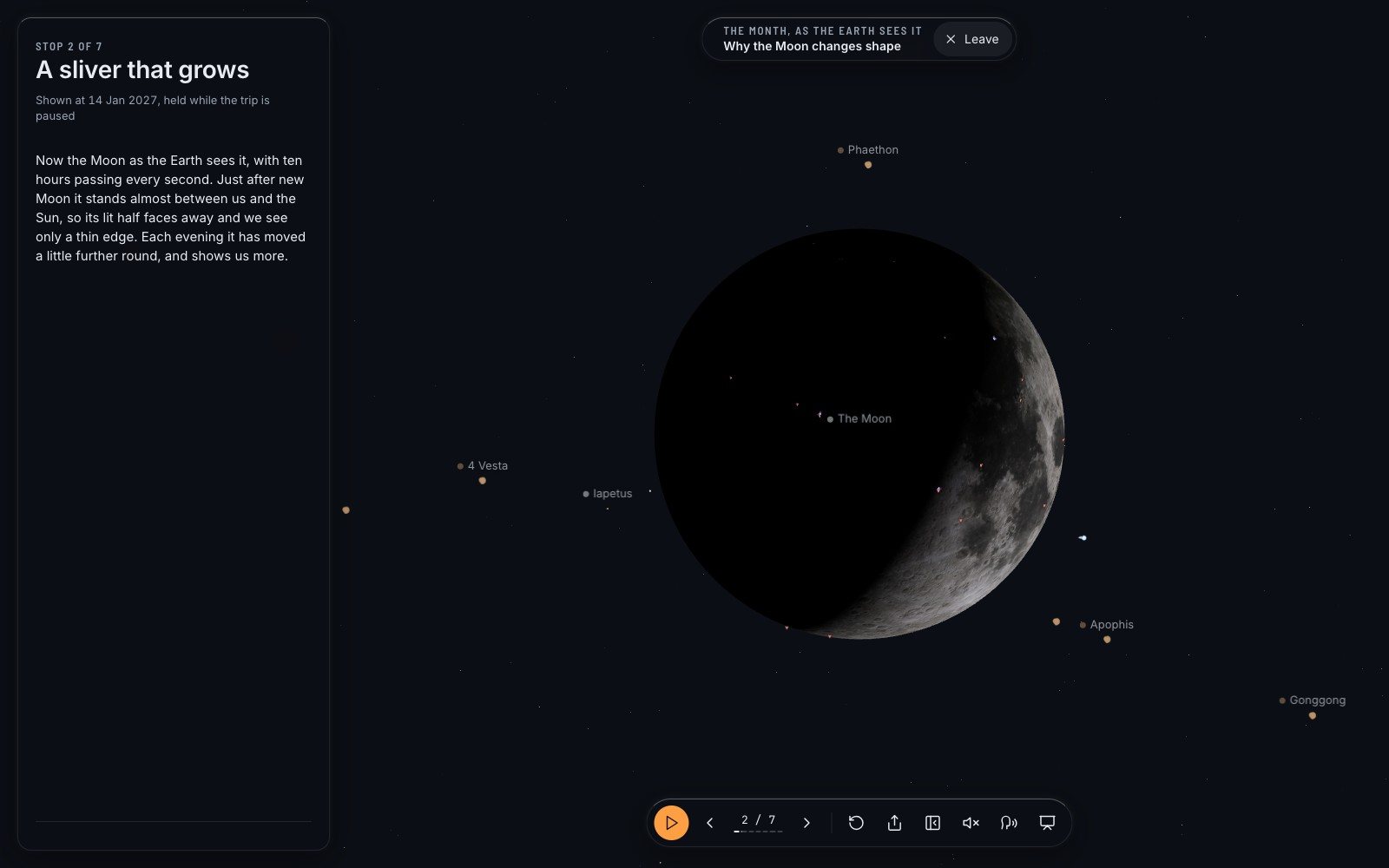
A trip may not promise a stop it will not deliver.
How a trip is written#
That sentence is from the top of the file where all 26 trips live, and it is the one rule the rest come from. A trip is not a film. It is a few dozen lines of plain text in a file anyone can read, and each stop names exactly one real target: an object, a world, a landing site, a patch of sky, or the visitor’s own place. If the target cannot be found on the day, because a satellite has come down or a source could not be read, the stop is dropped before the count is shown. “Five stops, about two minutes” has to be a true sentence.
The other rules are about honesty and about the ear. Every number and name on a card needs a source, written in a comment above the trip. A card may not call a model or a false-colour map a photograph. A card may not state the time itself; the frame prints “Shown at” from the clock, so the words cannot drift from the picture.
And the words are written to be heard: short sentences, plain words, for a curious twelve-year-old. The voice is synthetic, and the app says so on the button that turns it on. It was slowed to four fifths of its natural speed, about 155 words a minute, with a note in the file that I am fond of: “a planetarium is not in a hurry”. The script that makes the audio refuses any number it does not know how to pronounce. Every clip is then played to a speech recogniser, to catch a name said wrong.
I should be honest about the limit of that. A machine has heard every clip. As I write, an open issue in the project’s tracker says that no person has yet sat and listened to all of it.
The life of a star, told with nine real ones#
The third trip is the one that shows what the method is for. Nobody can watch a star live; it takes millions or billions of years. But the sky holds stars of every age at once, and the trip visits one real star at each stage, in order, like a family album assembled from strangers.
It starts in the Orion Nebula, where stars are being made now. Then the Pleiades, about a hundred million years old, “which for a star is childhood”. Then our own Sun, a little under half way through. Arcturus, which is what the Sun will become. Betelgeuse, heavy, young and already near its end. The Helix Nebula, a star like ours letting go of its outer layers.
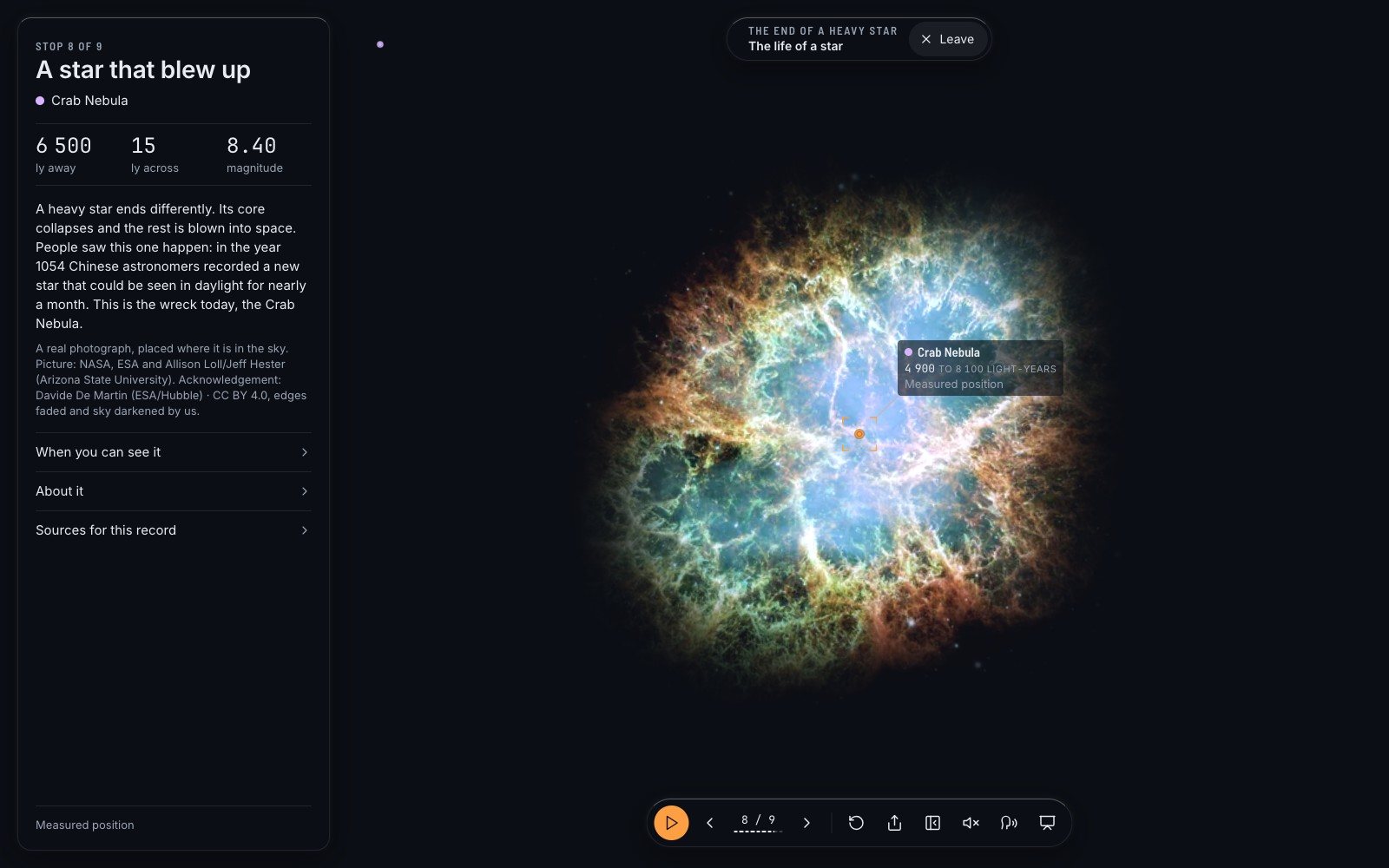
And then the other ending. In the year 1054, the card says, Chinese astronomers recorded a new star that could be seen in daylight for nearly a month. The camera is already flying to where it was. What is there today is the Crab Nebula, and at its centre a ball twenty kilometres across, spinning thirty times a second.
In a room, with a clicker#
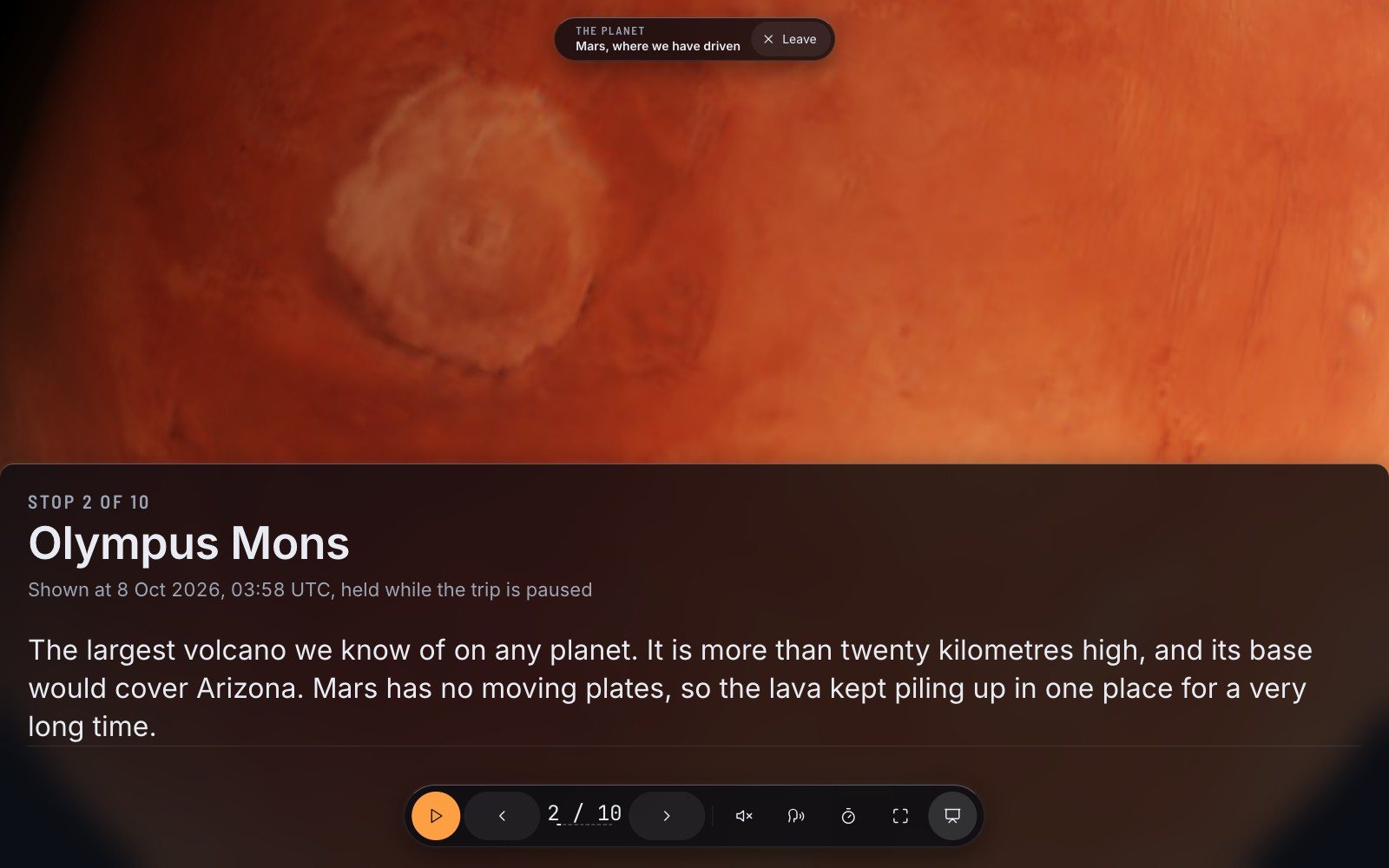
A trip on a phone is a private thing. The same trip can be given to a room. Add one word to its link, or press Present on its first card, and the panels go, the words of each stop are set large enough to read from the back, and whoever holds the clicker decides when to move on. The words on screen are the captions, so the room does not need sound. A teacher can open the Mars trip, ready to present, and be the person with the pointer.
That, in the end, is all a trip is: somebody chose where you should look first. Tonight, take the two-minute one. Start with the photograph in the dust, let it carry you out past the planets, and wait for the last stop, when the camera turns round.
Questions people ask
Is there a free virtual space tour I can take online?
Yes. Space Radar has 26 guided trips that run in a browser with no account, each a few minutes long, with narration and captions. NASA’s Eyes and several museums offer tours of their own as well.
How long does a trip take?
Between one and five minutes. Each trip’s card shows its number of stops and its length before you start, and you can pause, go back or leave at any stop.
Is the narration a real person?
No. It is a synthetic voice made in advance from the words on the cards, and the app says so. Captions carry the same words, so a trip works with the sound off.
Can I show a trip to a class?
Yes. Present mode sets the words large, hides the panels and waits for a clicker or the arrow keys. It also works from a copy saved on the school’s own computer.
Sources
- GitHub github.com
- Opened a room to the public deutsches-museum.de
- What is on that record science.nasa.gov
- Synthetic huggingface.co
- Spaceradar.ai spaceradar.ai
- Spectrum.ieee.org: planetarium history spectrum.ieee.org
Explore on Space Radar
Keep reading
Free planetarium software for a classroom with no Wi-Fi
Nearly half the world’s schools are not online. Space Radar is built so that one of them can keep its own copy on an old laptop and teach the sky from it. How that works, what a lesson looks like, and what it honestly cannot do without a network.
A live satellite map that tells you when it is guessing
Space Radar draws everything in orbit where it really is, for people who have never heard of an orbital element. Why I think a map of space has to be honest and kind at once, what that costs, and why it is free and open.
How accurate is satellite tracking? Follow the numbers
A map of space is a pile of other people’s measurements. Who made them, how old they are, which parts are computed, which are photographs and which are honest drawings, and how to send a correction when one of them is wrong.