
A solar eclipse simulator, and a clock you can drag
Drag the clock on a map of space and the Moon’s shadow, the seasons and the planets all move to where they will be. The satellites move too, and the map tells you to trust those less. On honest time travel.
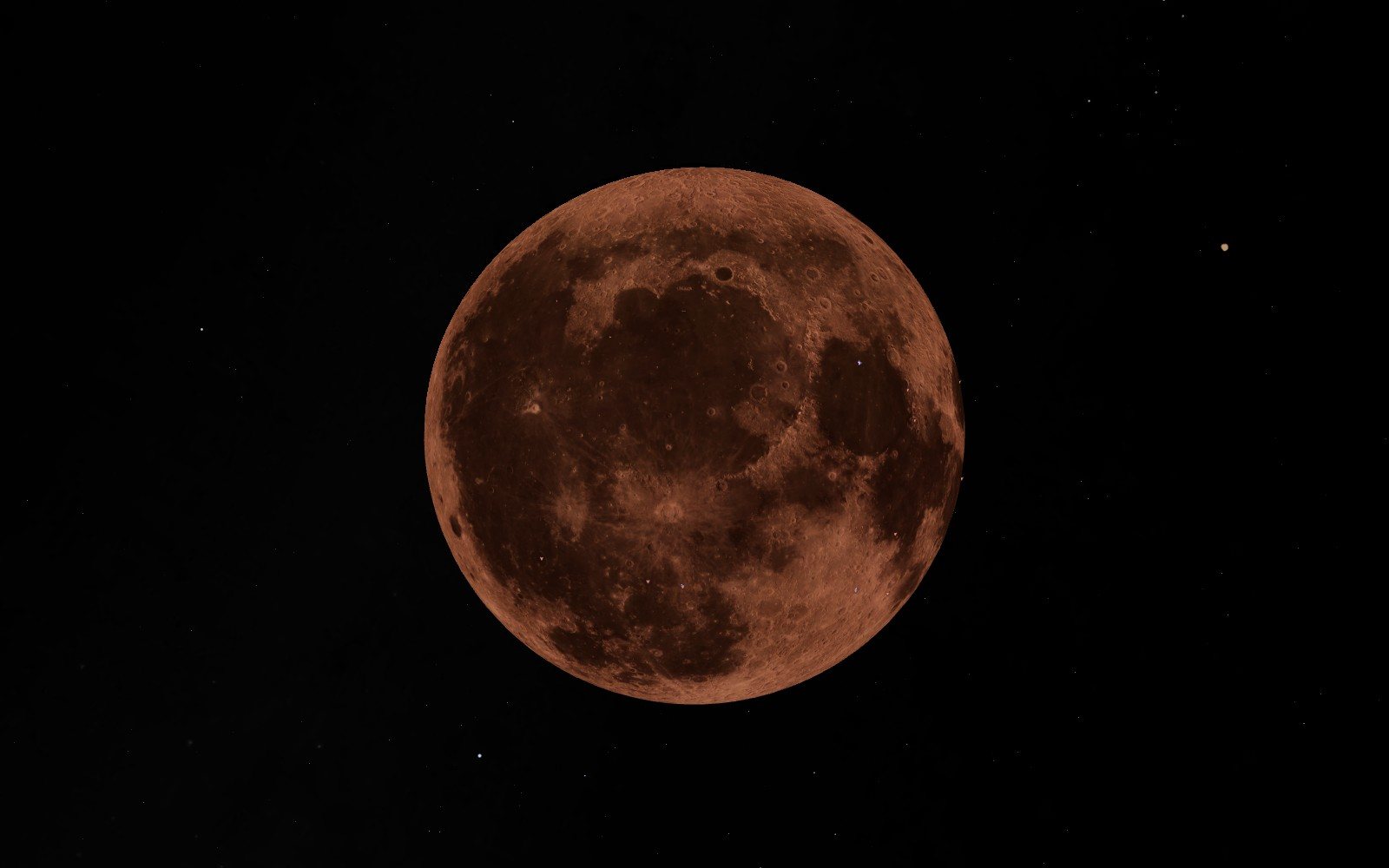
The total lunar eclipse of 31 December 2028, as the map draws it. The shadow’s position is computed. The red is not, and the card says so: “The colour is an illustration; the shadow is computed.”
In March 1715 a sheet of paper went on sale in London showing England with a dark oval lying across it. The astronomer Edmond Halley had worked out where the shadow of the Moon would fall on the morning of 3 May, and he had it printed weeks beforehand. The eclipse came, and London had three and a half minutes of night. By the usual account his timing was out by about four minutes, and his path by about twenty miles.
That sheet was a solar eclipse simulator made of ink. What made it possible is still the strangest fact about the sky: the big things in it keep their appointments. Know where the Sun and the Moon are, and you know where the shadow goes, three centuries ago or three centuries on.
I work on Space Radar, a live map of space, and at the bottom of its screen there is a clock you can drag. This piece is about what happens when you do. Most of what is on the map obeys. Some of it only pretends to, and the interesting part is that the map tells you which.
A tape, not a slider#
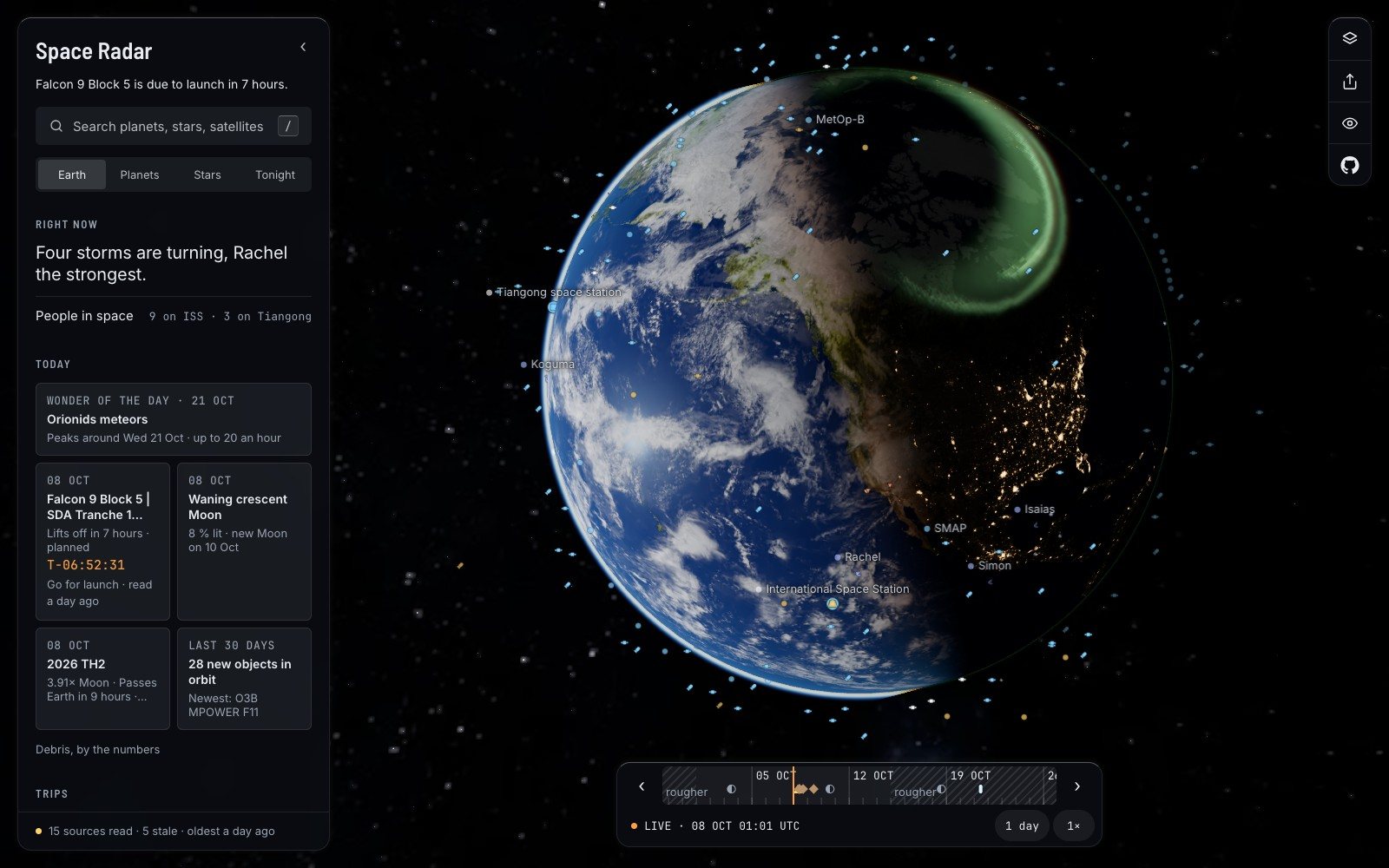
The clock is a pill at the foot of the picture. Left alone it reads LIVE and the time. Above it is a strip of ticks, and the strip is the thing you move: time is a tape that slides under a fixed mark, the way a station slides under the needle of an old radio.
The reason is in the code, in a comment: the things worth going to are a satellite pass in forty minutes and an eclipse in ten months, and on one fixed track “the next pass is a pixel from now”. So the tape has three gears, a minute, an hour or a day to the tick, and a speed button that runs the clock at up to an hour a second.
On the tape there are marks. The next pass over your place. A launch. An asteroid going by. The peak of a meteor shower. The Moon’s four phases. Tap a mark and the clock goes there. The tape reaches a month back and a year on. Another comment in the code says why it has the place a video player gives its own:
Time is not a setting; it is the one control a map of things in motion is about.
The line that never stops#
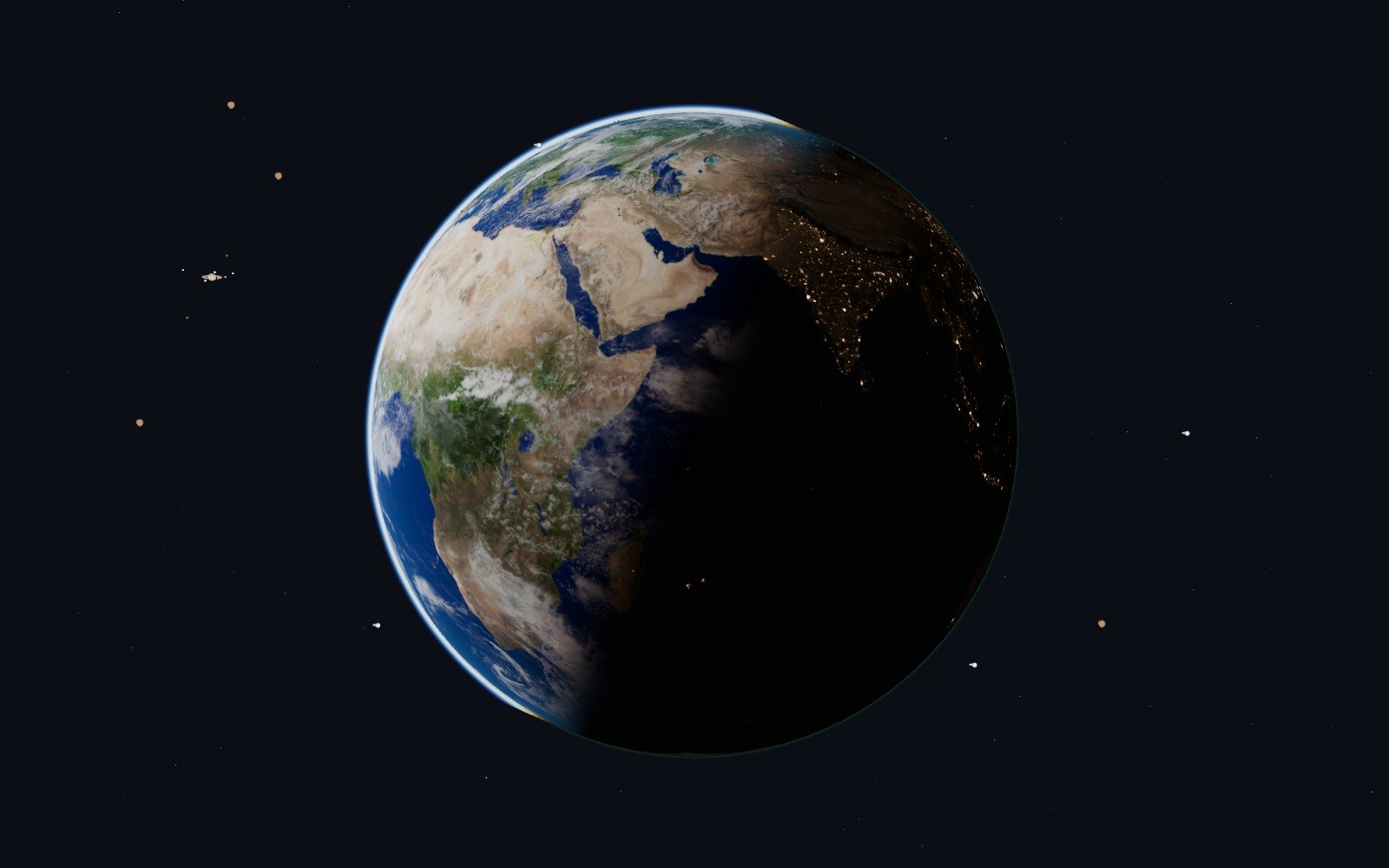
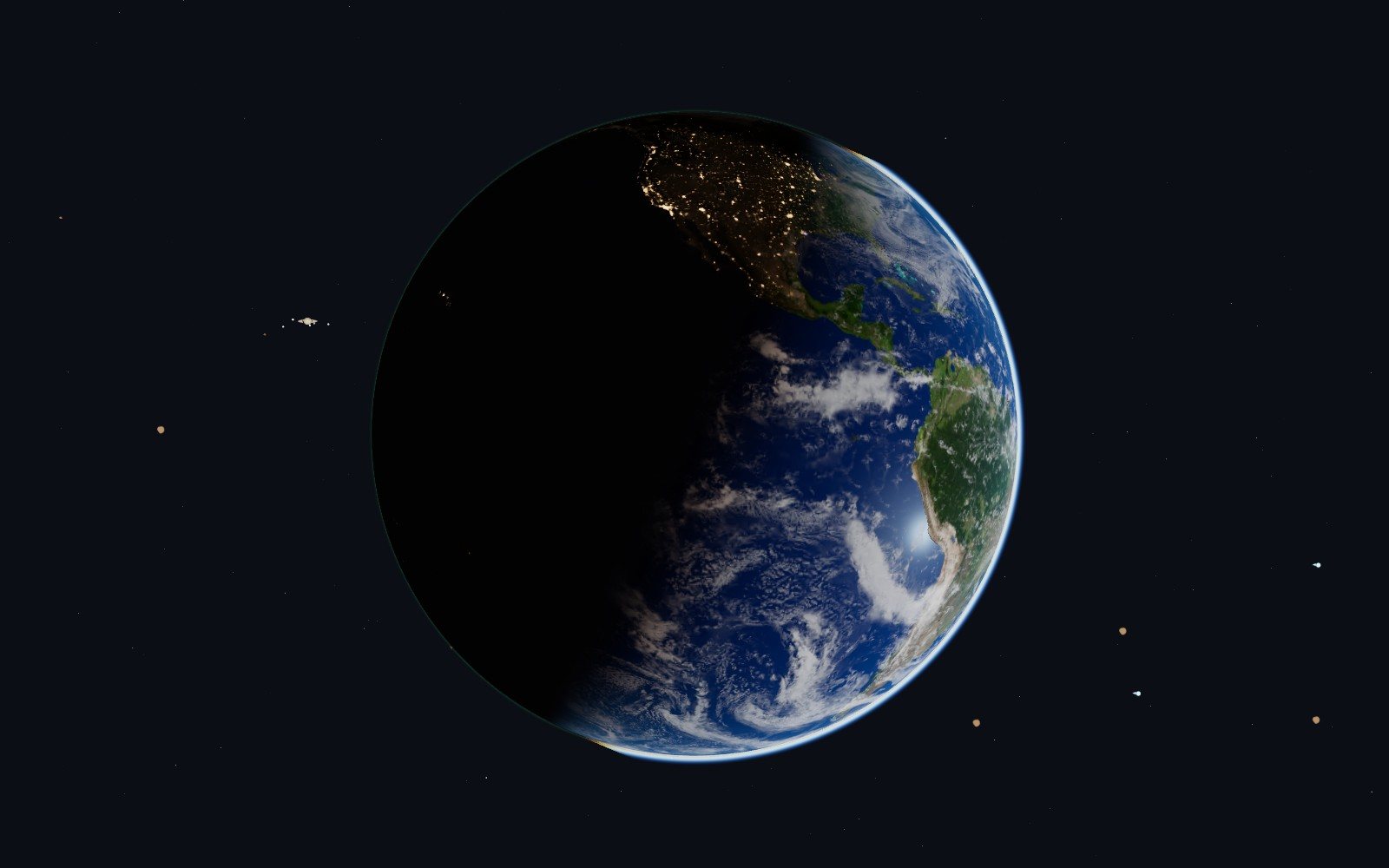
The simplest thing to watch is the edge of night. Half the Earth is always in daylight, and the line between the halves sweeps westward over the ground as the planet turns, at the equator at about 1,675 kilometres an hour. Drag the tape by hand and you can pull dusk across a continent and watch the cities switch on behind it.
Then go further. One of the trips, the living Earth, sets the clock to 21 June and then to 22 December and stops at each. In June the line between day and night crosses the map at a slant, and the Arctic never gets dark. Six months on it leans the other way. The card says what you are looking at: the Earth is tipped over by twenty-three degrees and keeps leaning the same way all year. “That lean, and nothing else, makes the seasons.”
Eclipses, to the minute#
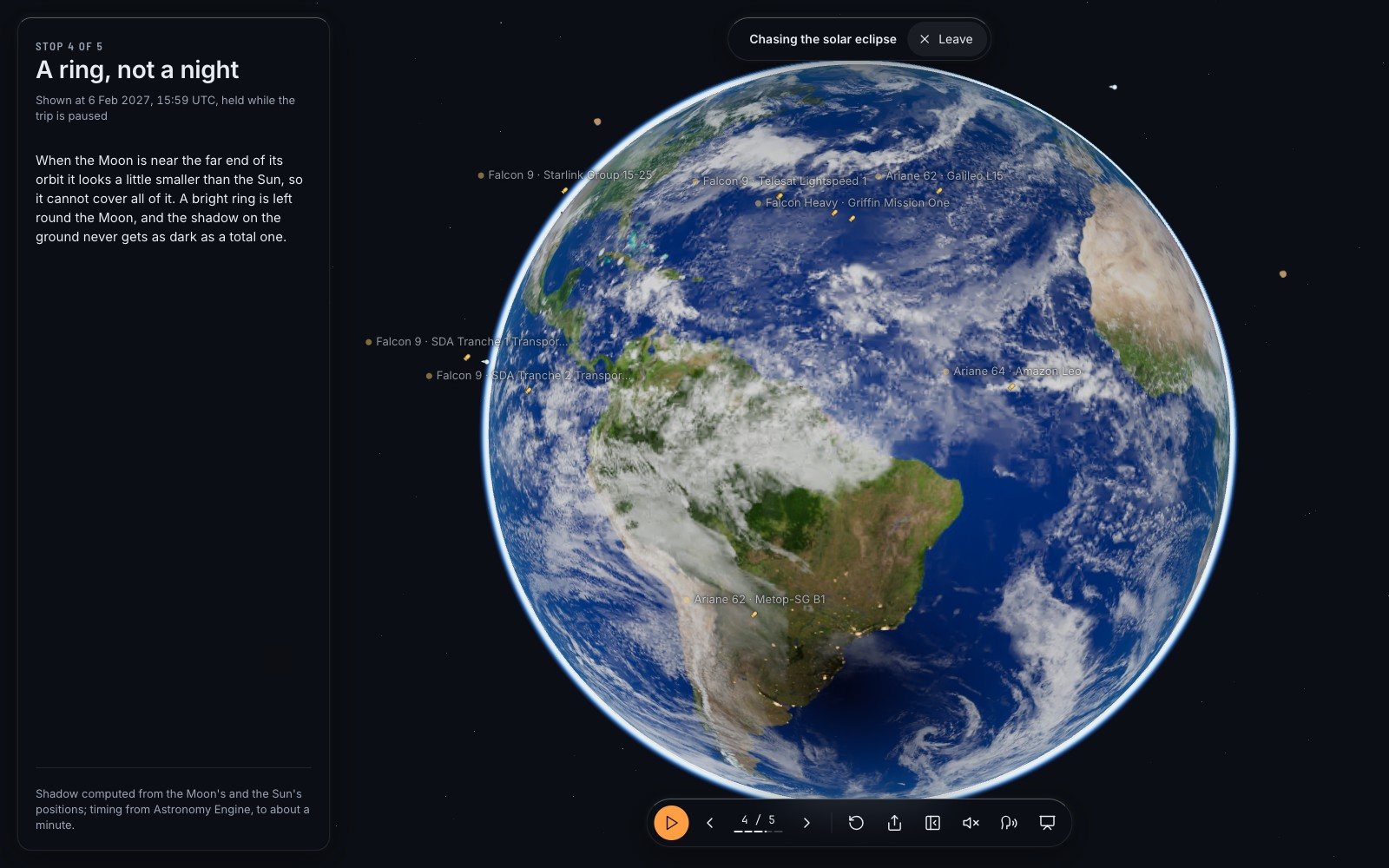
Halley needed weeks of work with tables. The map does it while you watch, with the same ingredients: where the Sun is, where the Moon is, and a line through both. The Moon’s shadow on the Earth is not a stored animation. It is drawn from the two positions at the instant on the clock, so it is right for any eclipse you can scrub to.
The trip called “Chasing the solar eclipse” takes the clock to the next few. After the ring of February 2027 comes the one people are already booking flights for: 2 August 2027, a total eclipse whose shadow crosses southern Spain, North Africa and Arabia, with up to 6 minutes 23 seconds of totality, according to NASA. You can stand above the Earth at the minute it happens and watch the dark core cross the ground.
The last stop turns the arrangement round. Now the Earth is in the way, and the Moon slides into our shadow. The next total one the map finds is on 31 December 2028, which is a fine thing to know two years early.
Why can a web page do this for dates so far off? Because the motions of the Sun, the Moon and the planets are known very well indeed. The reference tables that NASA’s Jet Propulsion Laboratory publishes for them run from the year 1549 to 2650. The map does these sums with an open-source library, Astronomy Engine. The tape says it in six words: “Planets and moons hold for centuries.”
A year in a minute#
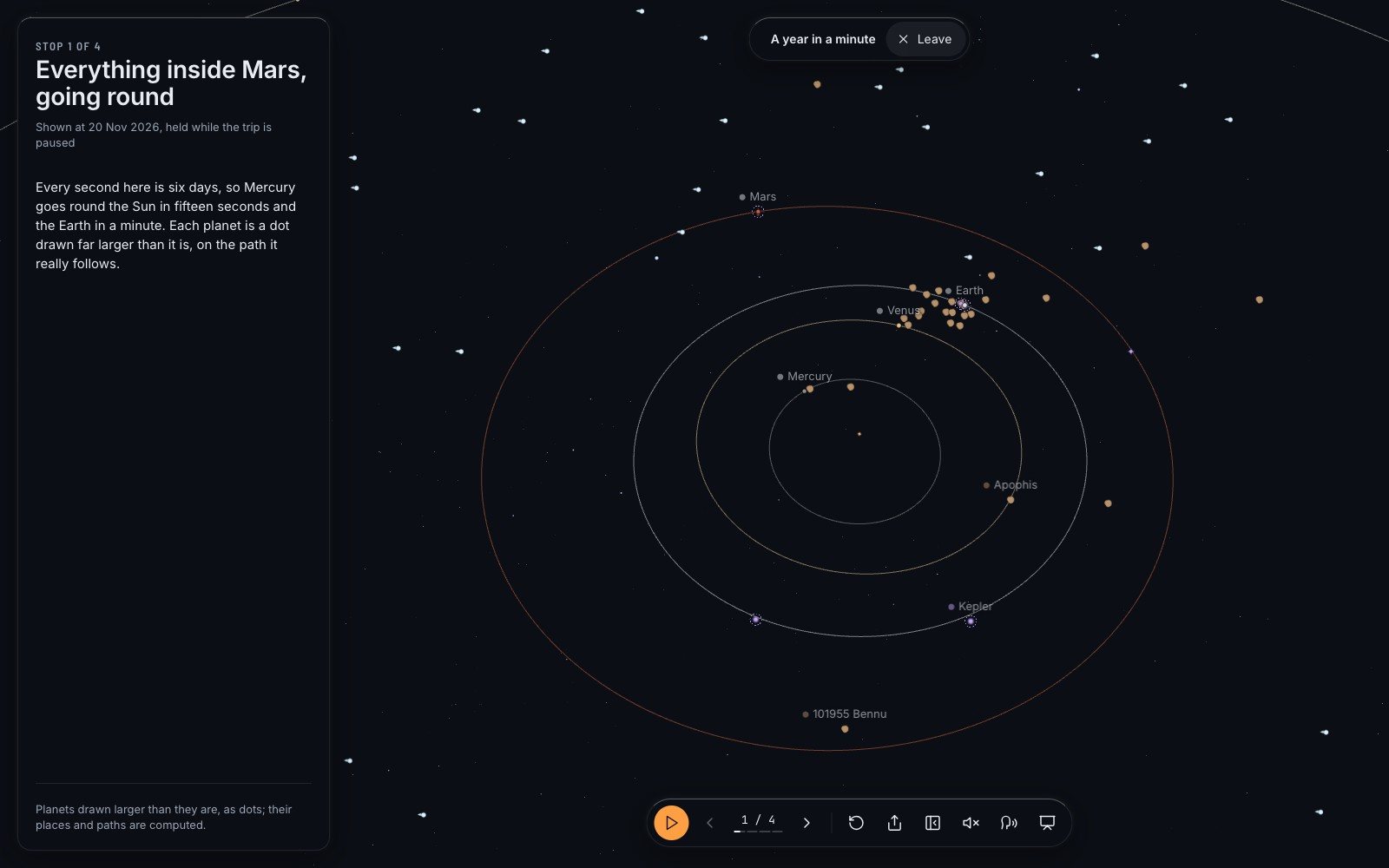
Speed is the other half of a time machine. One trip runs the clock 525,600 times too fast, which is exactly a year in a minute. Every second is six days. Mercury laps the Sun in fifteen seconds. The Moon goes round the Earth in four and a half.
It teaches something that no still diagram can. The planets do not go round like horses on a carousel. The inner ones overtake, again and again, and the outer ones barely seem to try: in the minute it takes the Earth to go round once, Jupiter covers a twelfth of its path.
Backwards, to a Sunday evening in 1969#
The tape itself goes back only a month. Some things go back much further, because they are links to a moment. More than a dozen missions have a timeline on their card, each event with its date and its source. Choose one and the clock goes there.
So you can open the Moon at 20:17 UTC on 20 July 1969, the minute the Eagle landed. The time pill reads “57 years ago”. The lander is where it is. What the map has worked out afresh is the light: the Moon is lit as it was that day.
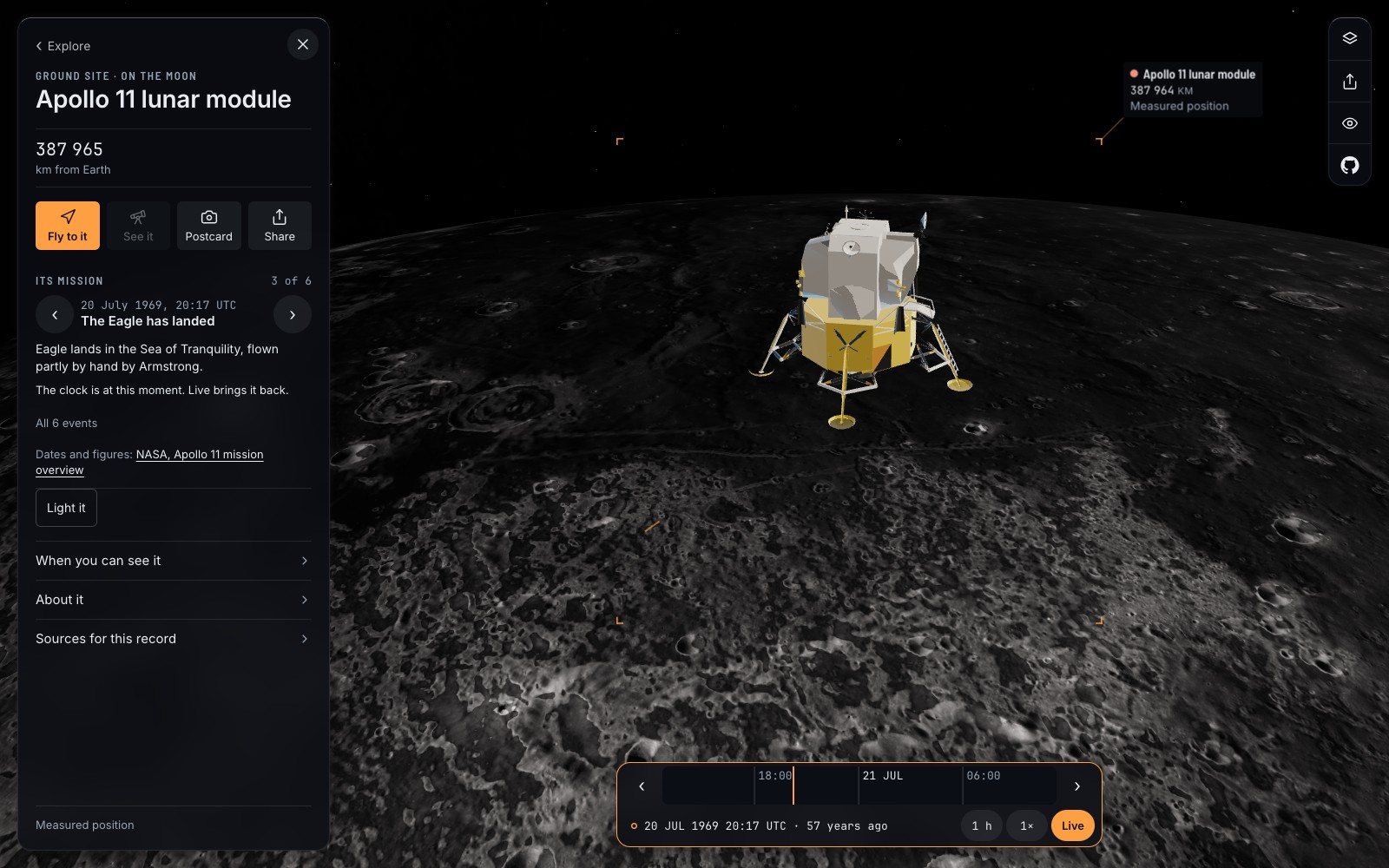
Here the honesty gets specific. For a spacecraft that was moving, the map needs a record of its path on that date, and often it has none. Then it says so and does not move the clock at all. I came across this by accident on the space station’s own card, on an event from 2011: “The map has no path for International Space Station on that day, so the clock stays where it is.”
Where the time machine stops being honest#
Which brings us to the hatching on the tape. A week either side of now, the strip is shaded and marked “rougher”, and if you ask why, it answers: “Satellite places are rough this far from now.”
A satellite is not a planet. It ploughs through the thin top of the atmosphere, which swells and shrinks with the Sun’s mood, and its operators fire its thrusters without telling a web page. The published numbers for its orbit are a fit to recent tracking, good to something like a kilometre near the day they were made and worse with every day after. So the map calls a satellite’s place “measured” only within twelve hours of that day. Beyond a month, it stops drawing the satellite at all.
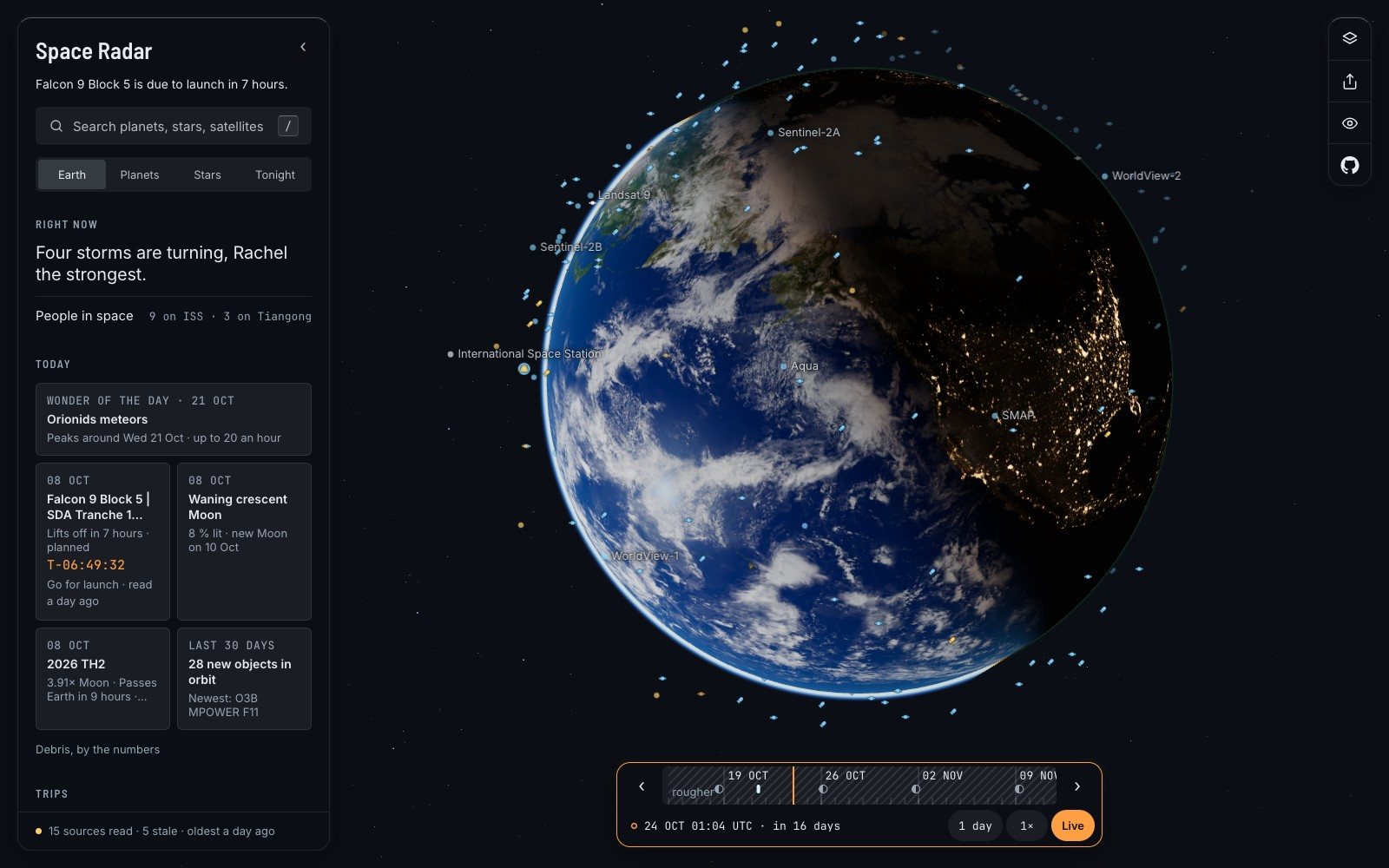
The same goes for the weather. Scrub more than half a day from the latest satellite picture and the clouds on the globe become a stand-in, and a line says they are “illustrative”. A launch on the tape is a plan, and reads “give or take” when the date is not fixed.
I find this the most satisfying part of the whole thing. A time machine that moved everything with equal confidence would be easier to build and nicer to demo. It would also be lying about half of what it showed.
One last appointment, then. On 13 April 2029 an asteroid about 340 metres across, Apophis, will pass some 32,000 kilometres above the ground, inside the ring of television satellites. The map will take you to that evening today. The card under it is three words long where it matters: “It will miss.” Then press Live, and come back to now.
Questions people ask
Is there a free solar eclipse simulator online?
Yes. Space Radar draws the Moon’s shadow on the Earth for any eclipse its clock can reach, computed from the Sun’s and Moon’s positions, in a browser with no account. NASA also publishes interactive path maps for each eclipse.
How accurately can an eclipse be predicted?
Very. The motions of the Sun and Moon are known well enough that eclipse times are given to the second decades ahead; the map’s own timing is good to about a minute.
Can I see where a satellite will be next month?
Only roughly. Published orbits are fits to recent tracking and drift within days, so the map marks satellite positions more than a week from now as “rougher”.
Can I go back in time on the map?
The timeline reaches a month back and a year forward, and links can open other moments, such as the Apollo 11 landing. Planets and moons are computed for any date.
Sources
- GitHub github.com
- 1,675 kilometres an hour gpm.nasa.gov
- 6 minutes 23 seconds of totality eclipse.gsfc.nasa.gov
- Run from the year 1549 to 2650 ssd.jpl.nasa.gov
- Astronomy Engine github.com
- Spaceradar.ai spaceradar.ai
- En.wikipedia.org: Solar eclipse of May 3, 1715 en.wikipedia.org
- Eclipse.gsfc.nasa.gov: SEdecade2021 eclipse.gsfc.nasa.gov
- Arxiv.org: 1002.2277 arxiv.org
Explore on Space Radar
Keep reading
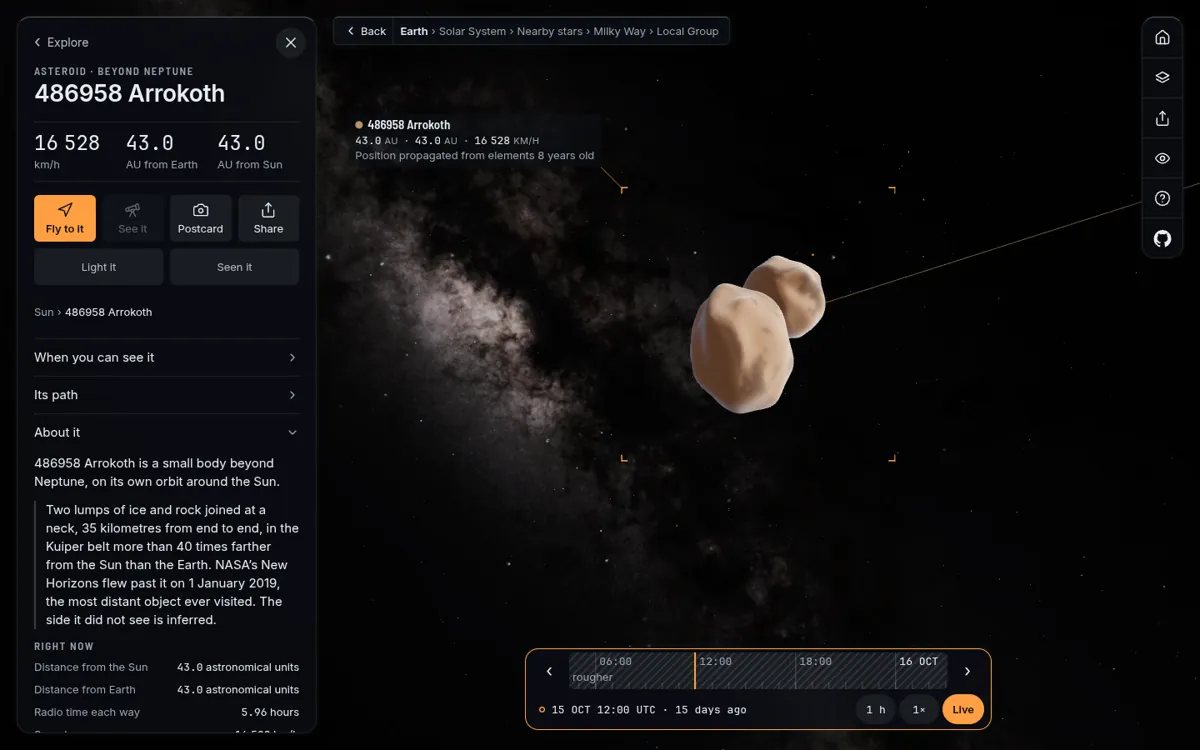
Arrokoth, Kleopatra and nine more small worlds in their own shapes
Release 1.5.0 replaces the generic rock with the shapes spacecraft and radar measured for eleven small bodies, and says on every card what was seen.
A live satellite map that tells you when it is guessing
Space Radar draws everything in orbit where it really is, for people who have never heard of an orbital element. Why I think a map of space has to be honest and kind at once, what that costs, and why it is free and open.
How accurate is satellite tracking? Follow the numbers
A map of space is a pile of other people’s measurements. Who made them, how old they are, which parts are computed, which are photographs and which are honest drawings, and how to send a correction when one of them is wrong.