

How many satellites are in orbit? The junkyard above us
About seventeen thousand working machines, and at least as many dead ones, share the space a few hundred kilometres over your head. How it filled up in one lifetime, who keeps the list, what a collision looks like, and why it reaches your weather forecast.
Working satellites in blue and tracked debris in grey, each at its real height. The low shell, under 2,000 kilometres, holds most of both.
At 16:56 Greenwich time on 10 February 2009, about 790 kilometres above northern Siberia, a working American telephone satellite and a dead Russian communications satellite arrived at the same point in space. Iridium 33 weighed 560 kilograms and Cosmos 2251 about 900. They met at more than eleven kilometres a second. Nobody saw it.
What radar found afterwards was two clouds. In time, more than 2,300 pieces of the pair were large enough to be tracked and given catalogue numbers, and a great many of them are still up. It is a useful thing to have in mind when you ask how many satellites are in orbit, because the honest answer comes in three parts: the ones that work, the ones that do not, and the pieces.
This is a story about a place most of us never think of as a place. In sixty-nine years the thin shell of space just above the weather has gone from empty to crowded, with traffic, wrecks, a rubbish problem and no caretaker. It matters to you even if you have no interest in space at all, because the machines that tell you whether to take an umbrella fly through the worst of it.
Sixty-nine years, from one to forty-seven thousand#
On 4 October 1957 there was one: Sputnik 1. A small American satellite, Vanguard 1, went up on 17 March 1958 and never came down. It is the oldest human-made thing still in orbit, sixty-eight years of laps and counting.
It took less than four years to break something. On 29 June 1961, seventy-seven minutes after reaching orbit, the upper stage of an American rocket broke apart. NASA’s history of such events calls it the first known satellite fragmentation. It left 317 pieces big enough to catalogue, and 193 of them were still in orbit six decades later.
Since then, by the European Space Agency’s running count (as of July 2026), about 7,320 launches have placed about 27,490 satellites in orbit. Roughly 18,850 are still up there. About 15,900 still work. The total mass of everything human-made in orbit is more than 17,000 tonnes, forty International Space Stations’ worth.
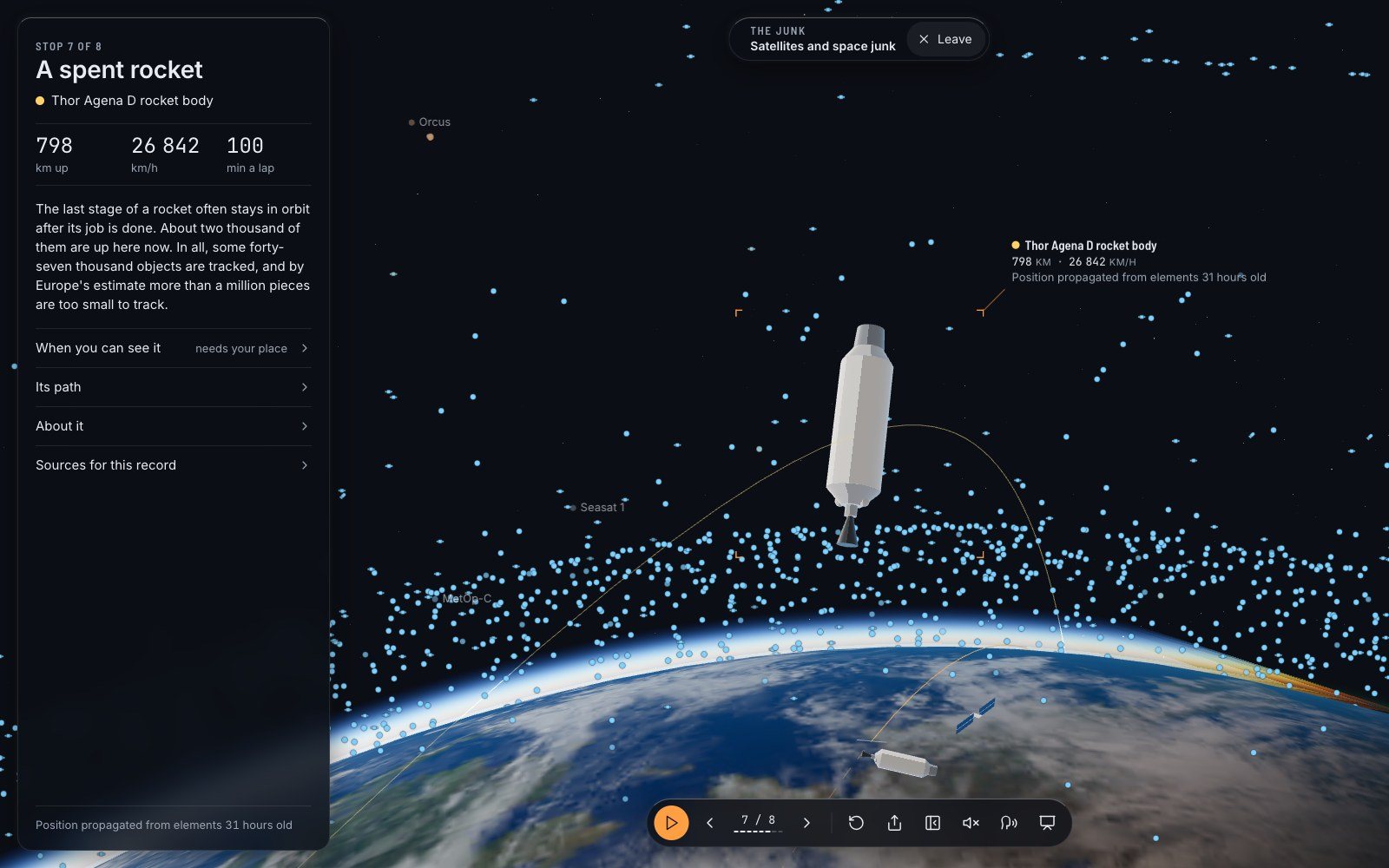
I have been looking at all this through Space Radar, a free live map of everything in orbit that draws each object where its published orbit puts it. It also counts. Working from the public catalogue as it stood on 6 October 2026, the map found 34,570 objects, and 17,450 of them were no longer doing a job: 12,347 fragments, 2,858 dead satellites and 2,245 spent rocket bodies.
- 1 in 2of the objects in the public catalogue no longer works: 17,450 of 34,570, counted by Space Radar from CelesTrak’s catalogue on 6 October 2026.
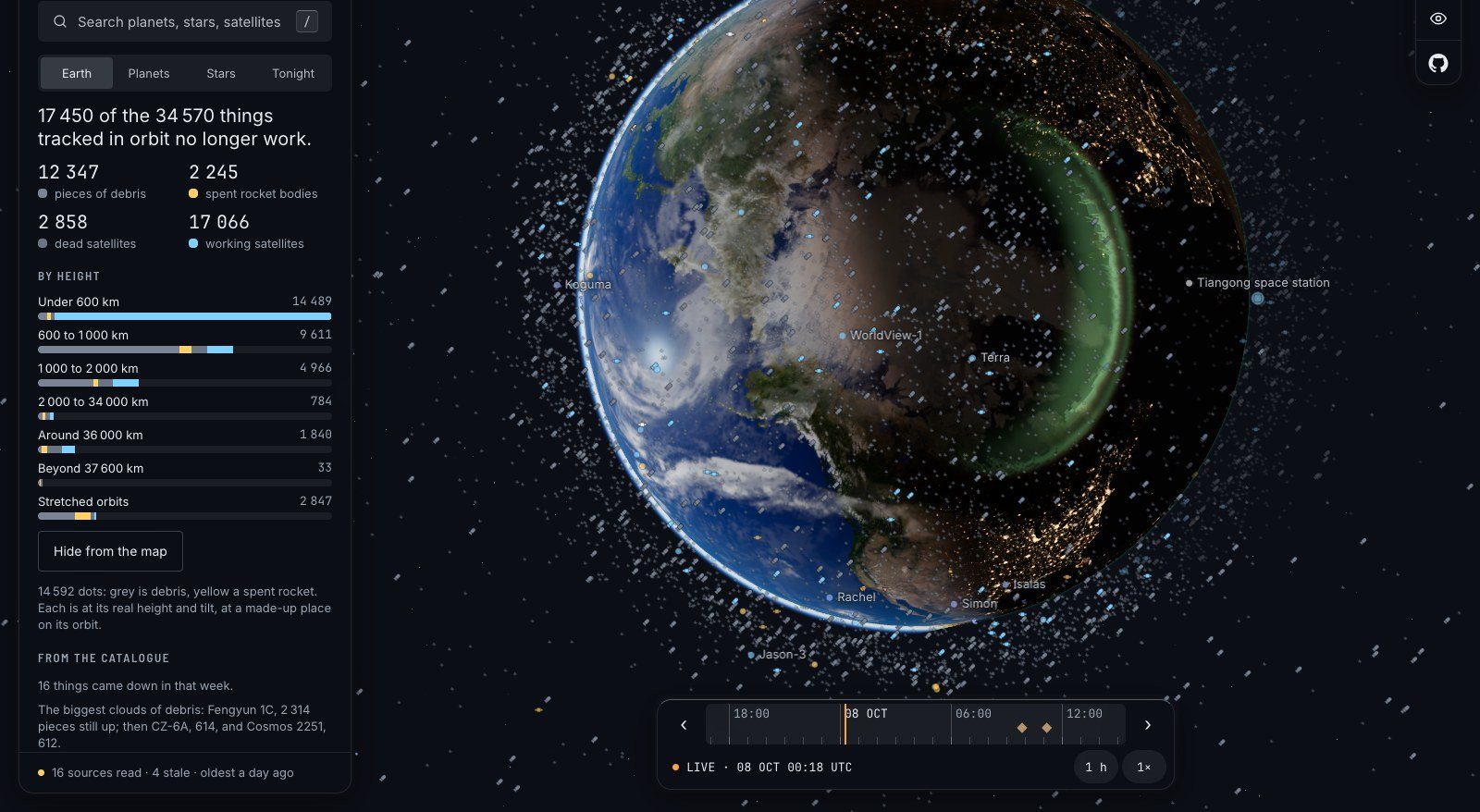
You can take the tour yourself. The guided trip Satellites and space junk starts with one station, switches on every working satellite, and then switches on the rest.
The people who keep the list#
Somebody has to know where all of it is. The main catalogue is kept by the United States Space Force: the 18th Space Defense Squadron, at Vandenberg in California, follows more than 47,000 objects with a worldwide network of radars and telescopes and publishes most of their orbits. T. S. Kelso republishes that data through a site called CelesTrak, in a form anyone can use. That openness is why a free map can exist at all.
The list has two blind spots. The first is that not everything tracked is published: about 47,000 objects are followed, but the public catalogue I counted from holds about 35,000. The second is size. From the ground, radar loses things smaller than about ten centimetres in low orbit, and smaller than about a metre in the high orbits.
What it cannot see is most of it. The European Space Agency’s model puts the number of pieces between one and ten centimetres at 1.5 million, and those between a millimetre and a centimetre at 230 million. These are estimates, not counts. But the evidence for them arrives regularly. In 2016 the astronaut Tim Peake photographed a seven-millimetre chip in a window of the space station’s observation dome. The agency’s best guess at the culprit was a flake of paint, or a metal fragment a few thousandths of a millimetre across. In November 2025 the return of three Chinese astronauts was delayed by more than a week after tiny cracks were found in a window of their capsule, most likely from a debris strike.
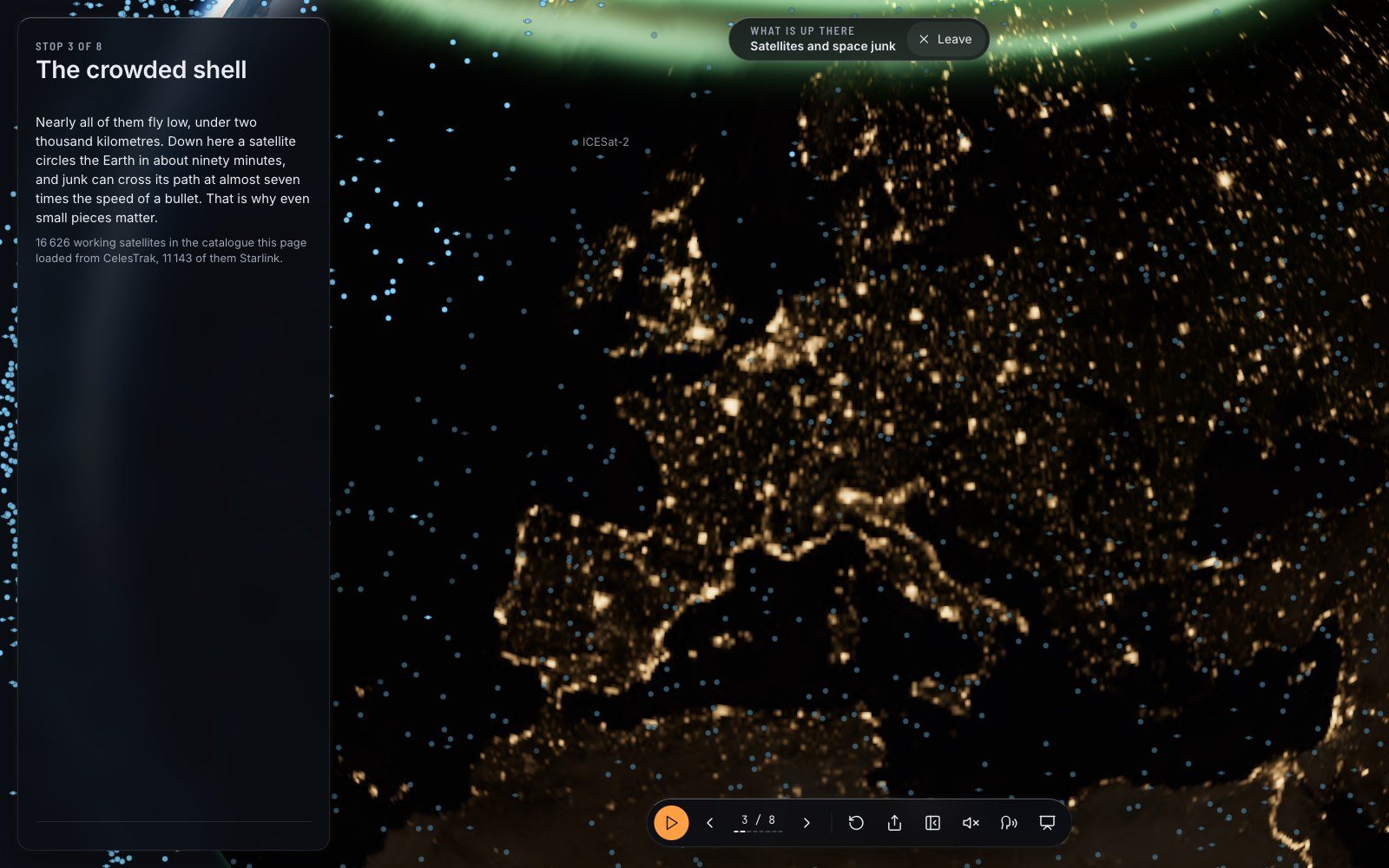
That is the arithmetic of the low shell, and you can fly down into the crowded part to see it. Everything is moving at seven or eight kilometres a second, in different directions, so the average impact comes at about ten, according to NASA. At that speed a fleck of paint is a bullet and a bolt is a bomb.
What a collision looks like#
The first known accident between two catalogued objects came on 24 July 1996. A small French satellite called Cerise was hit by a fragment of a European rocket stage that had broken up ten years earlier. The closing speed was 14.8 kilometres a second, and it knocked off a single piece large enough to track.
The worst single event was not an accident. On 11 January 2007 China destroyed one of its own old weather satellites, Fengyun-1C, with a missile, about 860 kilometres up. NASA eventually catalogued 3,532 fragments. The European Space Agency reckons the test raised the number of trackable objects in orbit by a quarter in a single event. At that height the air is too thin to clear the wreckage quickly: by the map’s count, 2,314 pieces of that one satellite were still circling in October 2026.
Then came 2009, the crash this story began with: 2,371 catalogued fragments from two satellites, one of them working. And on 15 November 2021 Russia destroyed its own defunct Cosmos 1408 in another missile test, adding 1,760 tracked pieces, at a height not far above the International Space Station. The crew were told to shelter in their return capsules. NASA’s administrator at the time, Bill Nelson, said he was “outraged by this irresponsible and destabilizing action”.
By April 2025 the space station had fired its engines 41 times to get out of the way of debris.
The station is the most protected thing in orbit and it still has to duck. NASA counts 41 avoidance manoeuvres since 1999. You can follow the ISS on the map and watch it do its ninety-minute lap through the same shell.
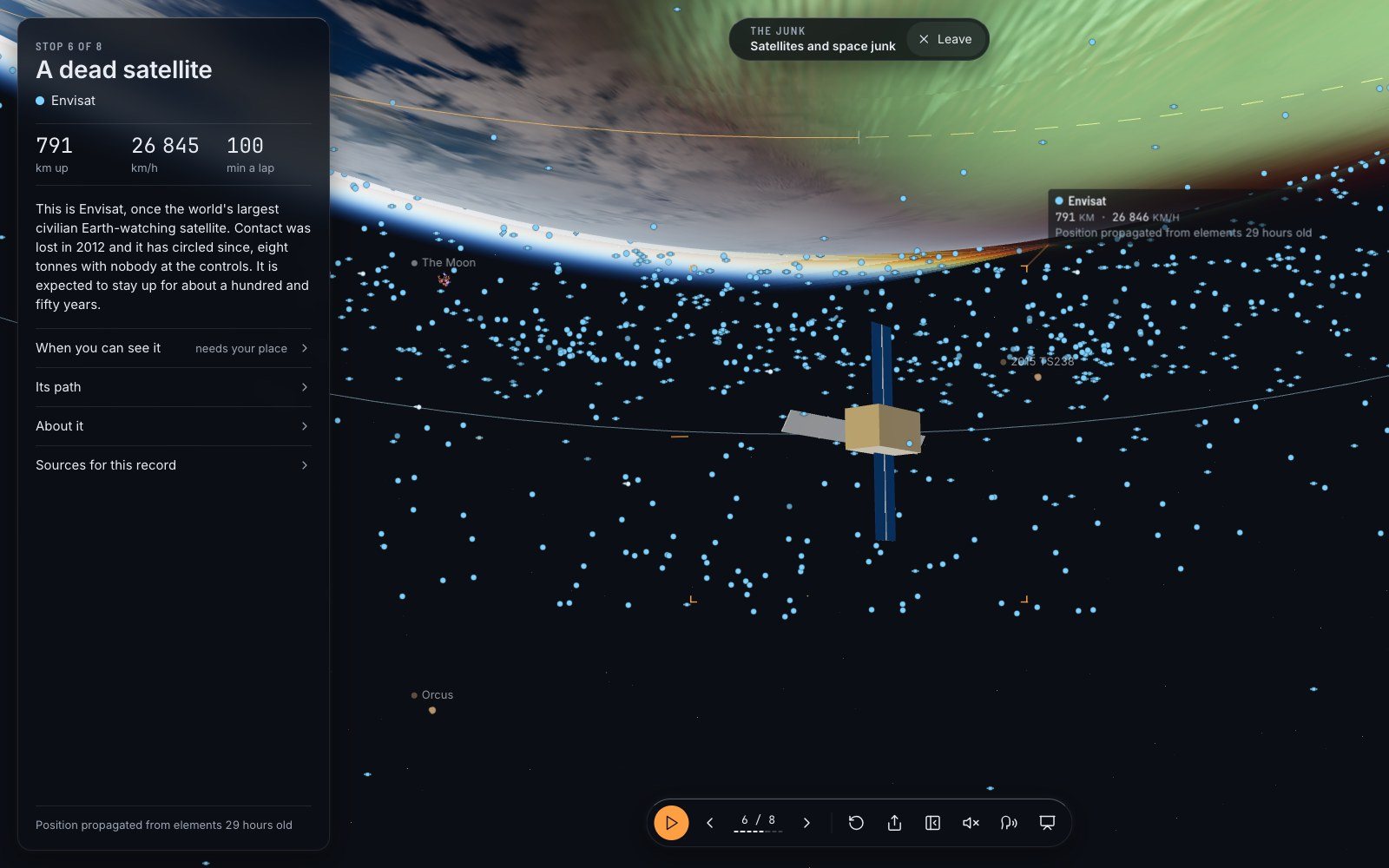
Not all of the danger is small. Envisat is an eight-tonne European environment satellite, one of the largest Earth-watching machines ever flown. On 8 April 2012 it stopped answering, and it has been going round ever since with nobody at the controls.
Kessler’s arithmetic#
In 1978 two NASA scientists, Donald Kessler and Burton Cour-Palais, published a paper with a dry title and an alarming subtitle: “Collision Frequency of Artificial Satellites: The Creation of a Debris Belt”. Their point was simple. Every collision makes fragments. Every fragment is a new thing that can collide. Past a certain crowding, the fragments are made faster than the atmosphere can drag them down, and the population grows by itself, even if nobody launches anything again.
A colleague later named this the Kessler syndrome, and films have turned it into a chain reaction that wipes out everything in an afternoon. The real version is slower and, in a way, worse: a process of decades that is hard to notice and impossible to reverse. Kessler has since written that the debris environment is already “unstable”. The European Space Agency’s 2026 report on the space environment says it without drama: even with no further launches, collisions among the debris already present are expected to make the population in low orbit keep growing.
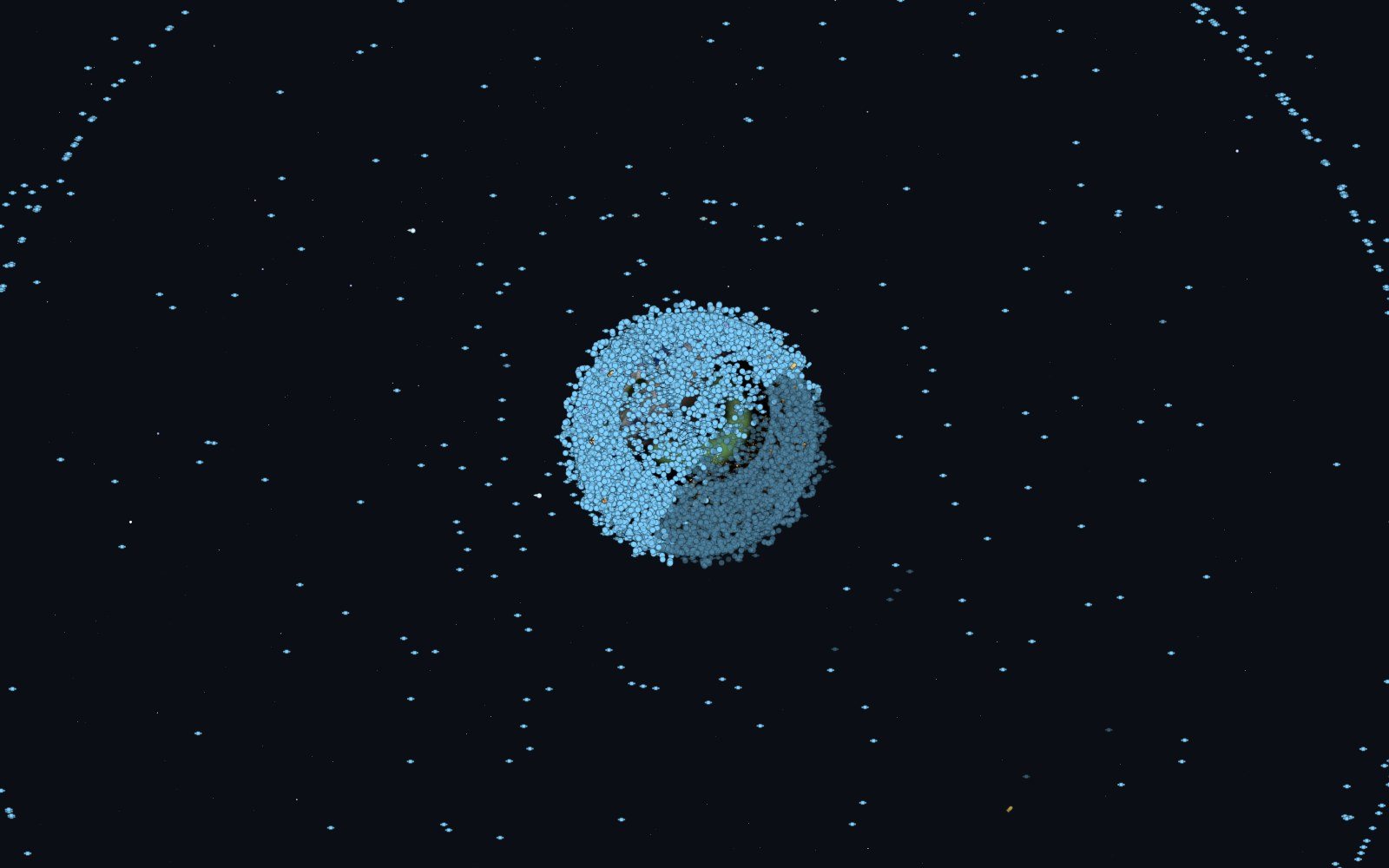
Height decides how long a mistake lasts. In the lowest orbits the air cleans up within a few years. Around 850 kilometres, nearly two decades have removed only about a third of the catalogued Fengyun wreckage. And in the ring that stands still, almost 36,000 kilometres up, where television and weather satellites sit, nothing ever comes down at all.
Eleven thousand of one kind#
Now add the newest fact, which is that the sky has a majority owner. As of 30 September 2026, the astronomer Jonathan McDowell, who keeps a widely used independent tally, counted 16,913 working satellites. Of those, 11,143 belong to a single internet network, Starlink. That is two out of every three.
The first sixty of them went up in May 2019. Other fleets are following, among them Amazon’s Kuiper and China’s Qianfan, each with a few hundred satellites up so far. In 2025 alone, more than 300 launches put over 4,000 new satellites into orbit.
The operators are not careless; they have every reason not to be. Starlink satellites fly low, so that a dead one falls out of the sky by itself, and they are built to dodge without waiting for a human. But look at what the dodging amounts to. In its latest half-yearly report to the United States regulator, SpaceX said its satellites had made 207,152 collision-avoidance manoeuvres between December 2025 and May 2026.
- Every 76 secondson average, a Starlink satellite changed course to avoid something, according to SpaceX’s report for the six months to May 2026.
Who cleans up#
Mostly, the air does. More than three intact satellites or rocket stages fall back into the atmosphere every day, the European agency reports, about 1,200 in 2025. Some are steered into the emptiest part of the South Pacific. Most simply burn up on the way down.
The rules are tightening. For years the guideline was to remove a satellite within twenty-five years of the end of its work; European missions must now do it within five, and the United States regulator adopted a five-year rule in 2022. In October 2023 it issued the first fine for breaking a debris promise: 150,000 dollars, to a television company that had left an old satellite in the wrong place. More than 200 organisations have signed a European “Zero Debris” charter.
As for actually collecting the rubbish, we are at the stage of proving it can be approached. In November 2024 a Japanese spacecraft called ADRAS-J flew to within about fifteen metres of a spent rocket stage, close enough to inspect it. A European mission to grab and remove a small old satellite is planned for 2029. No piece of old junk has yet been brought down by a clean-up mission.
The forecast#
Here is why it comes back to the umbrella. The European weather centre in Reading uses about 60 million observations a day to start its forecasts, and most of them come from around ninety instruments on satellites. Many of the most valuable ones ride on satellites that pass over the poles a little above 800 kilometres. That is the same band as the Chinese missile test and the 2009 crash. The forecast flies through the wreckage.
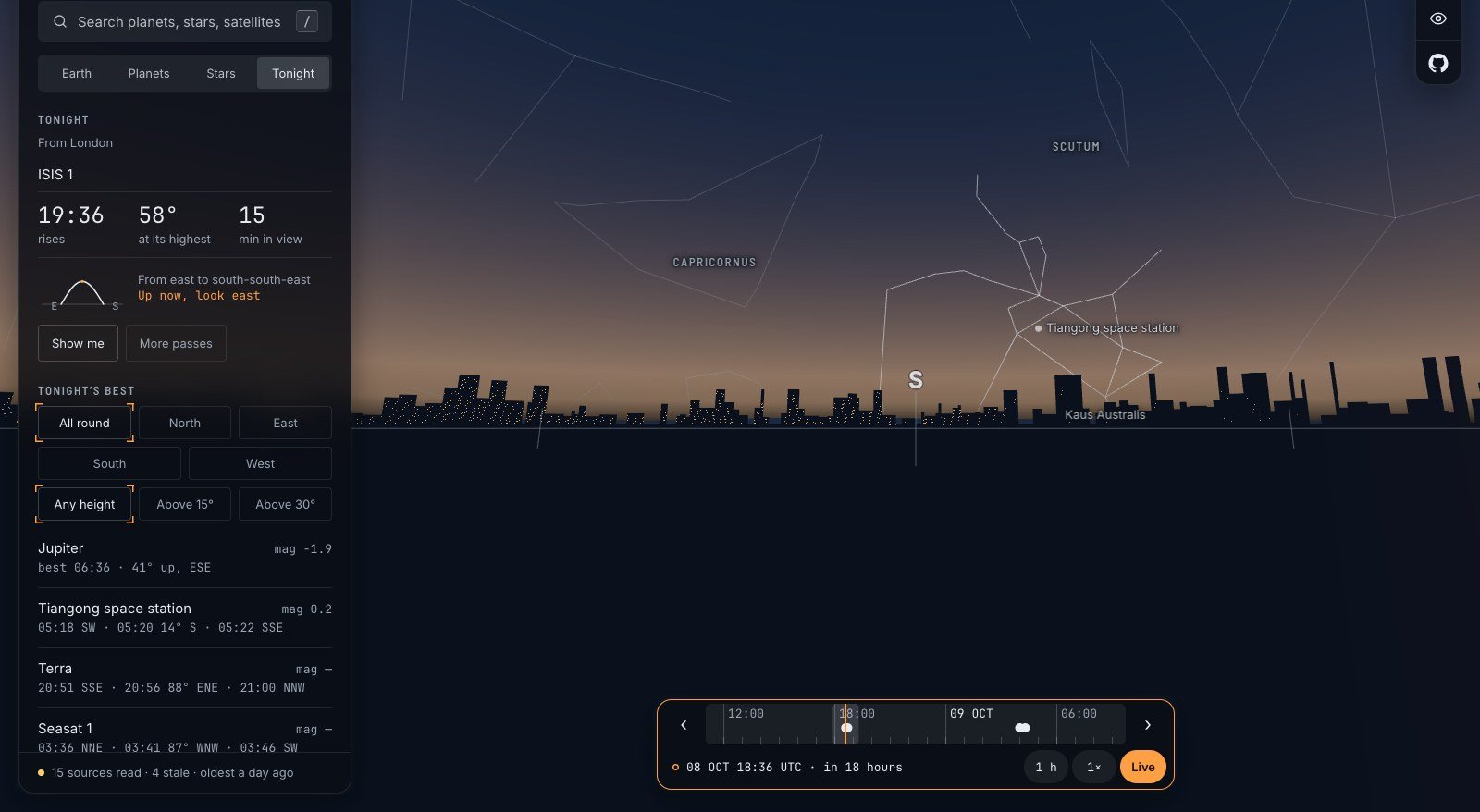
So go and look at it. On a clear evening, an hour after sunset, stand somewhere dark for ten minutes and watch for points of light that move steadily and do not blink. Each one is a machine, or the shell of one. The map will show you which satellites cross your own sky tonight. And somewhere among the ones too faint to see is Vanguard 1, still on its laps, sixty-eight years after someone let it go.
Questions people ask
How many satellites are in orbit right now?
About 16,900 working satellites as of 30 September 2026, by Jonathan McDowell’s count, and close to 19,000 or 20,000 if you include the dead ones still circling. Two thirds of the working ones belong to Starlink.
How much space debris is there?
Space surveillance networks follow about 47,000 objects, and roughly half of those in the public catalogue no longer work. The European Space Agency’s model adds about 1.5 million pieces between one and ten centimetres that are too small to track.
What is the Kessler syndrome?
It is the point at which collisions create fragments faster than the atmosphere removes them, so the debris keeps growing by itself. Donald Kessler and Burton Cour-Palais described it in 1978; it is a slow process of decades, not a sudden chain reaction.
Does space debris fall on people?
More than three intact satellites or rocket stages re-enter every day, and most of the material burns up. The largest spacecraft are steered into a remote part of the South Pacific.
Sources
- Running count sdup.esoc.esa.int
- “outraged by this irresponsible and destabilizing action” nasa.gov
- “Collision Frequency of Artificial Satellites: The Creation of a Debris Belt” doi.org
- 2026 report on the space environment esa.int
- A widely used independent tally planet4589.org
- Orbitaldebris.jsc.nasa.gov: ODQNv13i2.pdf orbitaldebris.jsc.nasa.gov
- Orbitaldebris.jsc.nasa.gov: HOOSF 16e.pdf orbitaldebris.jsc.nasa.gov
- Esa.int: About space debris esa.int
- Space-track.org: documentation space-track.org
- Esa.int: Impact chip esa.int
- Pbs.org: chinese astronauts return from space station after delay blamed on space debris damage pbs.org
- Orbitaldebris.jsc.nasa.gov: faq orbitaldebris.jsc.nasa.gov
- Aquarid.physics.uwo.ca: KesSym aquarid.physics.uwo.ca
- Sdo.esoc.esa.int: Space Environment Report I10R0 20260501.pdf sdo.esoc.esa.int
- Api-prod.fcc.gov: bff0244acfb947505791bf252f851ce6 api-prod.fcc.gov
- Esa.int: Mitigating space debris generation esa.int
- Docs.fcc.gov: DOC 397412A1.pdf docs.fcc.gov
- Blogs.esa.int: spacesafety community blogs.esa.int
- Esa.int: ClearSpace 1 esa.int
- Ecmwf.int ecmwf.int
Explore on Space Radar
Keep reading
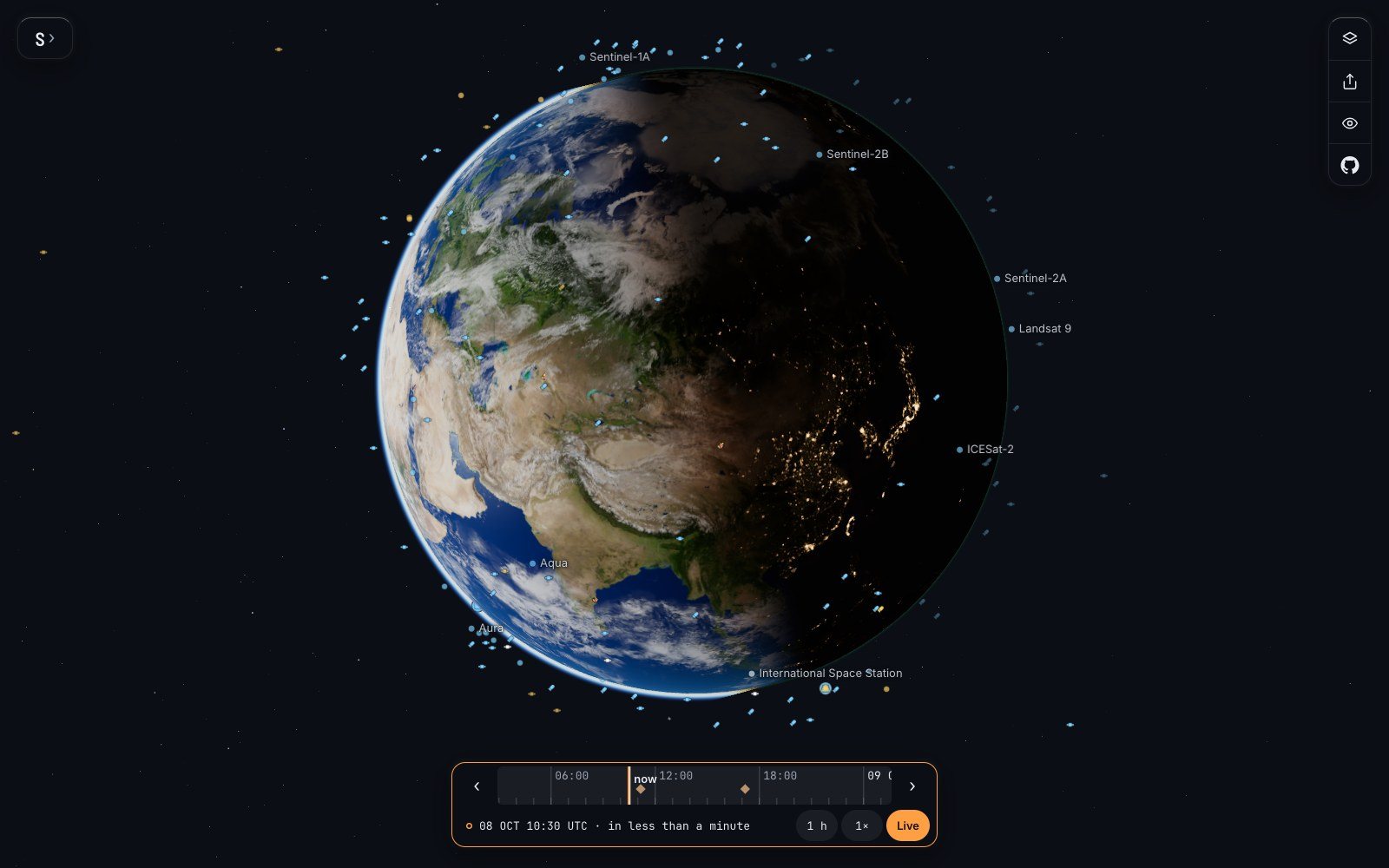
What do satellites do? The machines you used before breakfast
The time on your phone, the dot on the map, the weather icon, the bread on the table: an ordinary morning leans on a few hundred quiet machines that almost nobody thinks about. Where they are, how they work, and how easily they could be taken away.
A live satellite map that tells you when it is guessing
Space Radar draws everything in orbit where it really is, for people who have never heard of an orbital element. Why I think a map of space has to be honest and kind at once, what that costs, and why it is free and open.
How accurate is satellite tracking? Follow the numbers
A map of space is a pile of other people’s measurements. Who made them, how old they are, which parts are computed, which are photographs and which are honest drawings, and how to send a correction when one of them is wrong.