
What Changed on the Space Radar Map in Mid-November 2026: Andromeda, a White Sun, Euclid and More
Six sets of changes landed on 14 November. Links to Andromeda arrive where you can see it, the Sun is white, Euclid and five meteor showers are on the map, and the cards say more in plainer words. Here is what changed, with before and after pictures, and what is still not right.
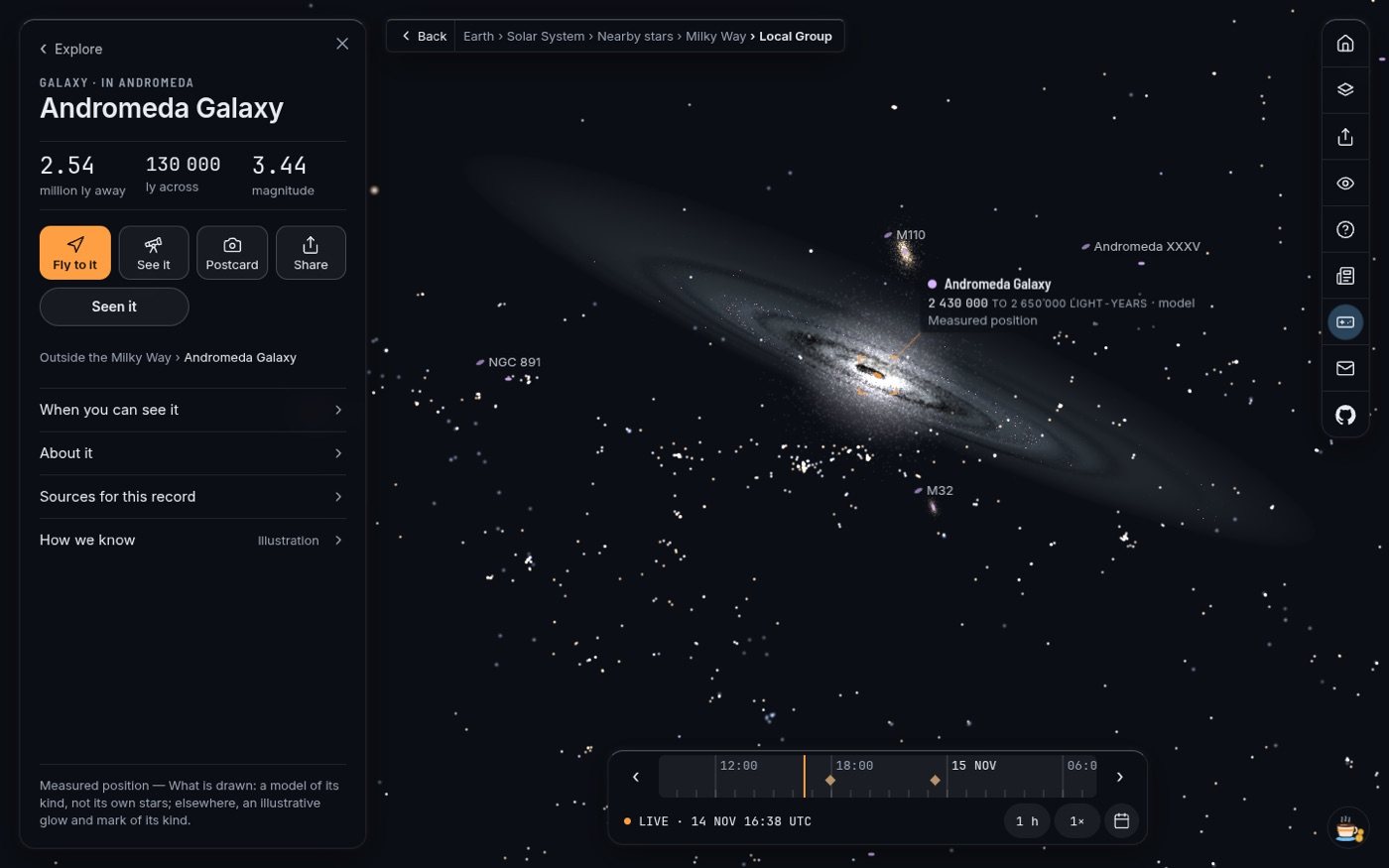
The Andromeda Galaxy, as a shared link now shows it. Before the change the same link showed a smudge with a radius of 75 px.
In the middle of November 2026 we changed how the Space Radar map draws the sky, and a few things it says about it. Shared links to the Andromeda Galaxy now arrive close enough to see it. The Sun is white, Venus is pale cream and a thin daytime Moon no longer blazes. Euclid and five more meteor showers are on the map, the cards explain a star’s class in words, and the map’s pages are in 11 languages. Most changes have a before and after picture from our test runs. Where one does not, or where something is still not right, this post says so.
There were six sets of changes, all merged on 14 November. Each section below names its pull request in the public repository, so you can read exactly what shipped.
Links that arrive where you can see the object#
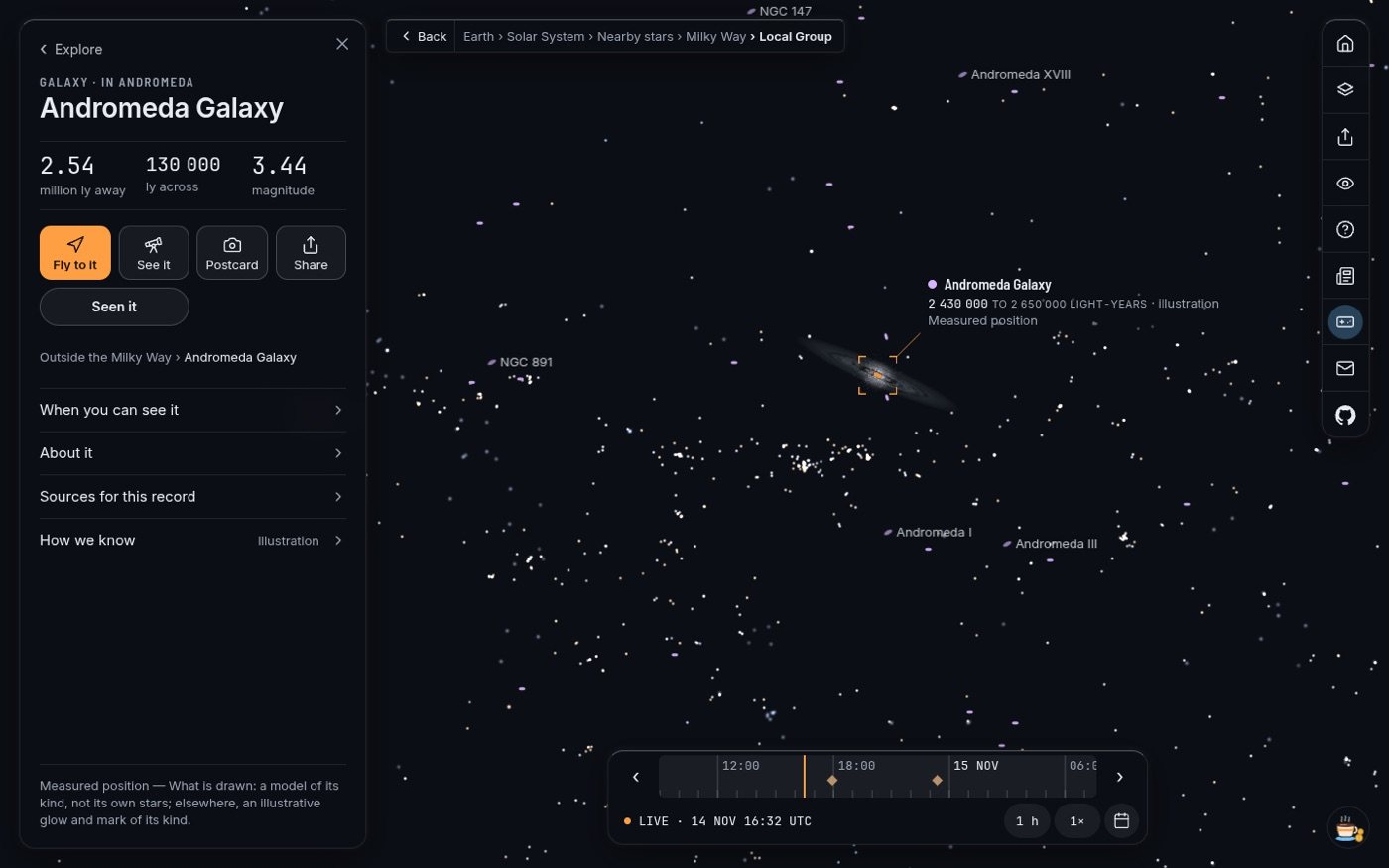
A shared link to Andromeda used to land a million light-years away, because that was the smallest distance the map would move to at that zoom. The galaxy arrived with a radius of 75 px on screen, a small smudge. Now the map moves in until the object fills the narrower side of the screen. The same link now shows Andromeda with a radius of about 367 px, and the model is drawn. Globular cluster M13 was worse: from the same zoom it was a dot a fraction of a pixel wide. It now arrives at about the same 367 px radius. The same fix applies to “Fly to it” on galaxies, clusters and nebulae. (#1401)
Two smaller fixes came with it. A landing-site link that would have opened at lunar night, with the Sun under 5 degrees, now moves the clock on to the next hour with the Sun 15 degrees up, and a note on the screen says so. A clock you set yourself, or one set by a link, is left alone. And the search box now keeps a name only after its own pick, and clears when you select something some other way, such as a card or a click on empty sky. We have no before and after picture of those two.
The sky and the stars#
Most of the drawing fixes are about light. They came from a look at the map by eye, then by pixel probe. (#1405)
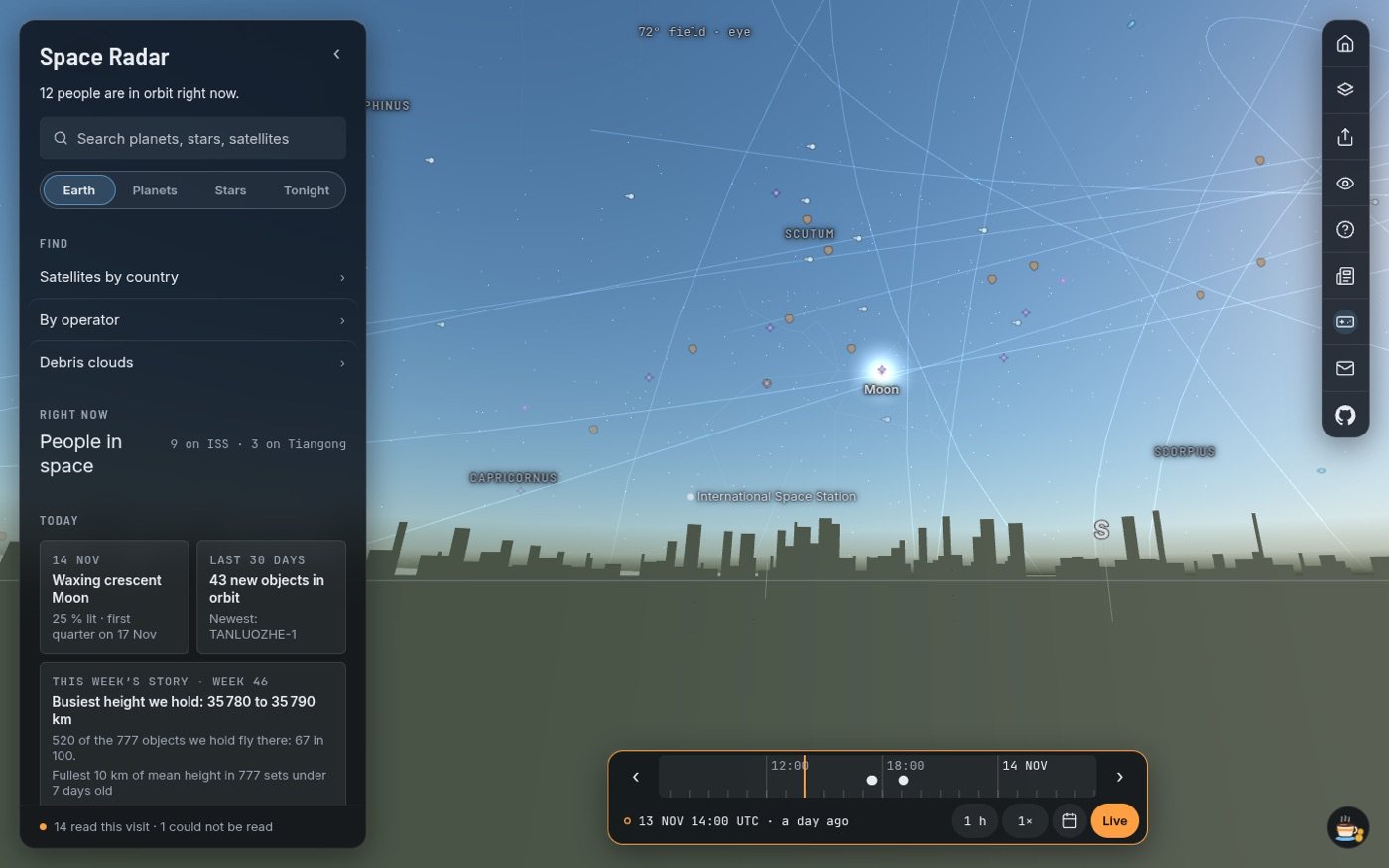
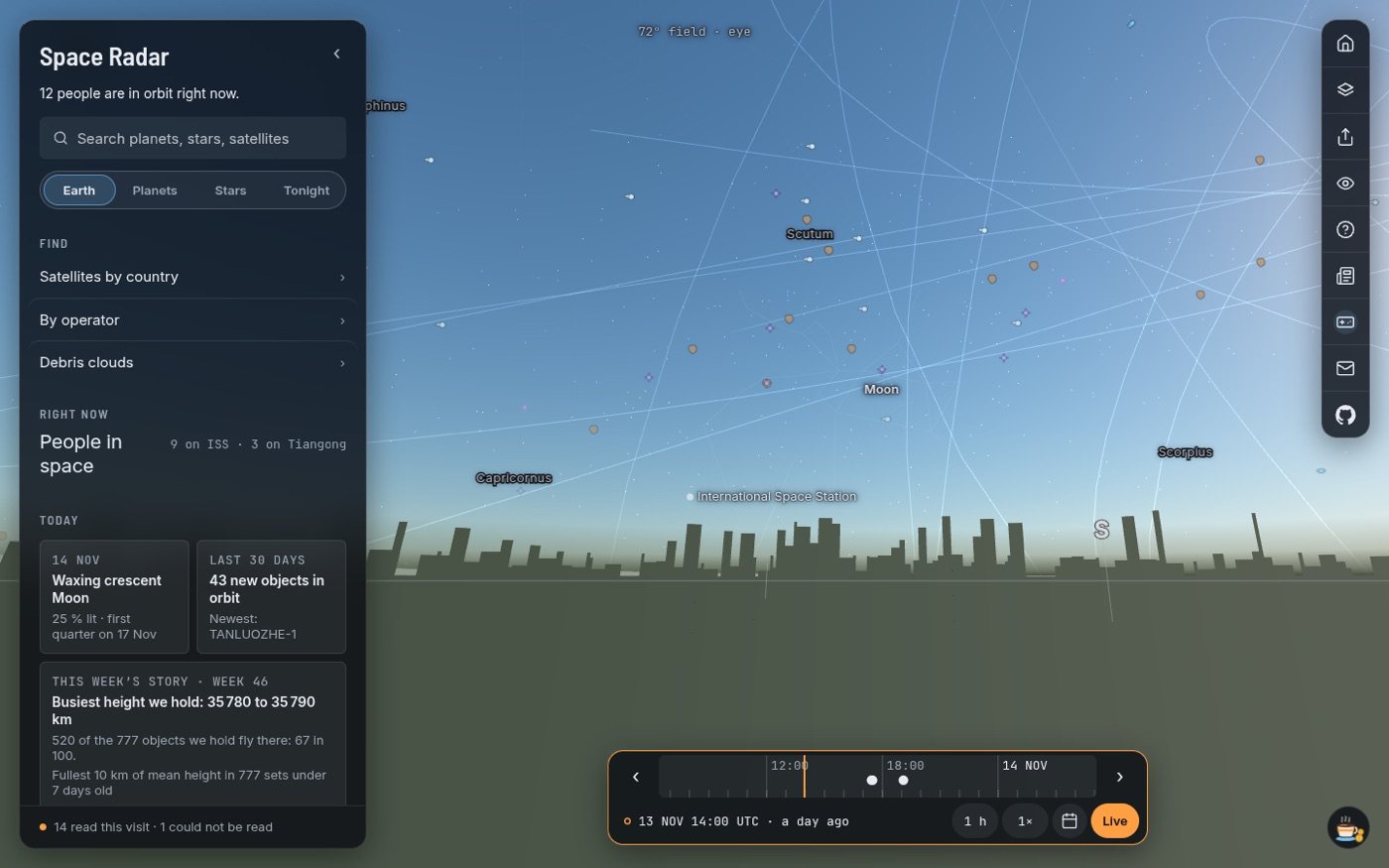
- A thin daytime Moon. The blaze came from a second layer that adds the planets as lights, and it was adding a bright Moon over the blue daytime sky. It is now off while the ground sky draws the sky, and the Moon is laid over the blue instead of added to it.
- Names on near stars. The disc of a close star such as Sirius now hides names behind it, as a planet would, so far-away names are no longer printed across it.
- The Milky Way from outside. Pulsars, X-ray binaries, other detail layers and planet hosts are no longer drawn farther than 65 000 light-years from the camera on the galaxy and Local Group views. You see the galaxy, not a wall of markers.
- Andromeda’s colours. A warm core, blue-white arms and ring, and softer dust. These are display values, labelled as such in the data.
- Star colours. They now come from a table of black-body colours (Mitchell Charity’s data), turned into screen colour, in place of a curve fit.
- Star edges. A star is dimmer at its edge than at its centre. The map used the Sun’s rule for every star. It now uses a model of a star’s atmosphere at that star’s own temperature. It is a model, and the code and credits say so.
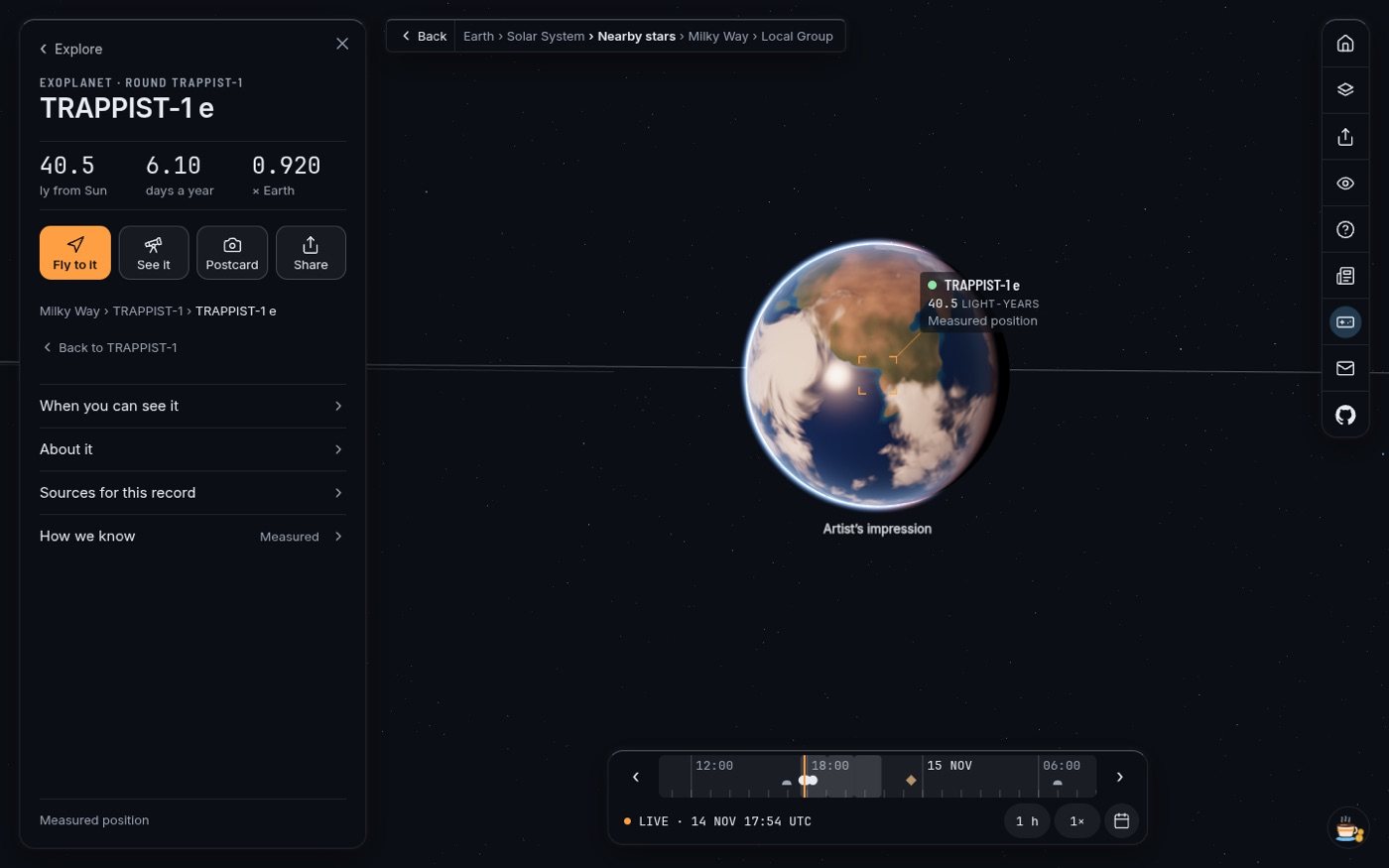
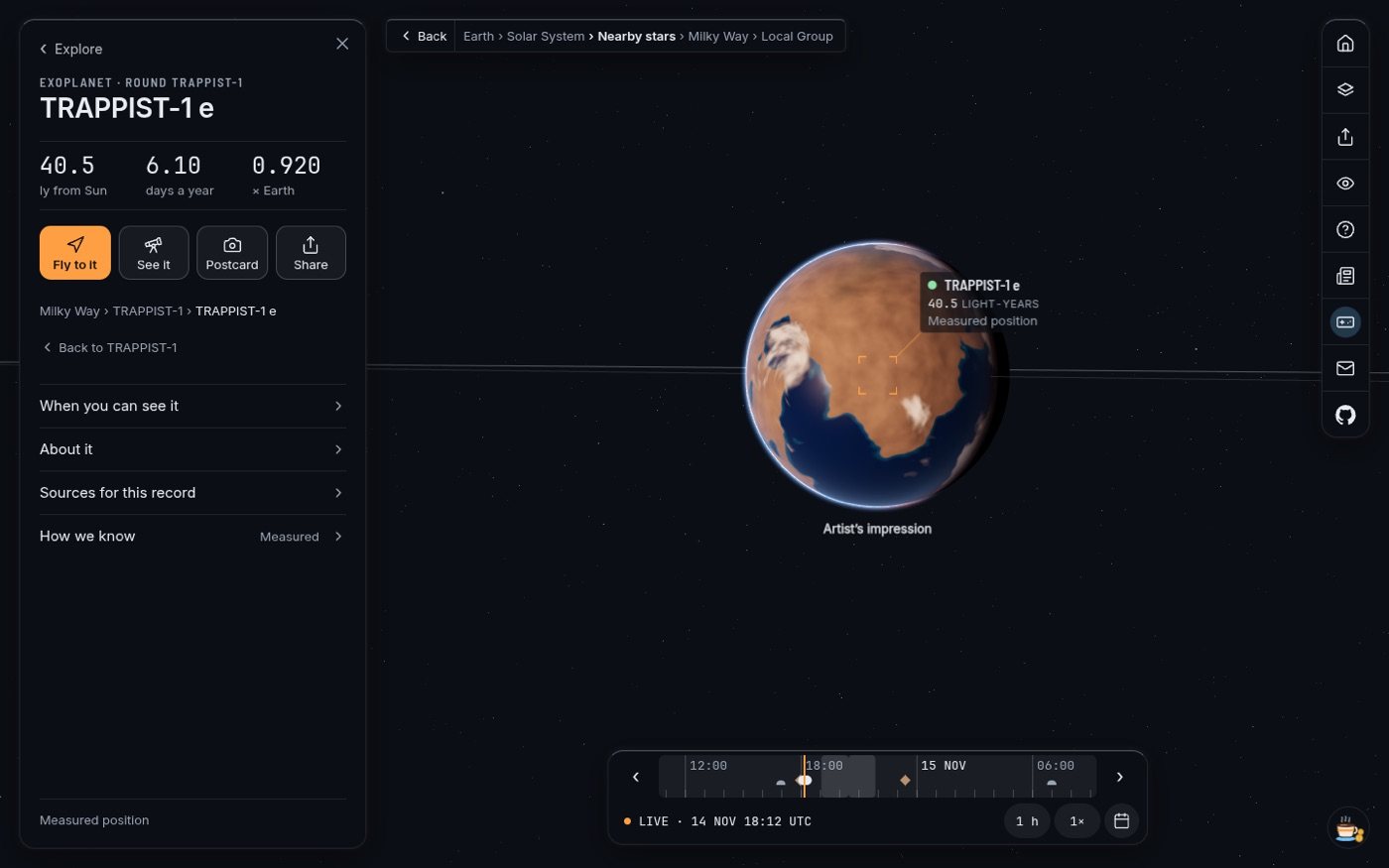
The TRAPPIST-1 e planet is drawn differently too. It is a rocky planet around a cool red star, 40.5 light-years away. Before, the map drew it as a second Earth, with seas and white cloud. A mild planet of a star under 4 000 K is now drawn mostly as rock, with a small share of sea and thin cloud. The change follows results from the Webb Space Telescope on the TRAPPIST-1 planets. Nobody has seen its surface, so the card still says “Artist’s impression”.
The Sun, Venus, comets and two satellites that look sideways#
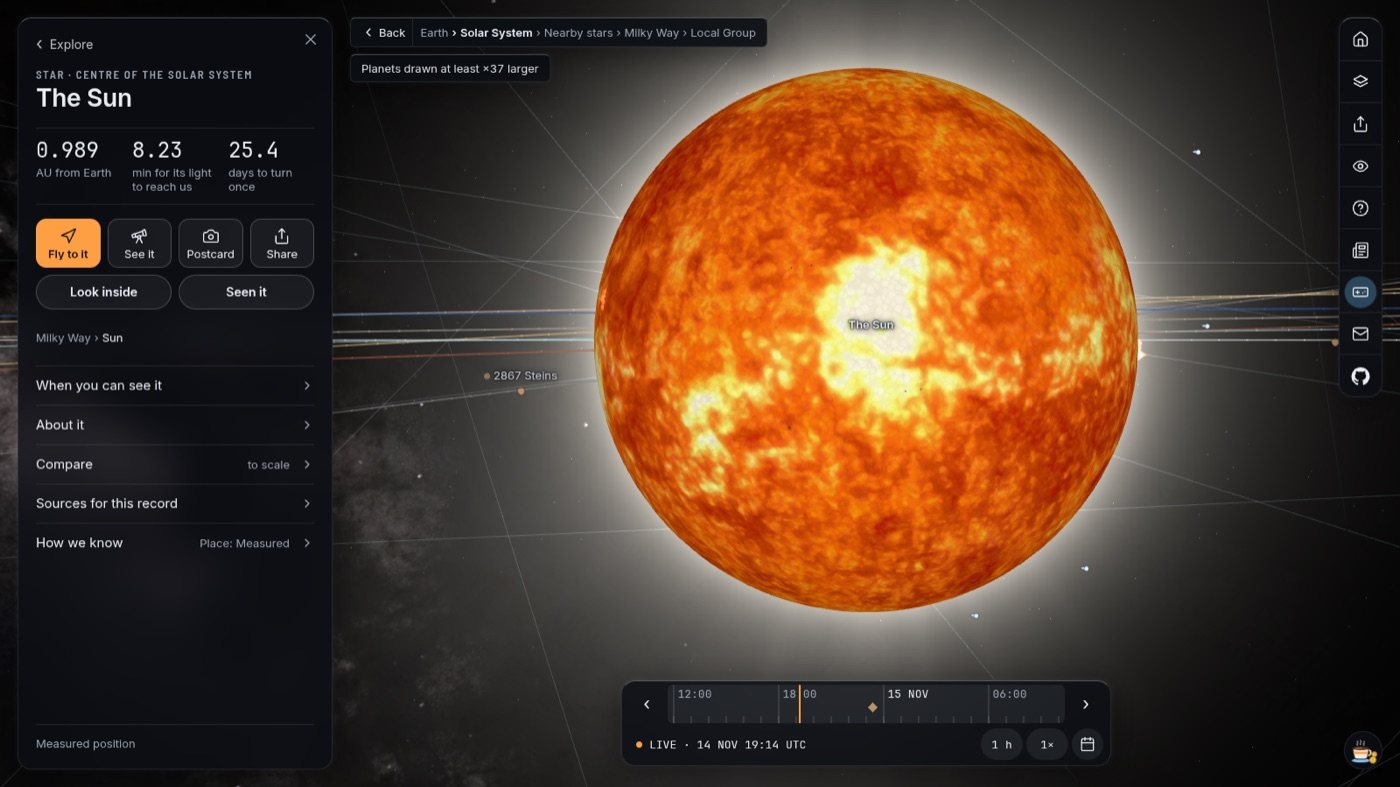
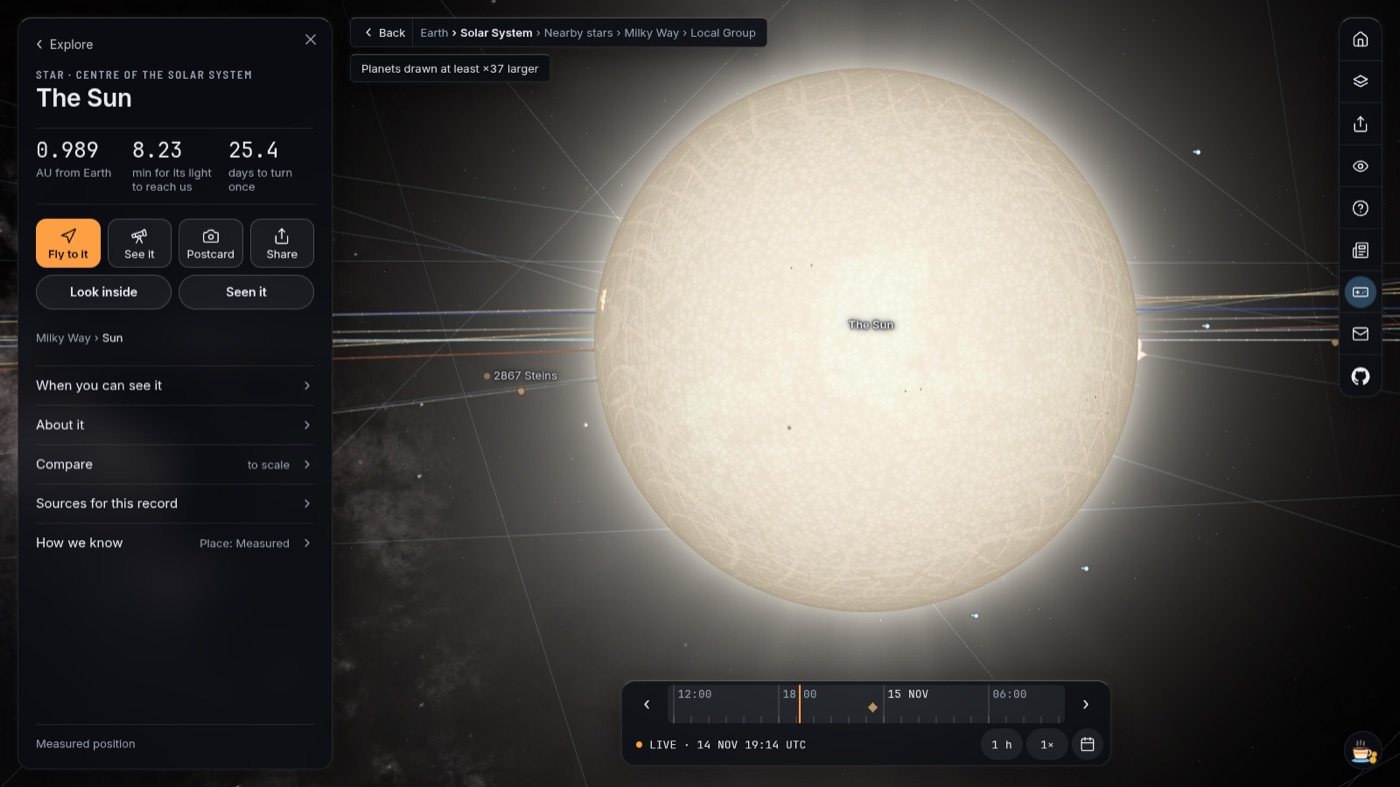
Above the atmosphere, the Sun looks white. It looks yellow or orange low in our sky because air scatters the blue out of its light. The map had drawn it as a big orange ball with dark blotches, from a texture that was not the colour the eye sees. The Sun is now one pale warm white with a faint mottle, and its card says the colour is the white the eye sees, not the orange many photographs are tinted. The texture is also much smaller to send: it went from 296 KB to 22 KB. (#1406)
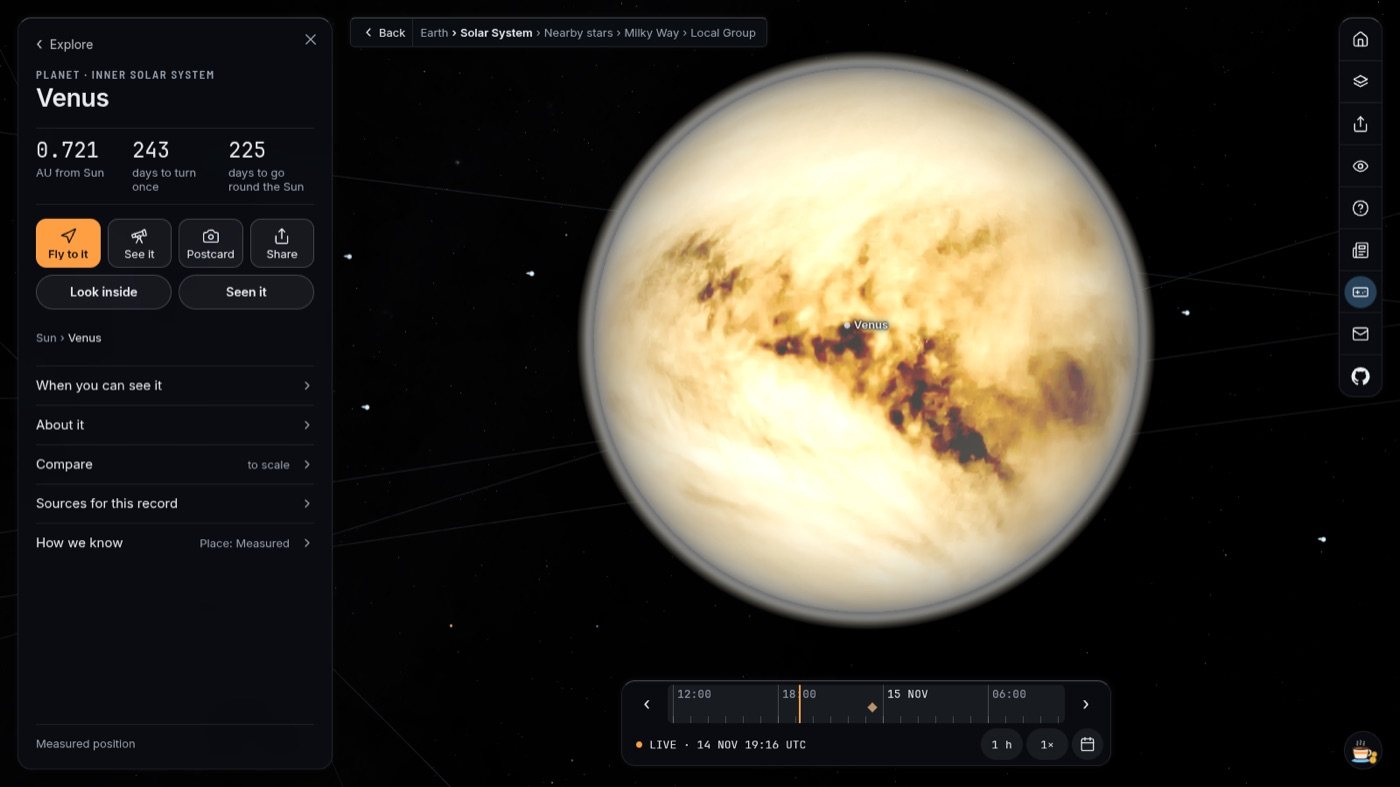
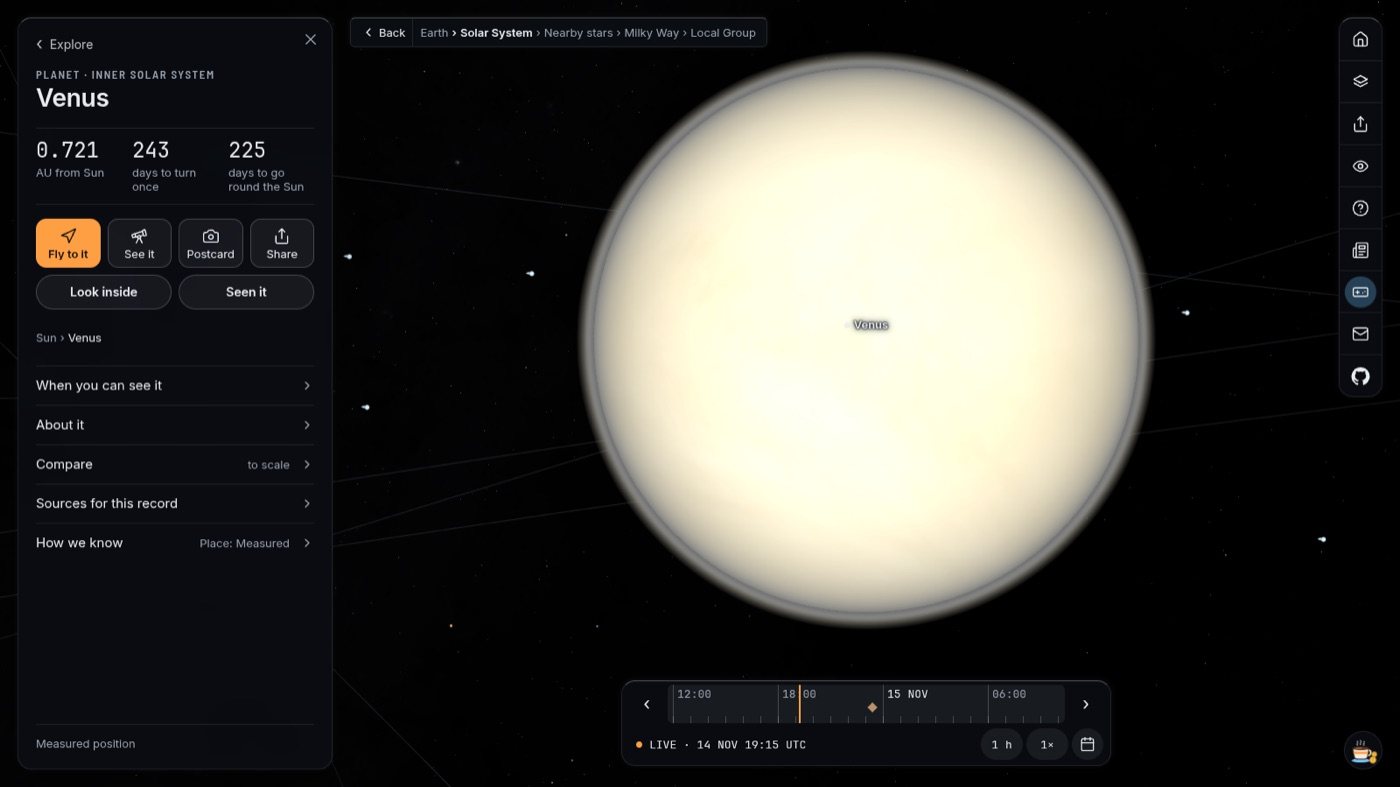
Venus was a cream disc with bold brown blotches. In visible light it is nearly plain, and the bands people know are seen in ultraviolet, so it is now drawn as a pale cream disc with faint streaks. The two card lines say the bands are ultraviolet and are not drawn.
Comet tails now brighten as a comet nears the Sun, and fade as it moves away. The tail’s brightness follows the inverse square of the distance from 0.8 au, with a floor so a tail never vanishes. We have not seen this on screen: our look run could not get a comet with a tail into view, so the rule is covered by tests only.
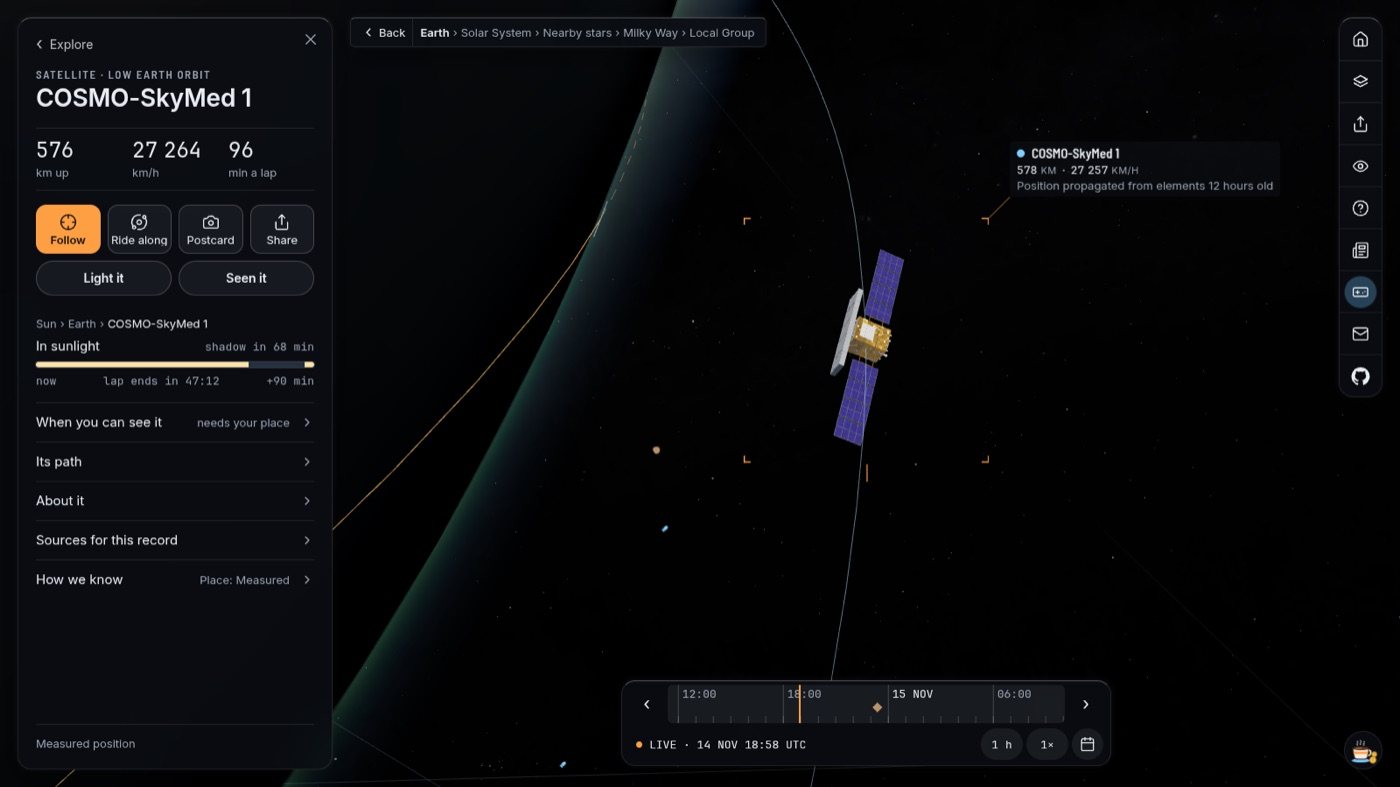
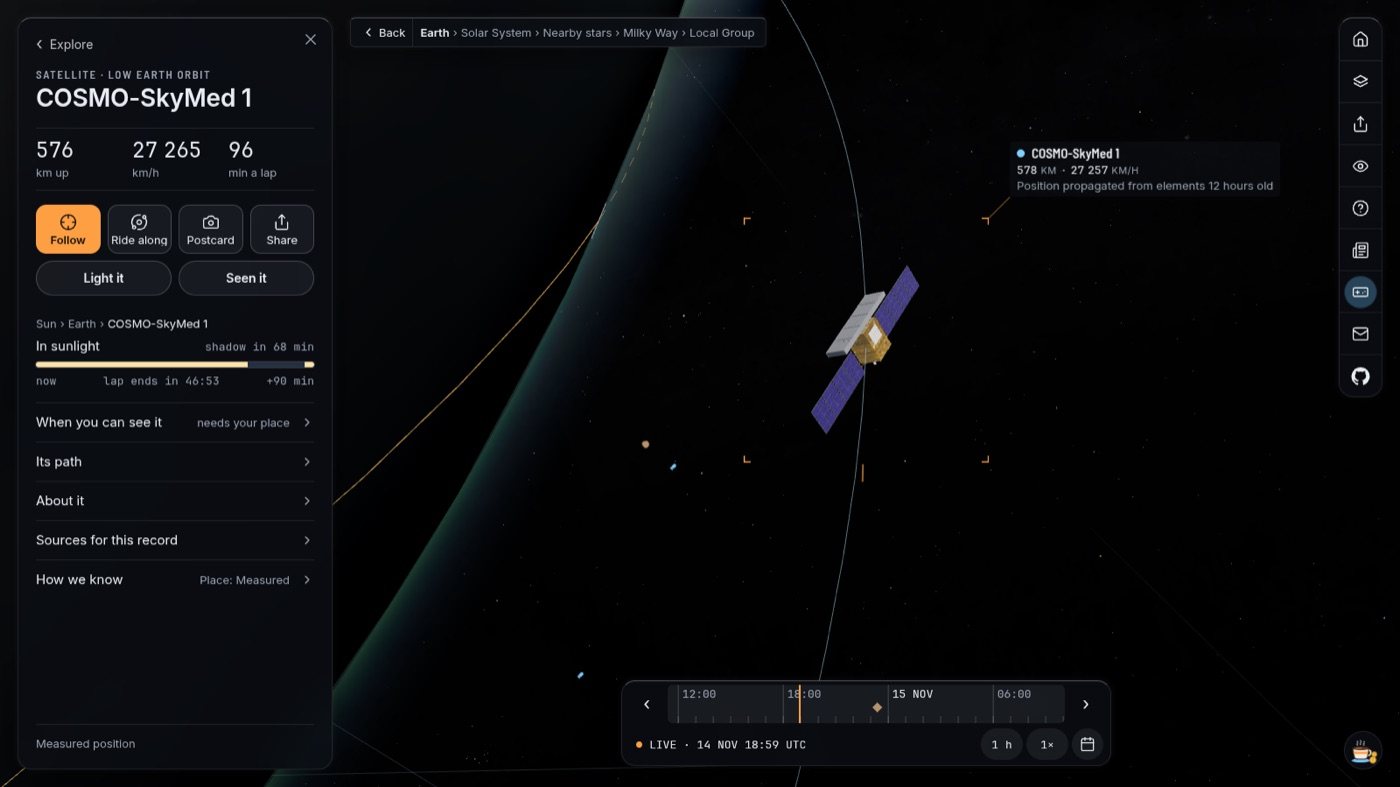
Two radar satellites now look sideways, as they do when they work. A radar imaging satellite does not look straight down. ALOS-2 is rolled 30 degrees, from the pointing angle published on eoPortal. COSMO-SkyMed 1 to 4 are rolled 34 degrees to the right of their track, worked out from the published incidence angle of 38 degrees at an altitude of 619.6 km. Other radar satellites, among them RADARSAT-2, the RADARSAT Constellation Mission, COSMO-SkyMed Second Generation and SAOCOM, stay level, because the pages we read give only a range of angles, not one.
Cards and Tonight, in plainer words#
A card is the panel that opens when you select an object. These changes make its words say what is true, and no more. (#1403)
- A star’s class in words. The class code now has a few words under it: “A0V, white mid-life star” or “M2Ib, red supergiant”. Brown and white dwarfs are named.
- Long years in Earth years. A card for a slow planet says “to go round the Sun, 29 Earth years” for Saturn, not only the number of days.
- What is measured and what is drawn. The “How we know” row says “Place: Measured”, and where the picture is a stand-in, as with exoplanets and generic shapes, “Place: Measured · Picture: Illustrative”. The words follow the Accuracy page: Measured, Modelled, Illustrative.
- Tonight’s best. A satellite pass of unknown brightness is no longer ranked. It stays in the list of passes.
- Tonight’s settings. The answer comes first, and the facing, height, lens, overlay, culture and light-pollution controls sit behind one “More sky settings” fold.
- Unfamiliar satellites. The headline pass gets a few words about the satellite when we have a sourced line for it.
- Smaller wording. The Planets size slider is “Extra size: none”, the Venus card no longer says rise times are not in this version, and the list is titled “The worlds, distance from Earth now”.
A caveat: the new groups of words are translated into all ten languages, but where we changed an existing English line, the other languages still carry the old wording until a translator updates it.
Euclid and five more meteor showers#
Euclid, the European Space Agency telescope that is mapping the dark Universe, is now on the map. It sits at the Sun-Earth L2 point, about 1.5 million kilometres from Earth on the side away from the Sun. Its path is JPL’s file, good to about 20 km. After 26 October 2026 that path is ESA’s prediction, which each station-keeping manoeuvre redraws. Its card gives the launch on 1 July 2023, the first full-colour pictures (ESA, 7 November 2023) and the first big data release, DR1-Foundation (ESA, 12 November 2026): about 13 months of observing, 1 900 square degrees of sky and over a billion objects. There is no 3D model of Euclid yet. (#1402)
The five meteor showers are the Alpha Capricornids, the Southern Delta Aquariids, the Draconids, and the Southern and Northern Taurids. Their activity, maximum, radiant, speed and rates come from the International Meteor Organization’s calendars for 2026 and 2027. The map now has 13 showers of its own, and no longer marks the same five twice from the IAU catalogue.
The pages are in 11 languages#
The map’s pages are now in ten languages besides English, from Spanish and French to Hindi and Arabic. They are machine translations checked by a second program, and no native speaker has read them yet. We wrote a separate post about it: Space Radar in 11 Languages. (#1404)
What is still not right#
- On the white Sun, the closer views show a faint network of pale lines. It was far less visible on the orange map. We have not fixed it.
- Venus still has a soft grey band inside its edge.
- The coronal loops on the Sun are still off. With them on they looked like small white dashes on the white disc, and they need a redesign.
- We have no picture of the comet tails changing, nor of the landing-site and search-box fixes.
- Euclid has no 3D model yet.
- The three-item key that explains the markers when a view first opens is not done, and a switch between seas and bare rock on TRAPPIST-1 e needs words in ten languages first.
Space Radar is free, runs in your browser and needs no account. Open the Andromeda link and fly in.
Questions people ask
Why is the Sun white in Space Radar?
Seen from above the atmosphere, the Sun looks white. It looks yellow or orange low in our sky because air scatters blue light out of its beam. Since mid-November 2026 the map draws the Sun as a pale warm white, with a faint mottle and a darker edge, and its card says so. Many photographs are tinted orange, which is not what the eye sees.
How do I link to the Andromeda Galaxy on a map?
Open the Andromeda Galaxy card on Space Radar and press Share, or use the address www.spaceradar.ai/#at=dso-m31&stage=local-group. Since 14 November 2026 the link, and the “Fly to it” button on any galaxy, cluster or nebula, arrives close enough to see the object: for Andromeda, a radius of about 367 px instead of 75 px.
Is Euclid on the Space Radar map?
Yes, since 14 November 2026. Euclid is drawn on its path at the Sun-Earth L2 point, and its card gives the launch, its first pictures and the data release of 12 November 2026. It is a point and a path for now, as there is no 3D model of it yet. Open it at www.spaceradar.ai/#at=deep-euclid.
What does “Place: Measured · Picture: Illustrative” mean?
It is the badge on an object’s card. “Place: Measured” means where the object is comes from real measurements. “Picture: Illustrative” means the image is a stand-in drawn to show the kind of object, not a photograph or a measured shape. The words follow the Accuracy page: Measured, Modelled, Illustrative.
Is TRAPPIST-1 e a second Earth?
Nobody knows. It is a rocky planet about the size of Earth, 40.5 light-years away, around a cool red star. Space Radar draws it as a mostly rocky world with thin cloud and a small share of sea, and labels the picture an artist’s impression. Its surface has not been seen.
Which meteor showers does Space Radar show?
The map has 13 showers of its own, including the Alpha Capricornids, Southern Delta Aquariids, Draconids, Southern Taurids and Northern Taurids, added in mid-November 2026. Dates, radiants and rates come from the International Meteor Organization’s calendars.
What are ALOS-2 and COSMO-SkyMed?
They are radar imaging satellites. A radar satellite looks to one side of its track, not straight down, so on Space Radar ALOS-2 is tilted 30 degrees and COSMO-SkyMed 1 to 4 are tilted 34 degrees, from published angles.
Sources
- Links and first screens: Andromeda link, deep-sky arrival, lit landings (PR 1401) github.com
- Sky and stage drawing fixes (PR 1405) github.com
- Cards and Tonight wording (PR 1403) github.com
- Registry rows with sources: five meteor showers and Euclid (PR 1402) github.com
- Looks: a white Sun, a pale Venus, comet tails, radar satellites (PR 1406) github.com
- ESA: Euclid lays the foundation for its best-ever 3D map of the Universe ESA
- ESA: Euclid ESA
Explore on Space Radar
Keep reading
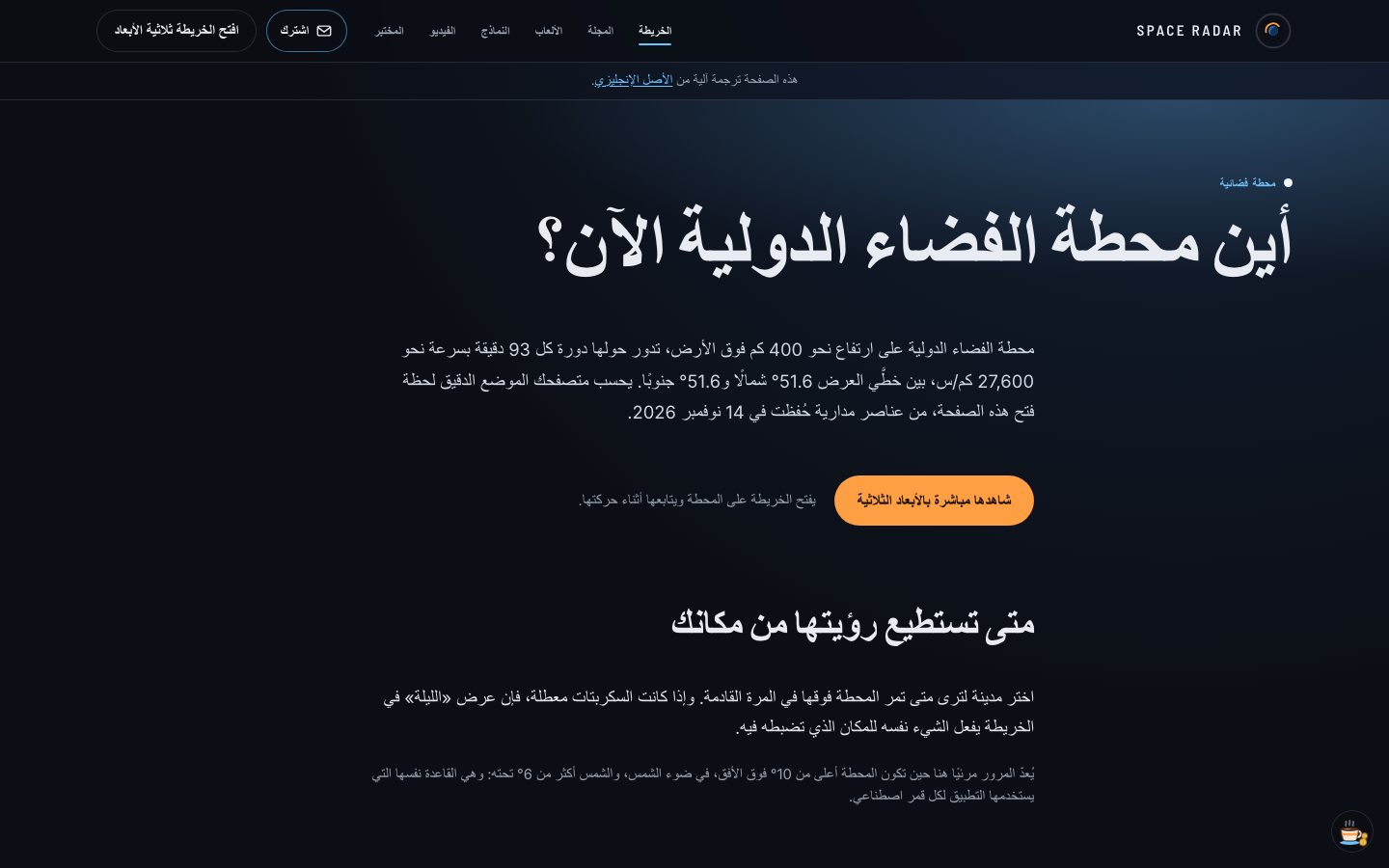
Space Radar in 11 Languages: The Map and Its Pages in Spanish, Hindi, Arabic and More
The pages of the free 3D map that search engines read are now in Spanish, French, German, Brazilian Portuguese, Russian, Ukrainian, Simplified Chinese, Hindi, Hebrew and Arabic, as well as English. They are machine translations that a second program checked, and no native speaker has read them yet. Here is what is translated, what is not, and how you can help.
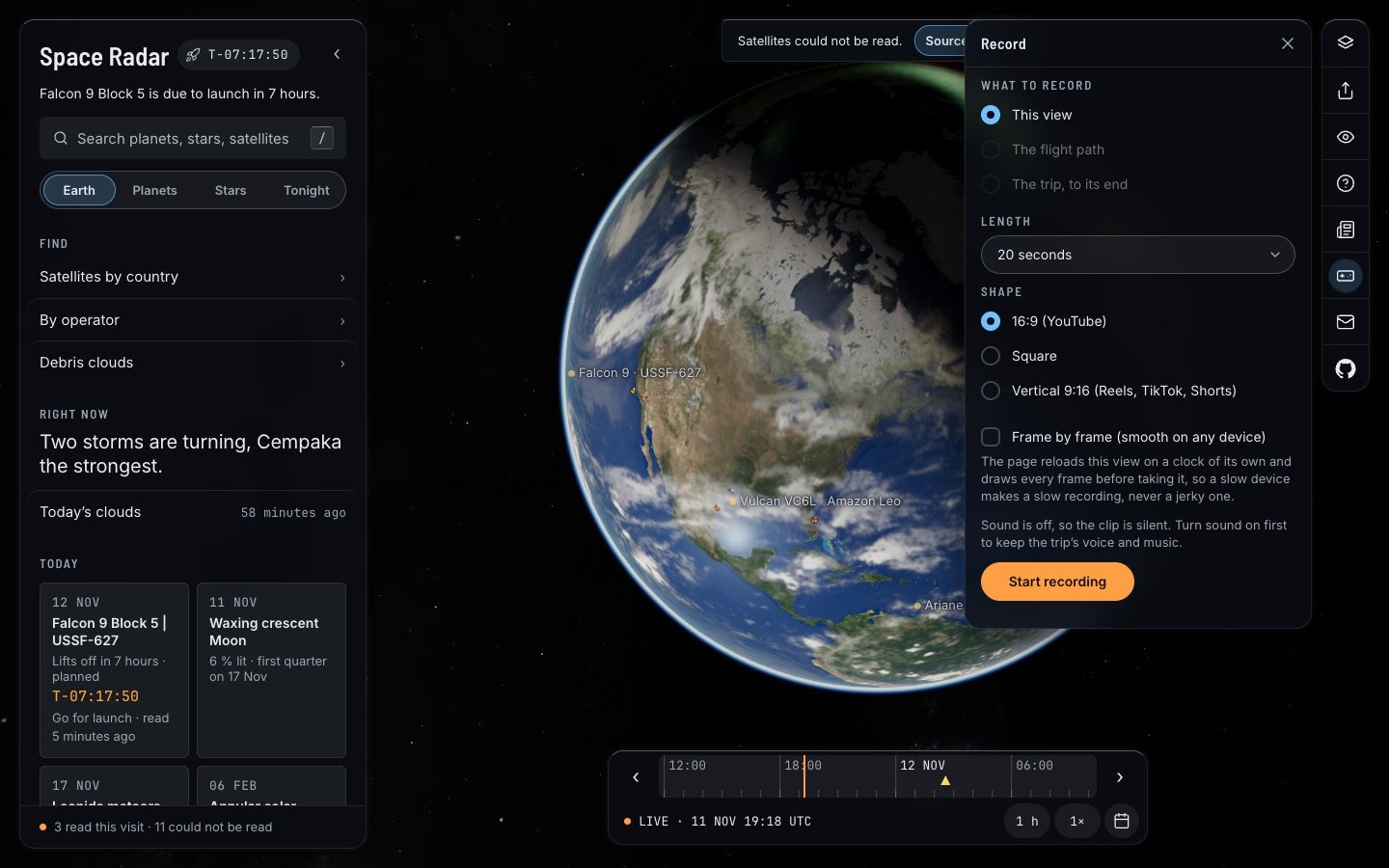
One Design for the Space Radar Map and Every Site: Bigger Targets, Clearer Choices
Every button, choice and panel on the 3D map now comes from one small set of controls, the same set the journal, games, models and video sites use. Here is what changed for you: targets a finger can hit, a focus ring you can see, motion that stays still when you ask, and one orange button that tells you what to do next.
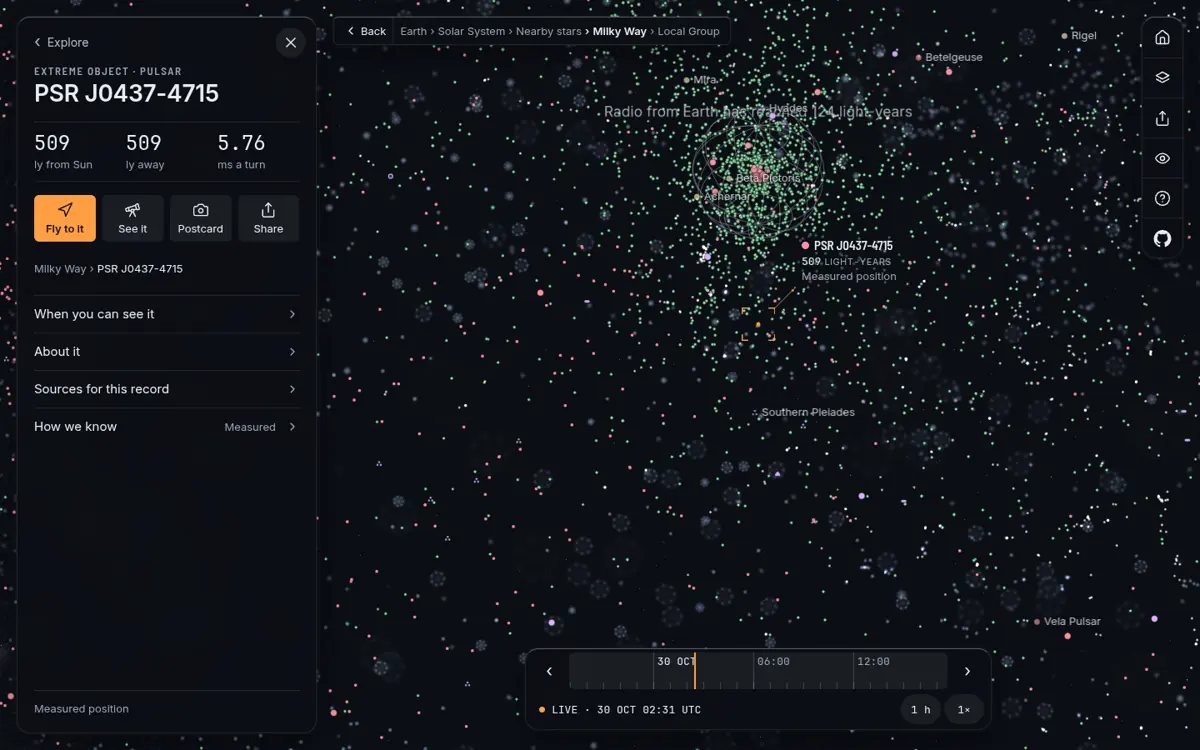
Stars with no distance, 4 383 pulsars and the farthest galaxy
Release 1.5.0 fills the sky with what the catalogues know, and says on every card how a distance was found, or that it never was.