
Who Is Talking to Whom: the Deep Space Network, Live, and Light Time
Three groups of giant dishes, in California, Spain and Australia, keep in touch with almost every spacecraft beyond the Moon. Space Radar now shows which dish is talking to which craft, draws the lines on the map, and says how long each message takes to get there.
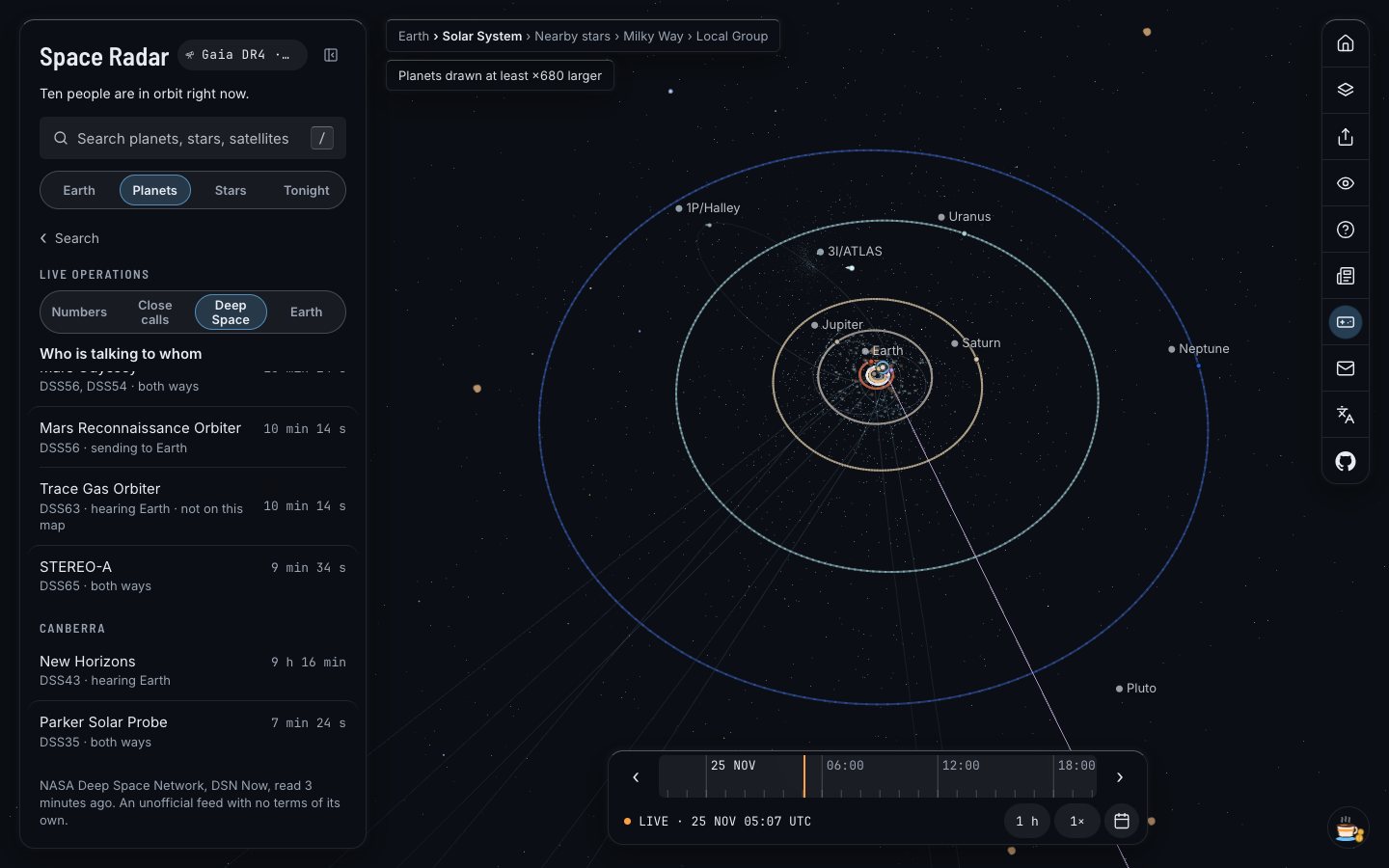
25 November 2026, about 05:07 UTC: the lines from the Earth to the craft the dishes were talking to. The long one is New Horizons, 9 hours 16 minutes away at the speed of light. Space Radar (MIT). Contacts: NASA Deep Space Network, DSN Now. Positions: NASA JPL Horizons.
Almost every spacecraft beyond the Moon talks to Earth through one network: NASA's Deep Space Network, three groups of big radio dishes at Goldstone in California, near Madrid in Spain and near Canberra in Australia. At five past five in the morning, UTC, on 25 November 2026, those dishes were in touch with nine craft, from two around the Moon to New Horizons, whose radio signal took 9 hours and 16 minutes to arrive. Space Radar now shows that live: who is talking to whom, a line on the map for each contact, and how long each message is on its way.
Three complexes, a third of the world apart#
The three sites are spaced about 120 degrees apart in longitude, NASA explains, so that as the Earth turns a distant craft never sets for all of them at once: before it drops below one site's horizon, the next has it. Each site has at least four antennas, and each has one giant, a dish 70 metres across.
NASA publishes what the dishes are doing, minute by minute, on a page called DSN Now, from a small data file behind it. For every dish it lists the target, whether a signal is going up to the craft, coming down from it, or both, the radio band, the data rate and the distance. Space Radar reads that file every five minutes, keeps a copy, and turns it into the Deep Space tab of a new sidebar view, Live operations.
One morning's contacts#
This is what the tab listed at about 05:05 UTC on 25 November 2026. The times are one way, at the speed of light.
| Complex | Craft | Dish | One way |
|---|---|---|---|
| Goldstone | Korea Pathfinder Lunar Orbiter | DSS23 | 1.2 s |
| Goldstone | Lunar Reconnaissance Orbiter | DSS24 | 1.2 s |
| Goldstone | MMS 4 | DSS26 | 0.6 s |
| Madrid | Mars Odyssey | DSS56, DSS54 | 10 min 14 s |
| Madrid | Mars Reconnaissance Orbiter | DSS56 | 10 min 14 s |
| Madrid | Trace Gas Orbiter | DSS63 | 10 min 14 s |
| Madrid | STEREO-A | DSS65 | 9 min 34 s |
| Canberra | New Horizons | DSS43 | 9 h 16 min |
| Canberra | Parker Solar Probe | DSS35 | 7 min 24 s |
A few things stand out. One Madrid dish, DSS56, was serving several Mars craft at once. The same 70-metre dish at Canberra, DSS43, that NASA pictures on its overview page was listening to New Horizons. Some dishes had no craft at all: in the same feed three were listed for engineering work, one for maintenance, and two were pointed at test targets. The tab leaves those out, because they are not contacts.
The data rates tell their own story. In our copy of 04:38 UTC, the Mars Reconnaissance Orbiter was sending 3 million bits a second through Madrid. New Horizons was sending 793.6 bits a second through Canberra, from more than 66 times the Earth's distance from the Sun.
How the light time is worked out#
There is nothing clever in it, and that is the point. The feed gives each target's range in kilometres. Divide by the speed of light, 299 792.458 km/s, and you have the one-way light time. For the Mars orbiters, 184 000 000 km ÷ 299 792.458 km/s = 613.8 seconds, or 10 minutes 14 seconds. When a range is missing, the map uses half the round-trip time the feed also gives.
One honest wrinkle: the feed rounds its ranges to three figures. All three Mars craft show exactly 184 000 000 km, and New Horizons shows 10 000 000 000 km. That is why the map says 9 h 16 min while JPL Horizons, with New Horizons 66.806 astronomical units away on 24 November, works out 555.6 minutes, which is 9 h 15 min 36 s. The difference is under a tenth of a per cent. The number is the DSN's, not ours, and we have left it as they give it.
Lines on the map#
A button above the list, Lines on the map, draws a straight line from each complex, on the turning Earth, to wherever the map puts the craft it is talking to. On the Earth view the far end would be out of the picture anyway, so each line stops about 40 000 km out, roughly six Earth radii, but points the true way. Zoom out to the Solar System and the lines reach the craft themselves: a short one to Mars, and one long thread out past Neptune and Pluto to New Horizons.
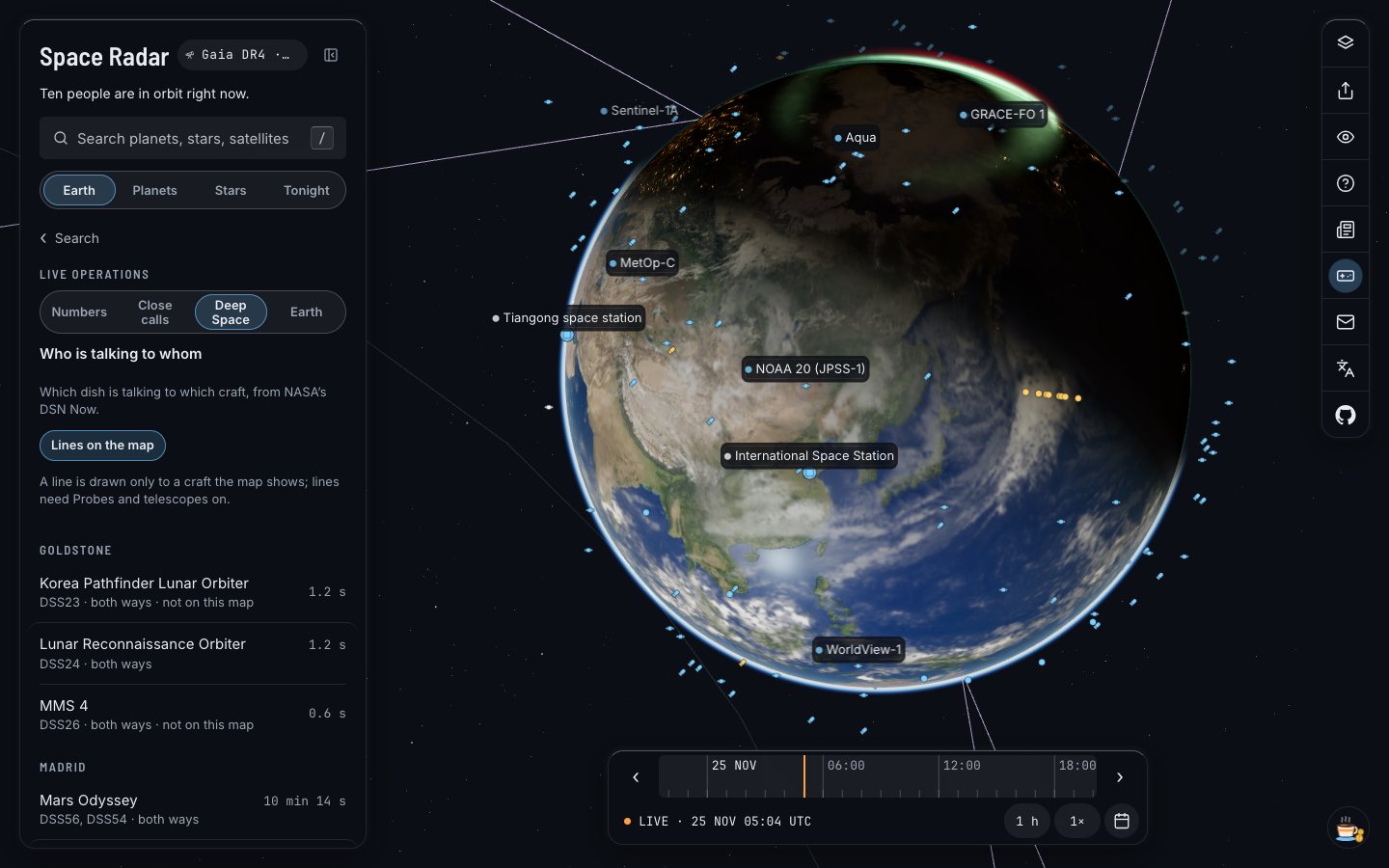
A line is drawn only to a craft the map itself shows, which needs the Probes and telescopes layer on. The Korea Pathfinder Lunar Orbiter, MMS 4 and the Trace Gas Orbiter were in contact that morning but have no path on the map yet, so the list names them and marks them “not on this map” instead of drawing a line to a guess. And a line is a direction, not a moving signal: the list says how long the light takes; the line just shows where it goes.
Waiting for the answer#
Light time is why a spacecraft far away has to look after itself. Anyone on Earth who asks a Mars orbiter a question waits more than 20 minutes for the reply. Nobody can steer New Horizons in real time: anything it is told arrives more than nine hours later, and the answer as long again. Voyager 1 passed one light-day from Earth on 18 November 2026, 25.902 billion km away; we told its story in where is Voyager 1 now.
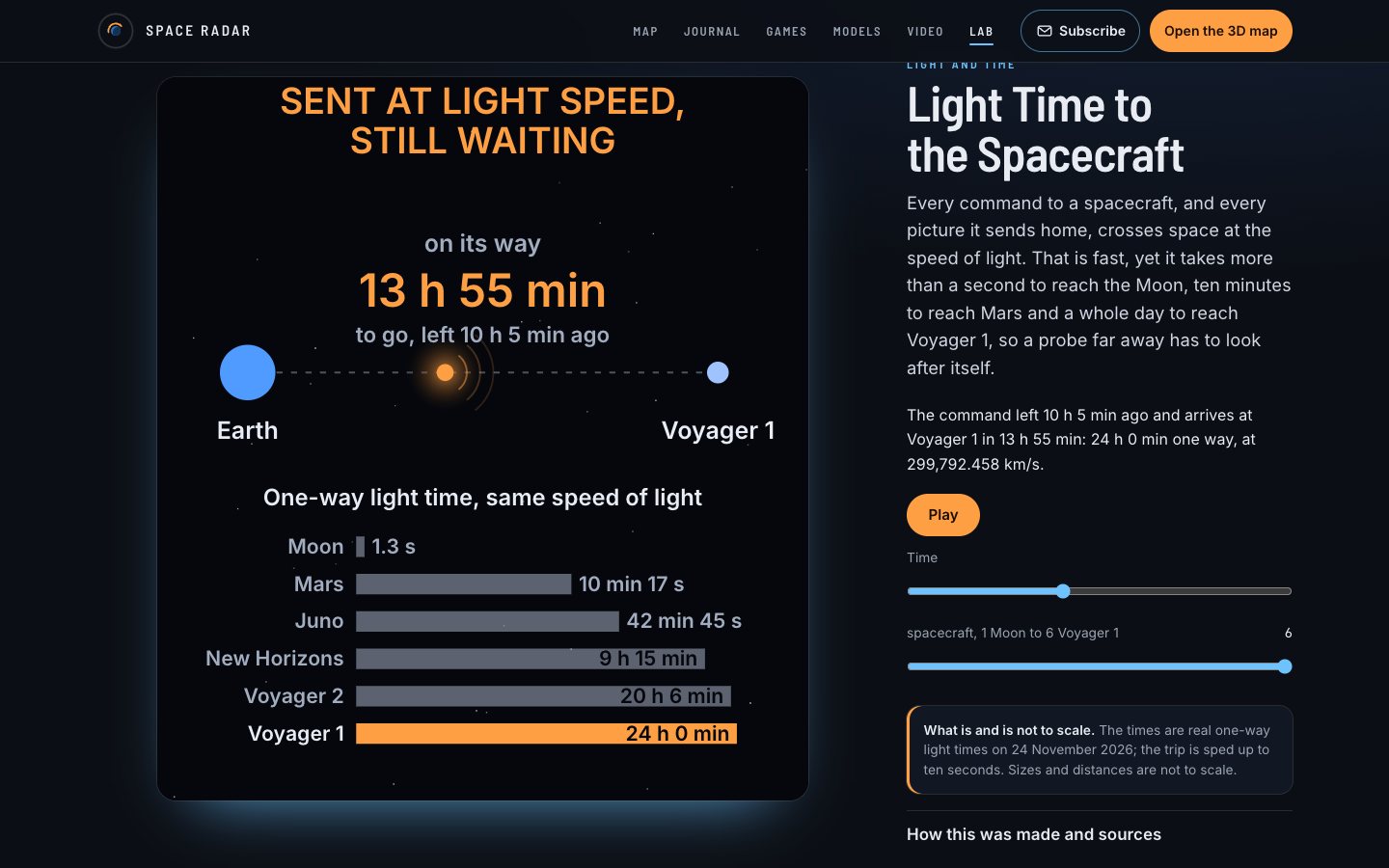
To feel the difference, the Lab has a new simulator, Light Time to the Spacecraft. Pick a target, from the Moon to Voyager 1, and watch a command leave the dish and cross the gap, sped up to ten seconds, with the real one-way times underneath: 1.3 seconds to the Moon, about 10 minutes to Mars, 42 minutes to Juno at Jupiter, 9 hours 15 minutes to New Horizons, 20 hours 6 minutes to Voyager 2 and 24 hours to Voyager 1, from JPL Horizons on 24 November 2026.
Questions people ask
What is the Deep Space Network?
NASA's Deep Space Network is three groups of large radio dishes, at Goldstone in California, near Madrid in Spain and near Canberra in Australia, about 120 degrees apart in longitude. As the Earth turns, at least one of them can see a distant spacecraft, so missions can stay in touch all day. Each site has one dish 70 metres across and several smaller ones.
How long does a signal take to reach New Horizons?
About 9 hours and 16 minutes one way in late November 2026. JPL Horizons put New Horizons 66.8 astronomical units from the Earth on 24 November 2026, which light crosses in 555.6 minutes. A command and its answer take more than 18 hours.
How long does a message take to reach Mars?
It depends on where the two planets are. On 25 November 2026 NASA's DSN feed gave the range to the Mars orbiters as 184 million km, about 10 minutes 14 seconds one way at the speed of light, so a question and its answer take more than 20 minutes.
Can I see which spacecraft the DSN is talking to right now?
Yes. NASA's DSN Now page shows it, and Space Radar's Deep Space tab under Live operations lists the same contacts by complex, with the one-way light time to each craft and a button that draws a line on the map from each complex to the craft it hears.
Sources
- What is the Deep Space Network? NASA The three complexes about 120 degrees apart in longitude, at least four antenna stations each, one 70-metre dish at each site, DSS-43 at Canberra. Read 25 November 2026.
- DSN Now NASA JPL The live feed (dsn.xml) behind every contact, range and data rate here, read on 25 November 2026 between 04:38 and 05:07 UTC; craft names from its config.xml. An unofficial feed with no terms of its own.
- JPL Horizons NASA JPL Distances and one-way light times on 24 November 2026 for Mars, Juno, New Horizons and the Voyagers, as the Lab simulator cites them.
- Astrodynamic parameters NASA JPL The speed of light, 299 792.458 km/s, and the astronomical unit, 149 597 870.7 km.
- Where are Voyager 1 and Voyager 2 now? NASA Voyager 1 one light-day from Earth, 25.902 billion km, on 18 November 2026.
- NASA Moon Fact Sheet NASA NSSDCA The Moon's mean distance, 384 400 km.
- Light Time to the Spacecraft Space Radar Lab The simulator and its sources, read 24 November 2026.
Explore on Space Radar
Keep reading
Where Is Voyager 1 Now? The Farthest Things We Threw
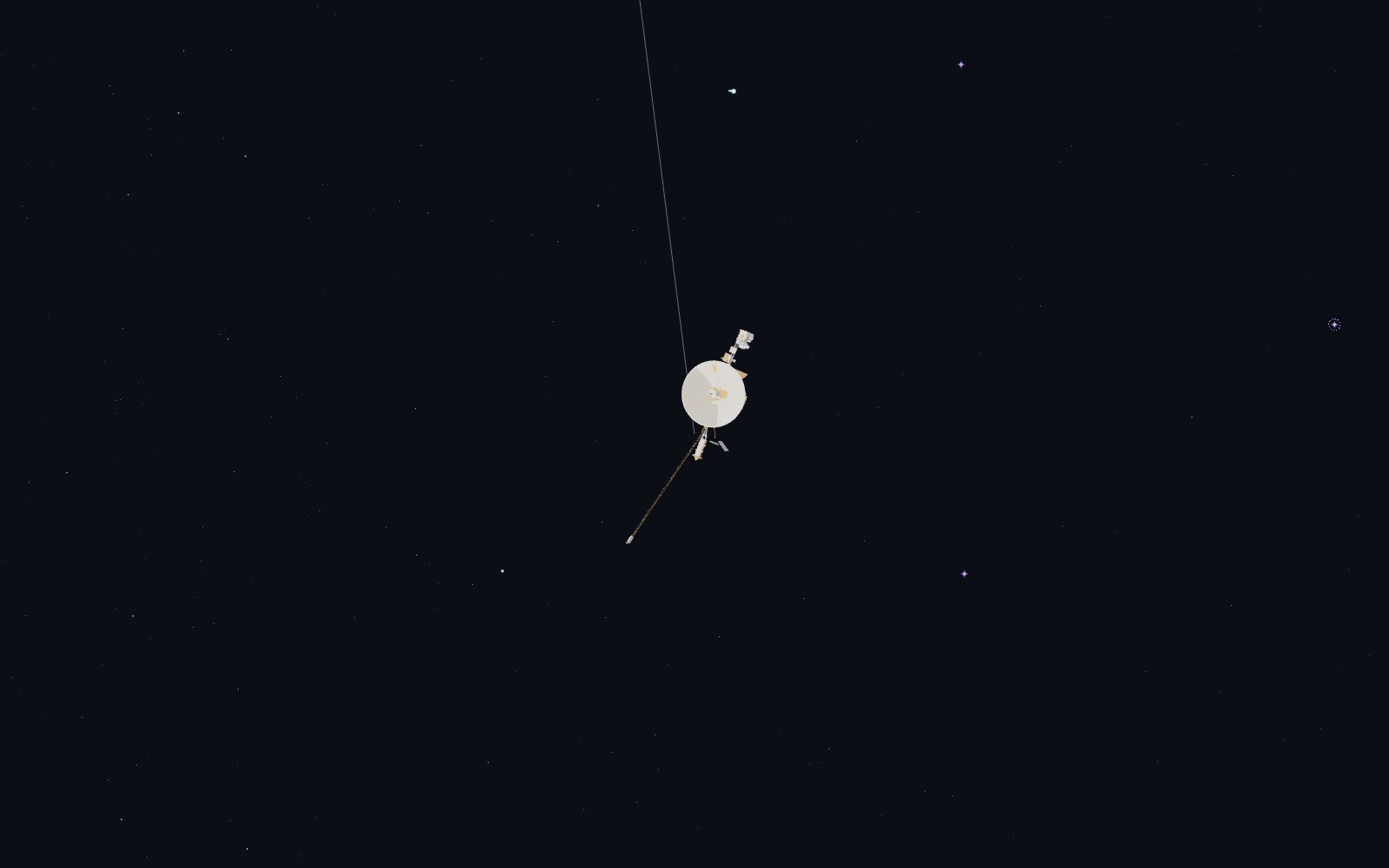
Where is Voyager 1 now? Almost exactly one day away at the speed of light, and still answering. A short tour of the farthest things people have thrown, and of the people who never stopped listening.
New Horizons at Pluto: When Was Closest Approach, and How Close?
New Horizons passed Pluto on 14 July 2015 at about 12,500 km and 13.8 km/s. NASA’s timetable and JPL’s track disagree on the second by 88 seconds, and a 3D replay has to show both.
Curiosity’s Landing: The Seven Minutes of Terror, Step by Step
Curiosity’s entry, descent and landing took 7 minutes 11 seconds on 6 August 2012. Here is the clock JPL published, the heights and speeds NASA gave, and what a 3D replay has to fill in between them.