
Where Is Voyager 1 Now? The Farthest Things We Threw
Where is Voyager 1 now? Almost exactly one day away at the speed of light, and still answering. A short tour of the farthest things people have thrown, and of the people who never stopped listening.
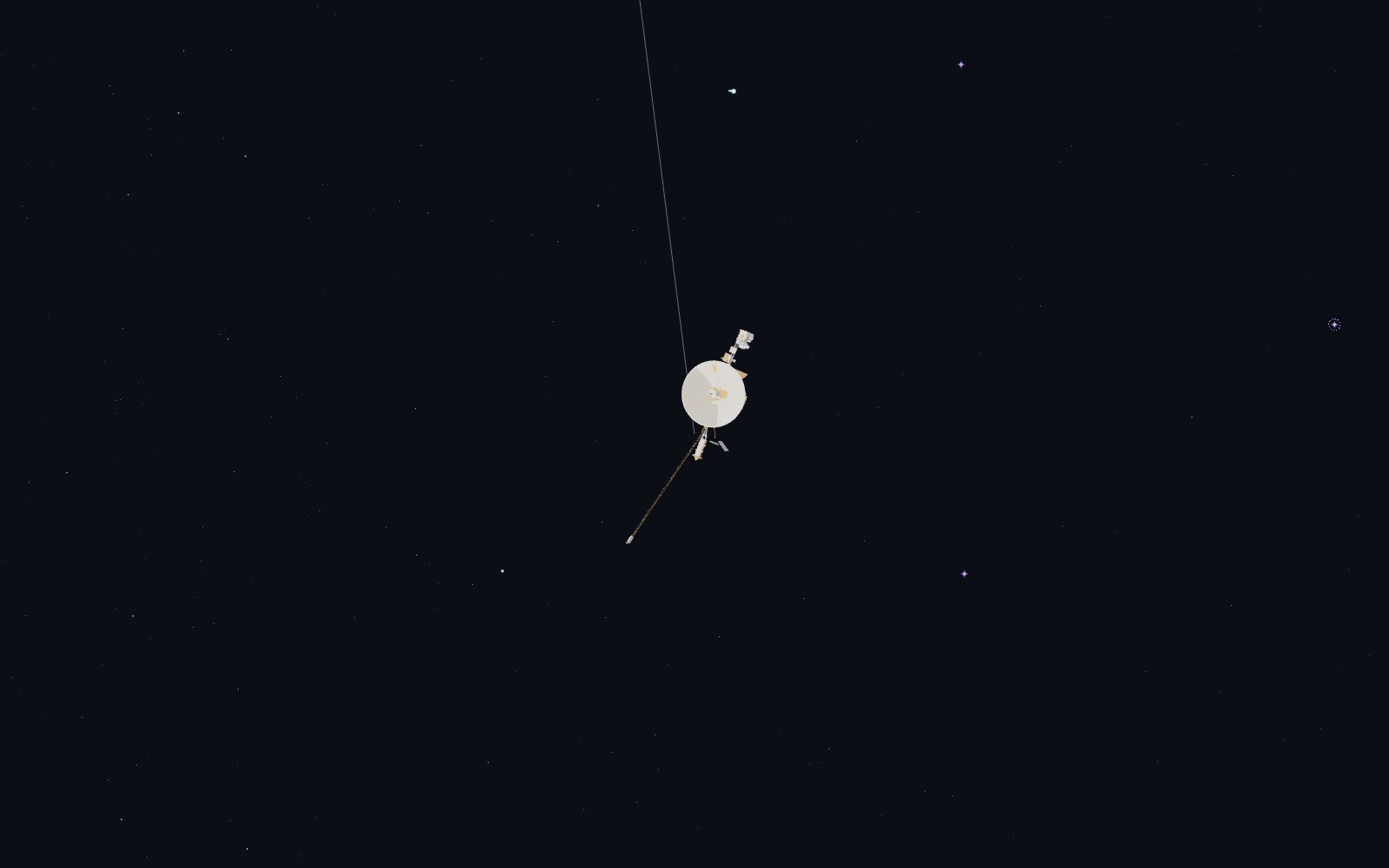
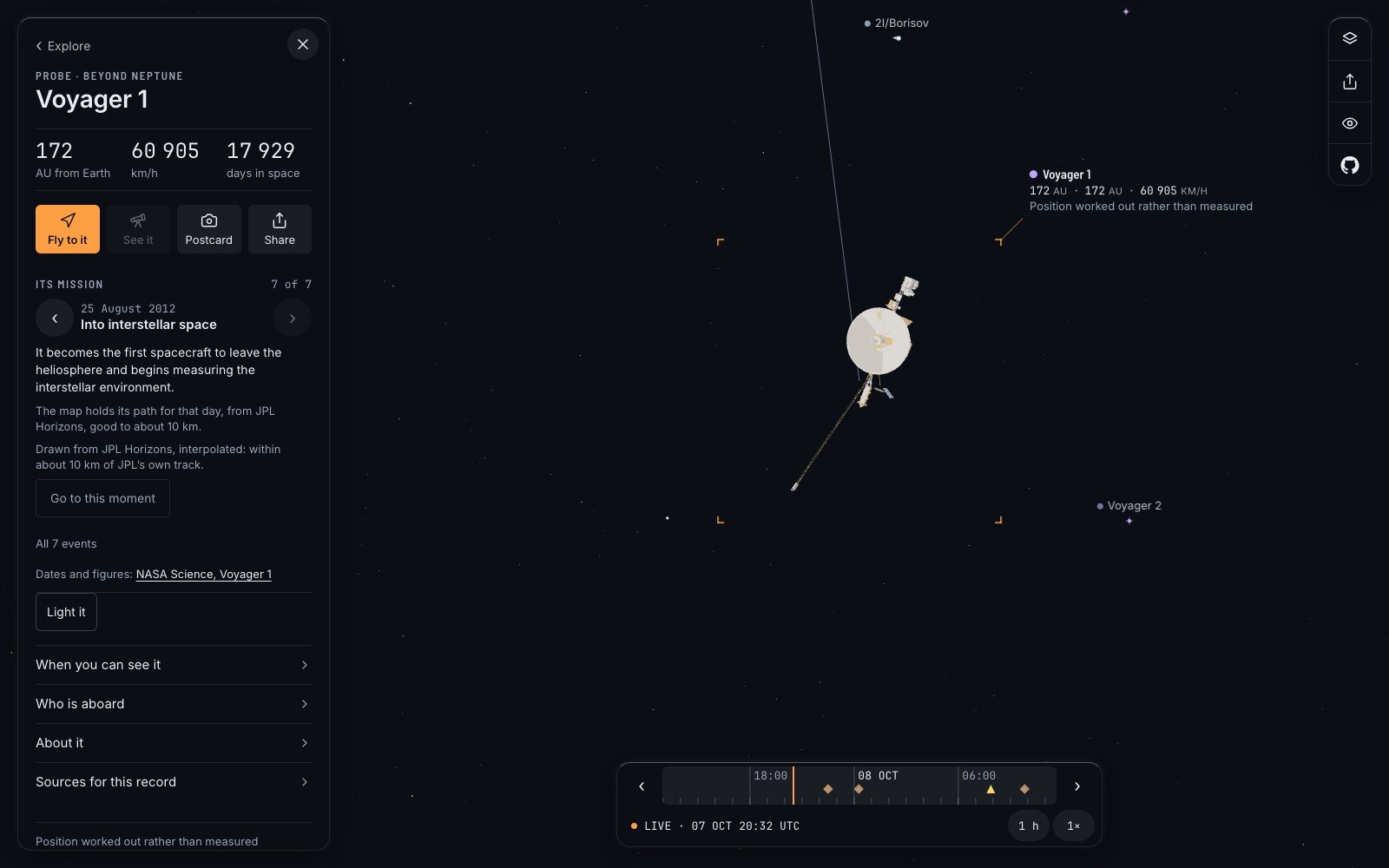
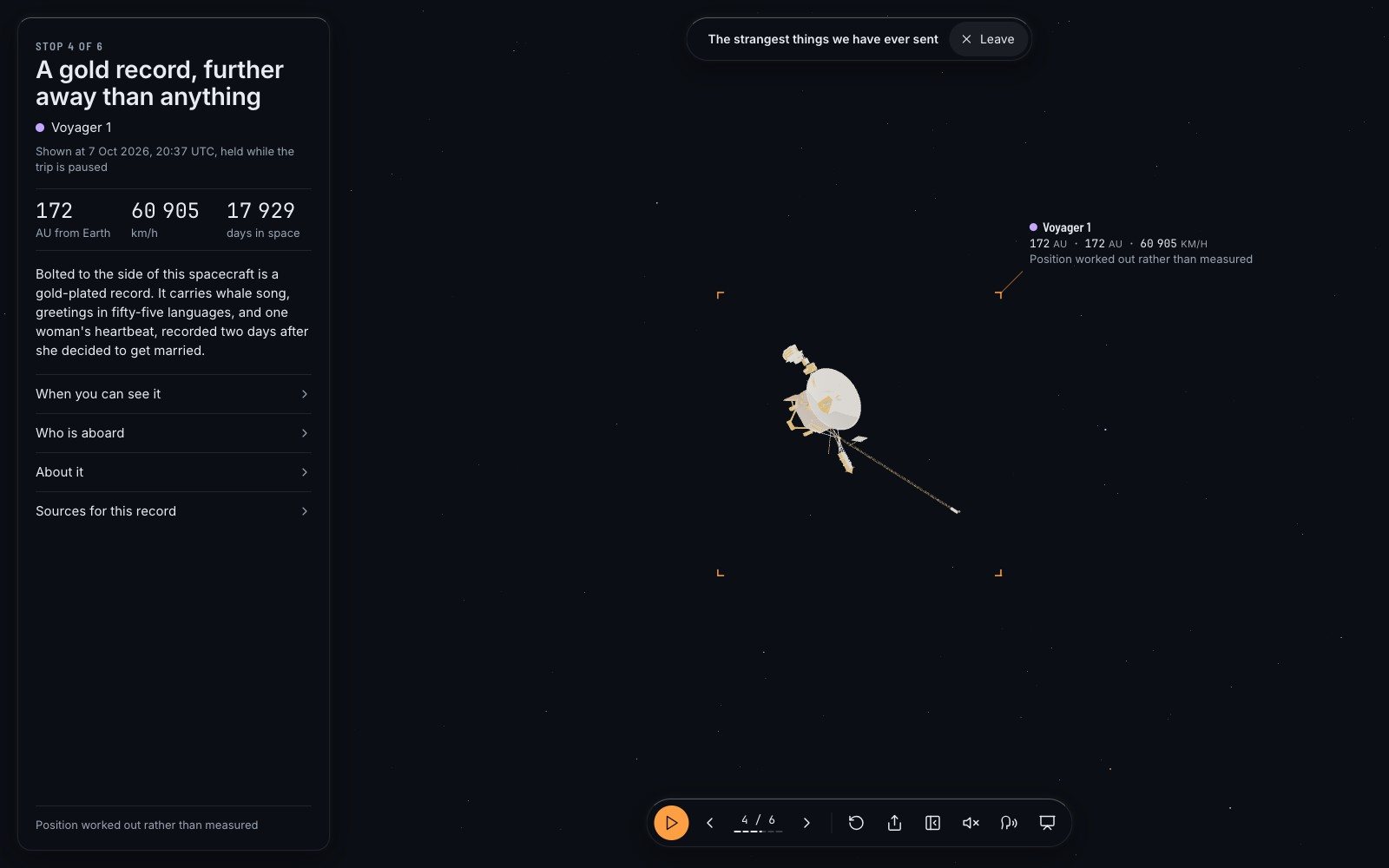
Voyager 1 as it is today, 172 times the Earth’s distance from the Sun. The dish, 3.7 metres across, is kept pointed at the Earth, which from there is lost in the glare of one very bright star: the Sun.
Suzanne Dodd has a way of explaining her job. If she says good morning to Voyager 1 at eight o’clock on a Monday, she told CNN last winter, she gets its answer at about eight o’clock on Wednesday.
Dodd manages the Voyager project at NASA’s Jet Propulsion Laboratory in California. The machine she is talking to left Florida on 5 September 1977. It weighs less than a small car, and its computers run more than a million times slower than the phone in your pocket. And on Wednesday 18 November 2026, at 10:16 in the morning Universal Time, it will pass a mark nothing built by people has ever reached: 25.9 billion kilometres from the Earth, the distance a radio signal covers in exactly twenty-four hours. One light-day.
So where is Voyager 1 now? In early October 2026 it is about 25.8 billion kilometres away, six minutes short of that line, and leaving at 17 kilometres every second. This piece is about what such a distance means, about the handful of other things we have thrown that far or left parked on the way, and about the people who have spent whole careers listening to one machine. I followed them on Space Radar, a free live map that draws each of them where it has been computed to be today.
A day away, at the speed of light#
Kilometres stop meaning anything long before Voyager. Time is the better ruler. Radio travels at the speed of light, so measure everything by how long a hello takes.
The Moon is 1.3 seconds away. The Webb telescope is five seconds. The Sun is eight minutes and twenty seconds, which means that if it went out you would have time to make a coffee before you knew. New Horizons, the probe that flew past Pluto, is nine hours out. Voyager 2 is about twenty. And Voyager 1, in a few weeks, will be a full day: you can see where Voyager 1 is right now, with its distance, its speed and the number of days it has been travelling.
- 23 h 54 minThe time a radio signal takes to reach Voyager 1 in early October 2026. On 18 November it becomes 24 hours.
It took 49 years to get one light-day from home. The nearest star is 4.2 light-years away. At Voyager’s pace that distance would take about 75,000 years, and Voyager is not even pointed that way. The farthest thing we ever threw has, on the scale of the galaxy, barely left the porch.
The farthest thing we ever threw has, on the scale of the galaxy, barely left the porch.
A fridge bulb, heard from interstellar space#
Here is the part that should not work. Voyager’s transmitter puts out about 23 watts, which NASA likes to compare to the light bulb in a refrigerator. By the time that signal has spread across 25 billion kilometres there is almost nothing left of it. NASA’s own comparison is that a digital watch runs on twenty billion times more power than a receiving dish collects from Voyager, and that figure dates from when the spacecraft was much closer.
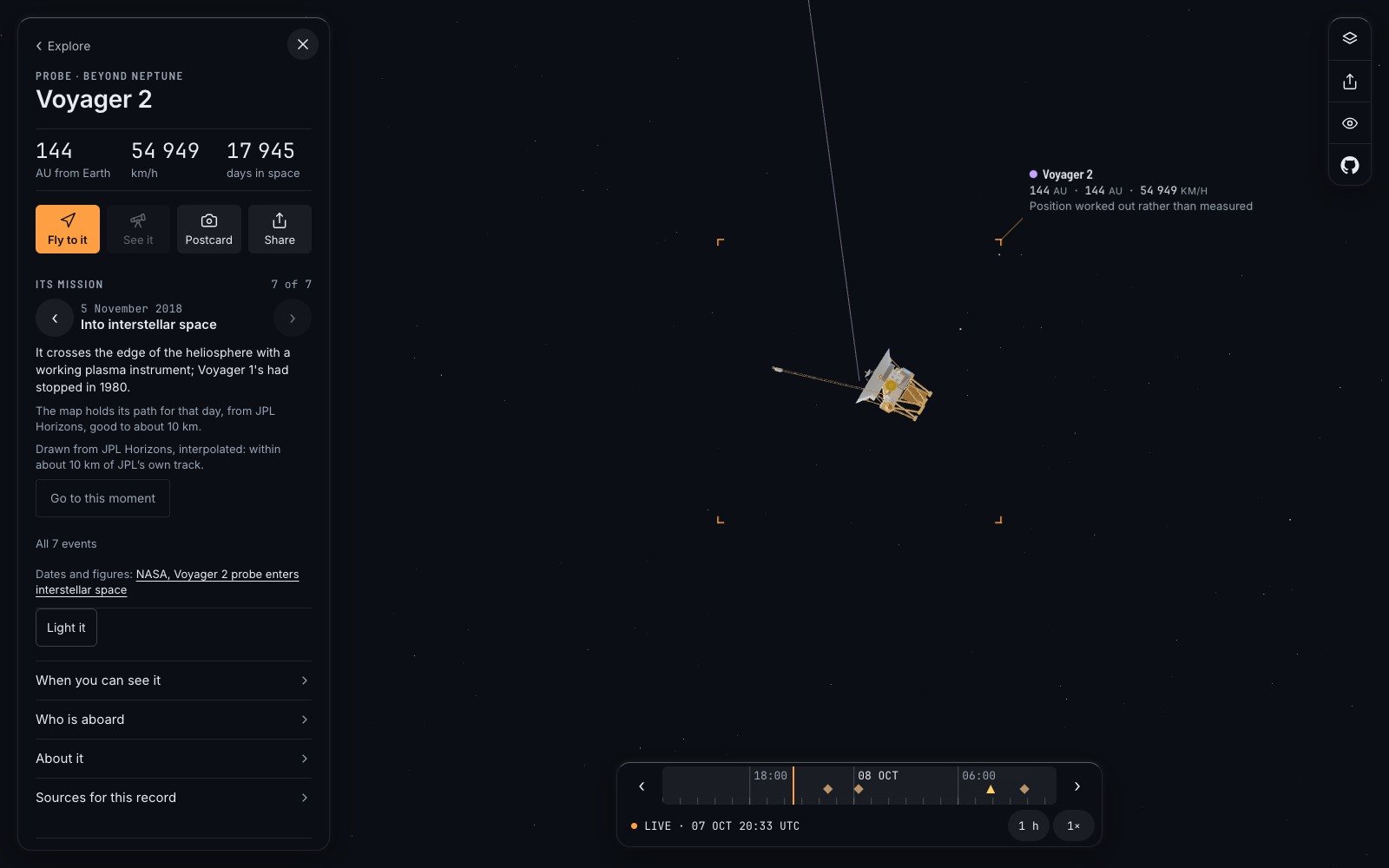
We hear it anyway, because the ears are enormous. NASA’s Deep Space Network has dishes 70 metres across in California, in Spain and in Australia, spaced round the planet so that one of them always faces the right way. Voyager 2 left the plane of the planets heading south, and can now be commanded from only one of them: the big dish near Canberra. When that dish was closed for repairs in 2020, Voyager 2 flew for eleven months with nobody able to tell it anything.
The data comes home at 160 bits a second. One ordinary phone photo, sent at that speed, would take about two days.
And the power is running out. Each Voyager carries a lump of plutonium whose heat is turned into electricity, and each year it makes about four watts less. The team has been switching off heaters and instruments one at a time to keep the transmitter alive: Voyager 1’s cosmic ray detector in February 2025, one of Voyager 2’s particle instruments a month later.
The people who grew old talking to one machine#
Edward Stone was a 36-year-old physics professor in 1972 when he was asked to be chief scientist of a plan to send two spacecraft past the giant planets. He held the job for fifty years. He was there for Jupiter’s volcanic moon and Saturn’s braided rings, for Neptune in 1989, and for 25 August 2012, when Voyager 1 left the bubble of thin gas the Sun blows around itself and became the first human object between the stars. He retired in 2022 and died in June 2024, aged 88. His successor, Linda Spilker, first worked on Voyager in 1977.
The team today is small, and some of it is very experienced indeed. It includes NASA retirees in their eighties. It also includes people who were born after the spacecraft left.
In November 2023 they needed all of it. Voyager 1 began sending gibberish. It took months to trace the fault to a single dead memory chip in a computer built in the 1970s, and then to move the lost code, piece by piece, into other corners of its memory. Every test took 22 and a half hours to arrive and 22 and a half to answer. In April 2024 the spacecraft made sense again.
A record that may never be played#
Bolted to the side of each Voyager is a gold-plated copper record, with a needle and drawn instructions for playing it. A committee led by the astronomer Carl Sagan decided what to put on it. They chose 115 pictures, greetings in 55 languages, the sound of surf and thunder and whales, and 90 minutes of music, from Bach to Chuck Berry.
One track is an hour of a young woman’s brain waves and heartbeat, squeezed into a minute. She was Ann Druyan, the project’s creative director, and it was recorded two days after she and Sagan had decided, on the telephone, to get married. You can stand beside the record as it is now, a day’s light from the nearest person who could put it on a turntable.
Voyager took its own picture of the senders, once. On 14 February 1990, six billion kilometres out, it turned its camera back and photographed the planets it had left. The Earth came out as a point of light less than a pixel wide. Then the cameras were switched off for good, to save power.
The rest of the far-flung fleet#
Five spacecraft are on their way out of the Solar System for good. The two Pioneers went first and fell silent long ago; the last faint word from Pioneer 10 came in January 2003. The newest is New Horizons, which crossed Pluto in 2015 after nine and a half years of flight and is now about 65 times the Earth’s distance from the Sun. It carries, on its upper deck, a small container of the ashes of Clyde Tombaugh, the man who found Pluto in 1930.
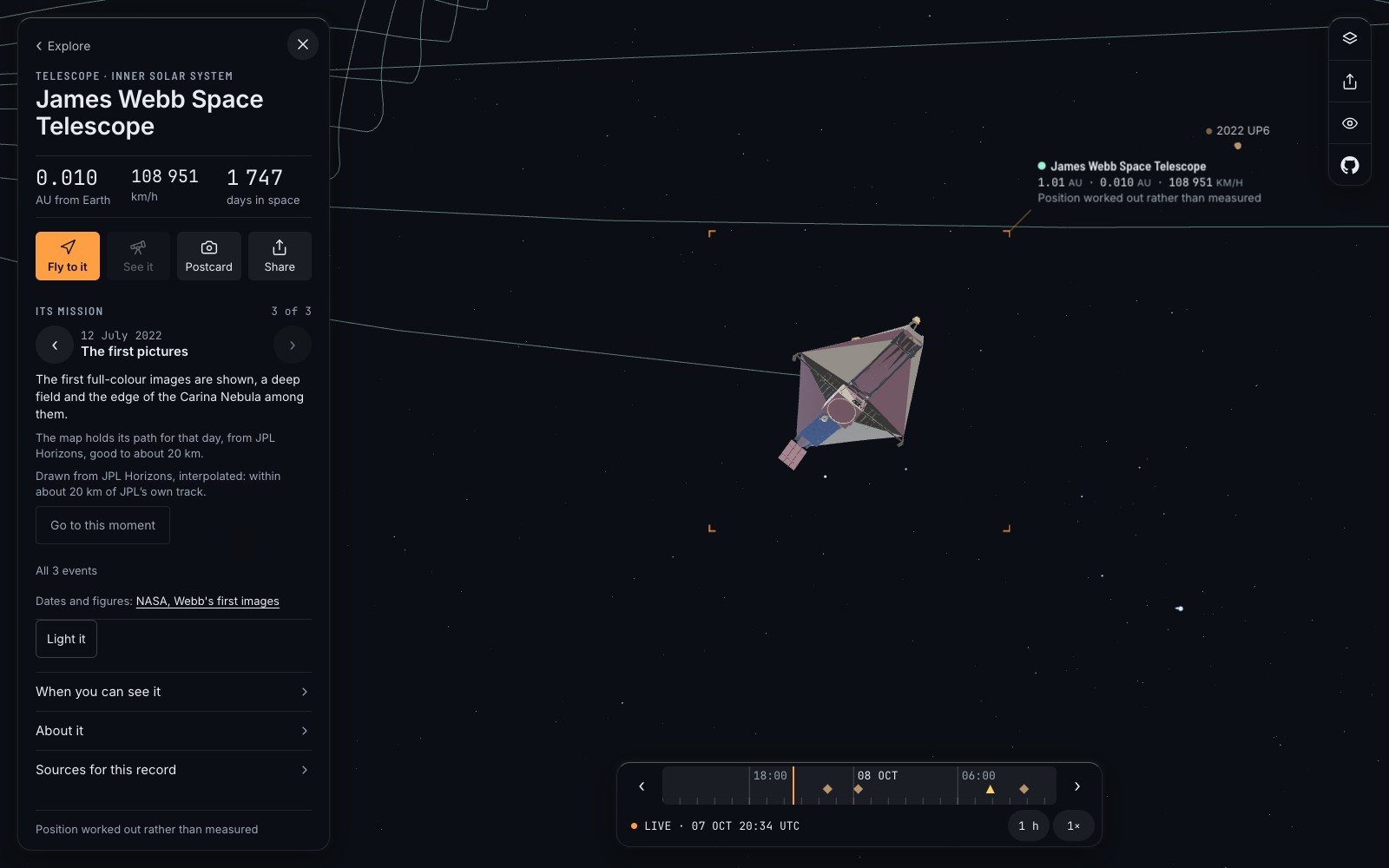
Not everything far away was thrown. The James Webb Space Telescope was placed, very carefully, 1.5 million kilometres from the Earth on the side away from the Sun, about four times as far as the Moon. From there the Sun, the Earth and the Moon are all in the same direction, so one sunshield the size of a tennis court can hide all three and let the 6.5-metre mirror cool to 225 degrees below zero. Its launch was so accurate that it kept enough fuel to hold that spot for about twenty years.
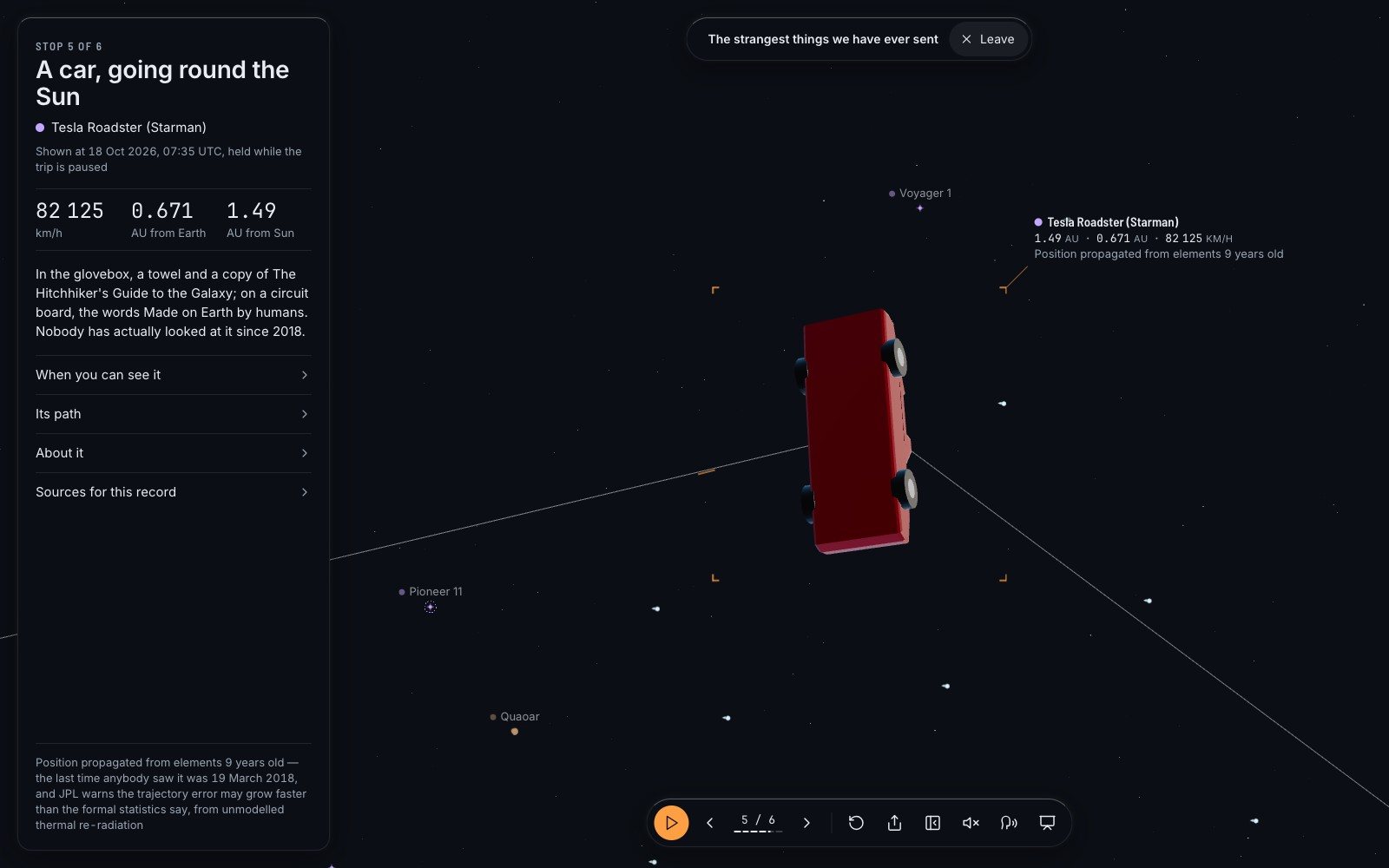
And one thing was thrown purely for show. In February 2018 a new rocket needed a test load, and its builder used his own car. The red Roadster has been circling the Sun ever since, once every 557 days, out past the orbit of Mars and back. In January 2025 astronomers announced a new asteroid, 2018 CN41, and deleted it less than a day later. It was the car.
What we will hear last#
Nobody knows the date. NASA’s own estimate is that the Voyagers may stay within reach of the big dishes until about 2036, if they still have the power to transmit. Dodd said last year that she was confident at least one of them could keep working for another two to five years. September 2027 will be Voyager 1’s fiftieth birthday.
The last thing we hear will not be a discovery. It will most likely be a thin stream of housekeeping numbers, temperatures and voltages, from a machine with one instrument left on. Some day a scheduled call will go unanswered, and somebody will try again the next day.
After that the spacecraft simply goes on. In about 300 years it reaches the inner edge of the cloud of comets that surrounds the Sun. In the year 40,272, by NASA’s reckoning, it passes within 1.7 light-years of a faint star in the Little Bear. The record will still be on its side.
The last thing we hear will not be a discovery.
Open the map tonight, or take the trip out past Jupiter to the farthest thing we sent, and look at Voyager’s card. It said 17,929 days in space on the evening I wrote this. By the time you have read this sentence, the spacecraft is another hundred kilometres away.
Distances are as of October 2026 and change every second; the figures here come from NASA’s Jet Propulsion Laboratory and from Space Radar’s own live readings. Space Radar is a free, open-source live 3D map of everything in orbit and beyond. It runs in a browser at spaceradar.ai, with no account.
Questions people ask
Where is Voyager 1 now?
As of October 2026 it is about 25.8 billion km from the Earth, roughly 172 times the Earth’s distance from the Sun, in interstellar space. It reaches one light-day, 25.9 billion km, on 18 November 2026.
Is Voyager 1 still working?
Yes. As of 2026 it still sends data from its remaining instruments at 160 bits per second, and NASA hopes to keep at least one Voyager running into the 2030s.
How far is the James Webb telescope from Earth?
About 1.5 million km, four times the Moon’s distance, in orbit around a balance point called L2 on the side of the Earth away from the Sun. A radio signal takes five seconds to reach it.
What is on the Voyager golden record?
115 images, spoken greetings in 55 languages, natural sounds and 90 minutes of music from many cultures, chosen in 1977 by a committee chaired by Carl Sagan.
Sources
- The light bulb in a refrigerator jpl.nasa.gov
- Successor, Linda Spilker jpl.nasa.gov
- In April 2024 the spacecraft made sense again jpl.nasa.gov
- Placed, very carefully science.nasa.gov
- Cp24.com: voyager 1 will reach one light day from earth in 2026 heres what that means cp24.com
- Science.nasa.gov: where are voyager 1 and voyager 2 now science.nasa.gov
- Science.nasa.gov: fact sheet science.nasa.gov
- Science.nasa.gov: mission overview science.nasa.gov
- Science.nasa.gov: frequently asked questions science.nasa.gov
- Science.nasa.gov: did you know science.nasa.gov
- Science.nasa.gov: spacecraft science.nasa.gov
- Jpl.nasa.gov: nasas deep space antenna upgrades to affect voyager communications jpl.nasa.gov
- Space.com: nasa commands voyager 2 probe interstellar space upgraded dsn space.com
- Skyatnightmagazine.com: voyager 2 low energy charged particle instrument switch off skyatnightmagazine.com
- Jpl.nasa.gov: ed stone former director of jpl and voyager project scientist dies jpl.nasa.gov
- Science.nasa.gov: golden record contents science.nasa.gov
- Science.nasa.gov: greetings science.nasa.gov
- En.wikipedia.org: Contents of the Voyager Golden Record en.wikipedia.org
- Npr.org npr.org
- Edition.cnn.com: nasa pluto new horizons clyde tombaugh ashes edition.cnn.com
- Space.com: james webb space telescope fuel 20 years space.com
- Esawebb.org: sun shield esawebb.org
- Astronomy.com: astronomers just deleted an asteroid because it turned out to be elon musks tesla roadster astronomy.com
- Spaceradar.ai spaceradar.ai
Explore on Space Radar
Keep reading
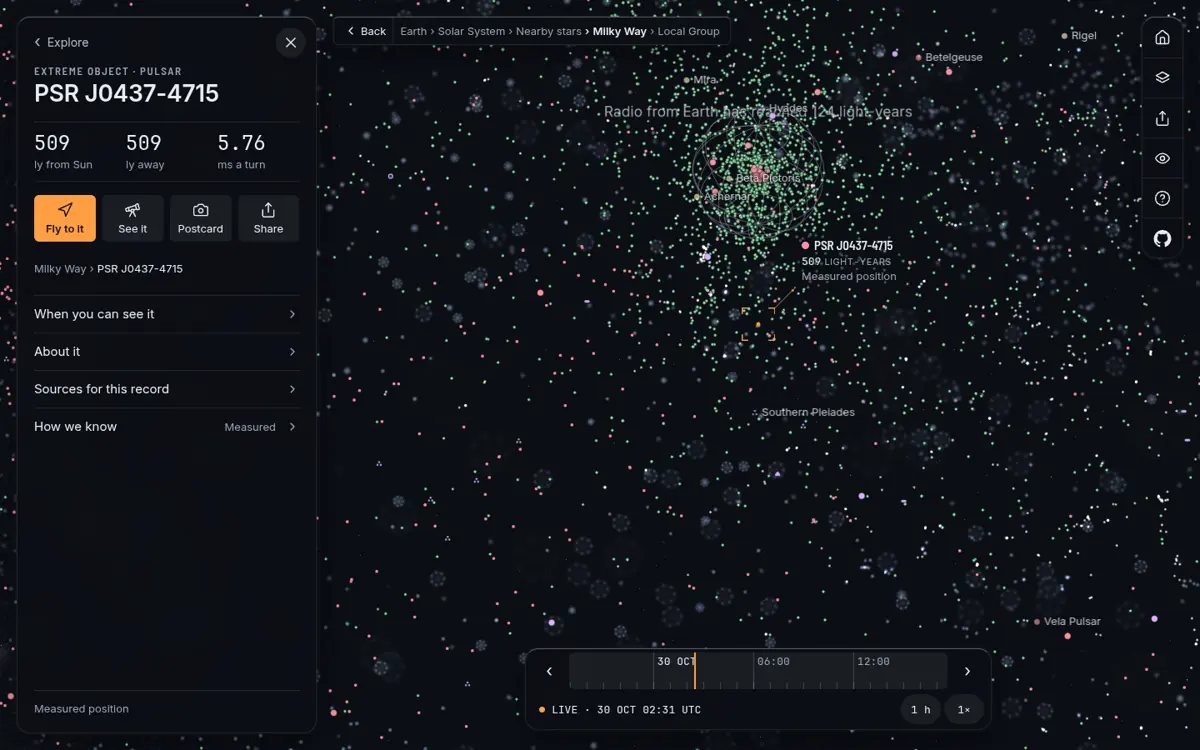
Stars with no distance, 4 383 pulsars and the farthest galaxy
Release 1.5.0 fills the sky with what the catalogues know, and says on every card how a distance was found, or that it never was.
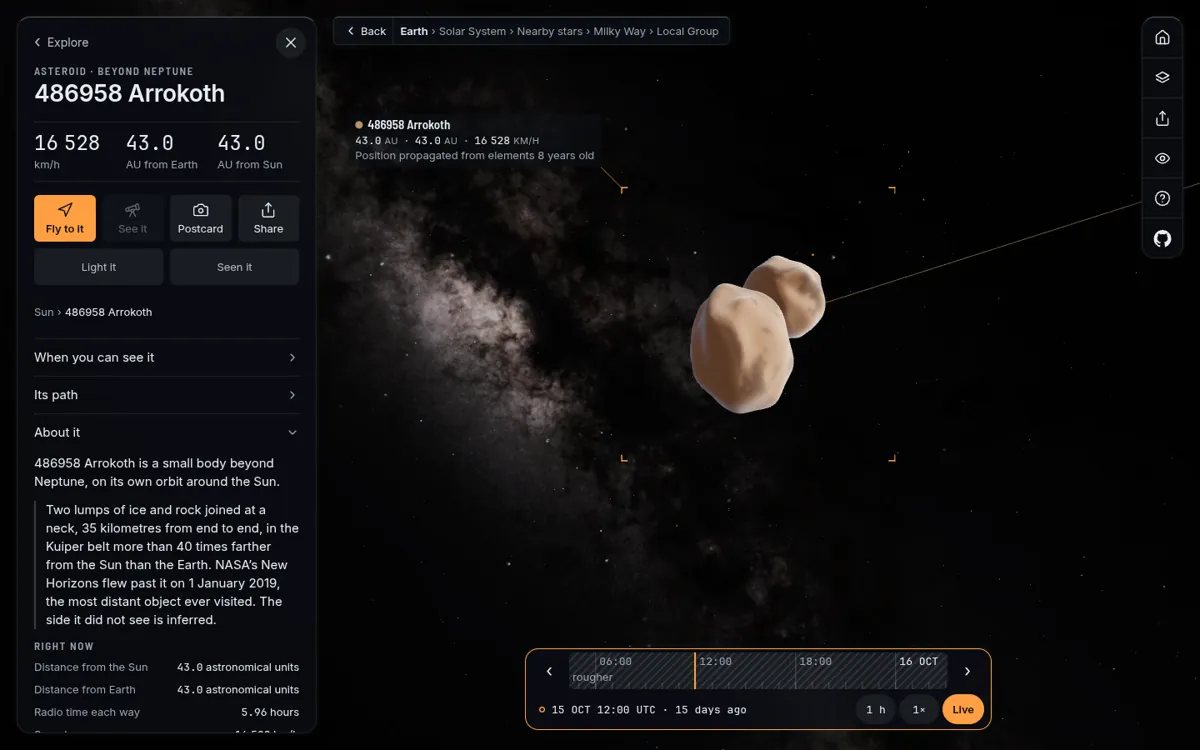
Arrokoth, Kleopatra and nine more small worlds in their own shapes
Release 1.5.0 replaces the generic rock with the shapes spacecraft and radar measured for eleven small bodies, and says on every card what was seen.
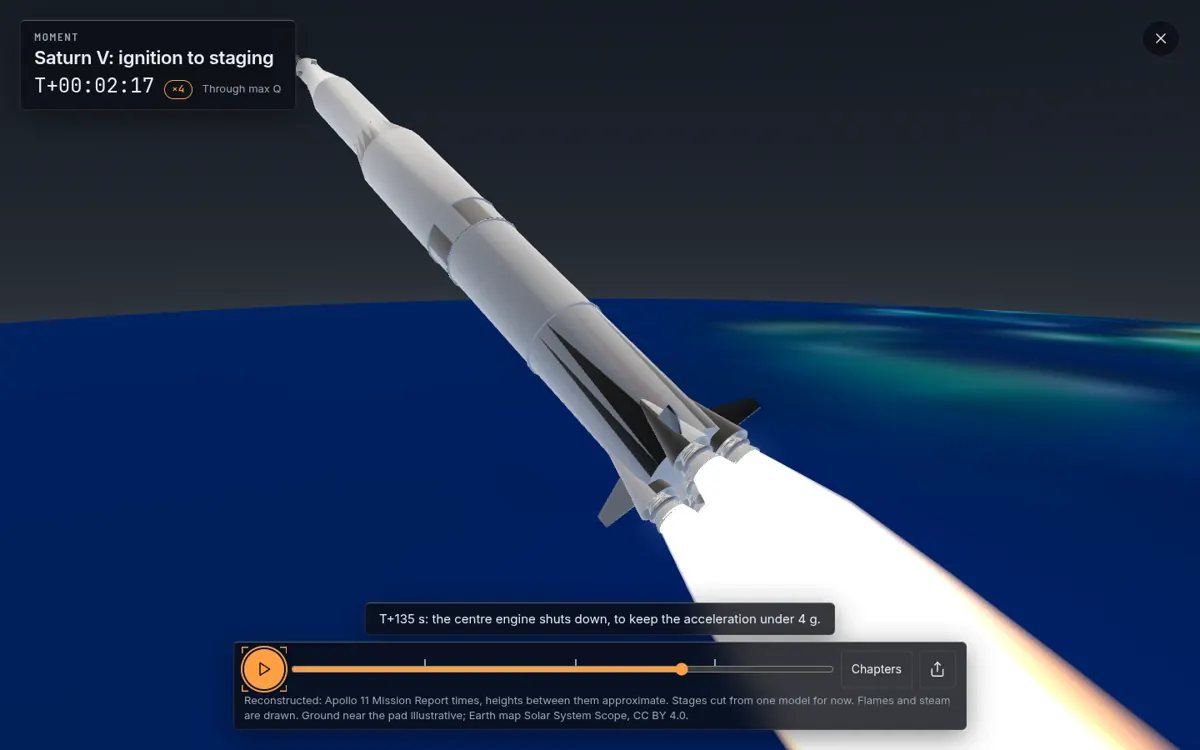
Moments: a mission replayed in 3D on one clock
Release 1.5.0 adds a new kind of tour, a Moment, and its first demonstration: Apollo 11's Saturn V from ignition to the jettison of the escape tower.