
New Horizons at Pluto: When Was Closest Approach, and How Close?
New Horizons passed Pluto on 14 July 2015 at about 12,500 km and 13.8 km/s. NASA’s timetable and JPL’s track disagree on the second by 88 seconds, and a 3D replay has to show both.
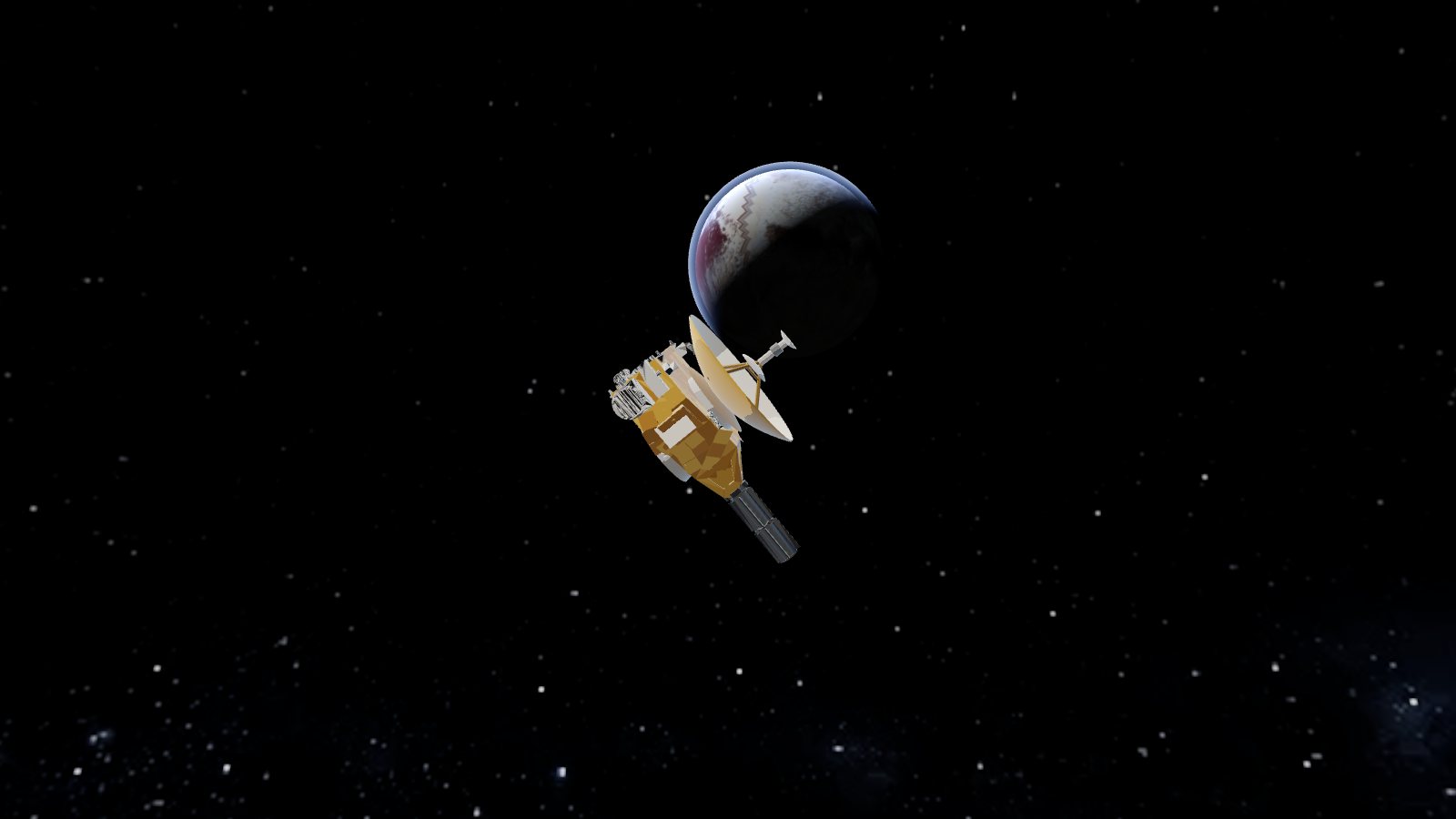
12 seconds before the replay’s closest approach: the probe and a lit Pluto, whose rim glows blue. A frame of Space Radar’s Moment; the glow of the rim is drawn, the planet’s haze is not.
New Horizons made its closest approach to Pluto on 14 July 2015, passing about 12,500 km above the surface at about 13.8 km/s. NASA’s encounter timetable puts that at about 7:49 am EDT, 11:49:57 UTC. JPL’s Horizons track of the spacecraft has it nearest Pluto at 11:48:29 UT, 88 seconds earlier. Space Radar’s replay of the flyby gives both times in its captions and says they are not reconciled.
This post walks through the six hours around the pass, with the figures NASA and JPL published, and marks which parts of the Space Radar Moment “New Horizons at Pluto” are the app’s own drawing. The Moment was added in release 1.7.9.
What NASA published#
- Launch: 19 January 2006. It reached Pluto after more than nine years and about 3 billion miles.
- Closest approach: about 7:49 am EDT on 14 July 2015, roughly 12,500 km (7,800 miles) above Pluto’s surface, at about 30,800 mph, which is about 13.8 km/s.
- Charon: about 14 minutes after Pluto the craft passed within about 28,860 km (17,930 miles) of its largest moon.
- The worlds: NASA gives Pluto as about 2,370 km across and Charon as about 1,208 km. They circle each other every 6.4 days.
- The craft: seven science instruments.
The timetable also warned that for much of 14 July the spacecraft would be on its own, pointing its instruments at Pluto and out of contact with mission control. That matters for the replay: nothing you see could have been steered live.
Two clocks, 88 seconds apart#
The replay needs a zero for its clock, and it takes it from JPL’s Horizons system rather than from the timetable. T-0 is the second at which Horizons has the craft nearest Pluto, 11:48:29 UT. The project read it again through Horizons’ API on 3 November: the spacecraft’s range rate to Pluto changes sign between 11:48 and 11:49. In the repository’s own file of the track, which follows JPL’s to within a few kilometres, the craft is 12,488 km over the surface at 13.78 km/s at that second.
NASA’s timetable, published in the hours before the encounter, has the closest approach at 11:49:57 UTC. The captions state both times. The project’s notes say the 88 seconds between them are not explained, and this post does not guess at a reason.
- 88 sThe gap between JPL Horizons’ closest second (11:48:29 UT) and NASA’s timetable (11:49:57 UTC).
The six hours before#
The replay opens at 05:48 UTC, six hours out and some 300,000 km from Pluto. Pluto and Charon are points still. The play speed changes as the story goes: ×300 for the first five hours, ×40 through the next fifty-five minutes, ×6 as the last few minutes close in, and only ×1.5 for the 80 seconds around the pass, so that the closest second is not rushed. The speed-up is printed beside the clock the whole time.
The path is JPL Horizons’ track of the craft, turned into Pluto’s own frame: the approach is over the lit side, and from the pass the craft is over the night side, looking back at the sunlit planet. The craft’s attitude is drawn nose-forward, which is the app’s choice. The Sun’s side of Pluto is lit and the planet has a blue glow at its rim; Pluto’s thin haze is not drawn.
Closest approach, and the crescent behind#
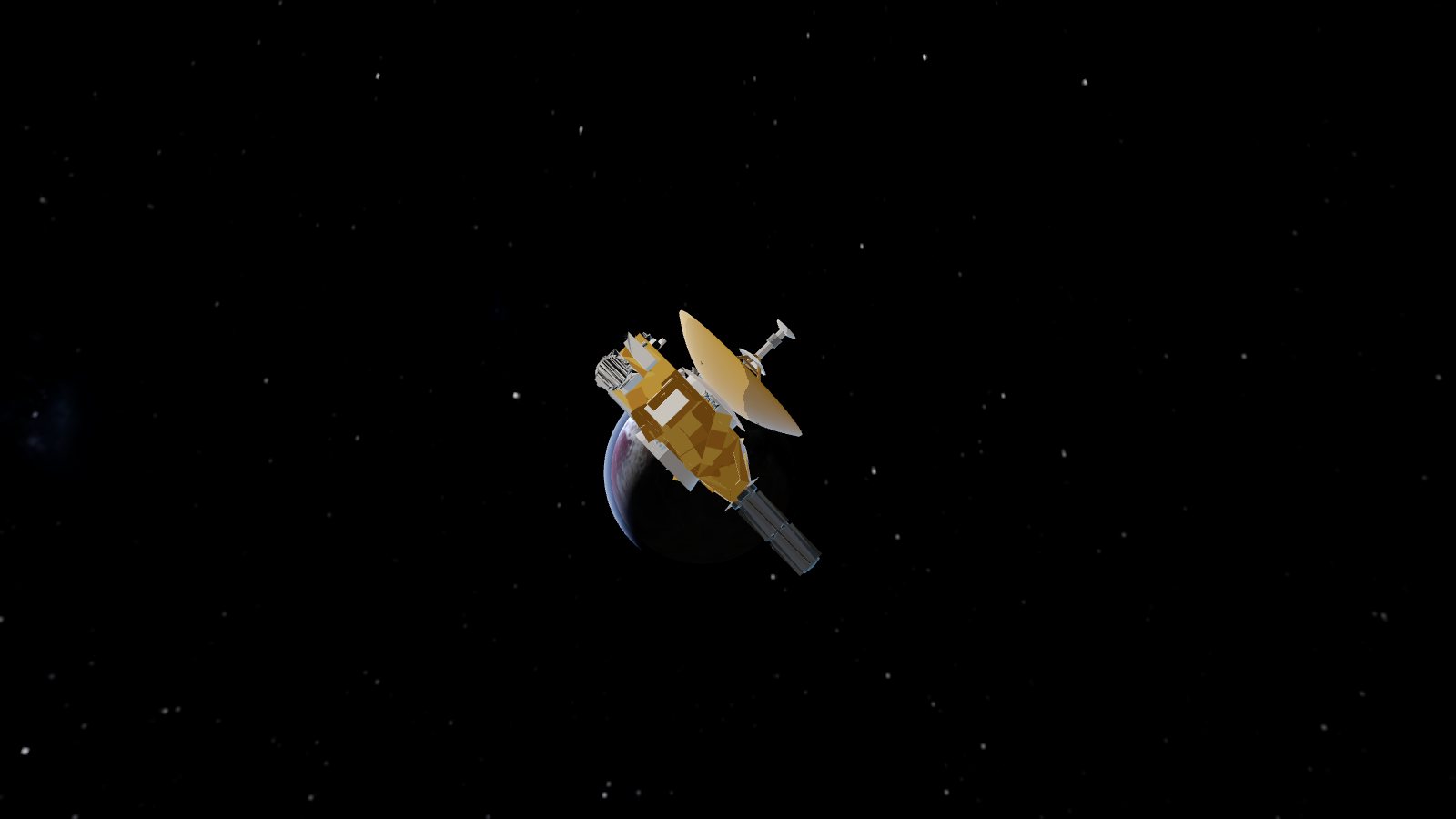
In the replay the closest-approach caption gives 12,490 km over the surface at 13.78 km/s in JPL’s track at 11:48:29 UT, and NASA’s 7:49 am EDT beside it. A few minutes later, the craft has crossed the line between day and night on Pluto and looks back: Pluto is a crescent that grows thinner as the craft recedes. The Earth is 4.77 billion km away, 4 hours 25 minutes by radio, by the app’s own sum from the planets’ places.
Charon, fourteen minutes later#
Charon comes next. NASA’s timetable has the craft within about 28,860 km of it about 14 minutes after Pluto. In the replay Charon is nearest at 12:02:36 UT, JPL’s Pluto second plus 14 minutes 7 seconds, at about 29,000 km. Where Charon stands is the app’s own drawing: above longitude 0 on Pluto’s equator, 19,591 km out, which is where the two keep their faces to each other. The caption adds that Wikipedia’s article on New Horizons has 12:02:22 UTC instead.
The signal that mattered#
What the craft sees takes 4 hours 25 minutes to reach the Earth, and a reply would take as long again, so the replay closes on the one message people were waiting for. The replay marks the “phone home” signal at about 00:53 UTC on 15 July, which is 8:53 pm EDT on the 14th. Astronomy magazine had told readers to expect it right around 9 pm EDT. It was a status message: New Horizons had survived the flyby.
The science came home afterwards. NASA lists, among what the flyby found, that Pluto is more complex and active than expected, with a large nitrogen-ice glacier called Sputnik Planitia, signs of past liquid on the surface, shifting atmospheric pressure, and hints of a possible ocean of water ice underground; on Charon, a tectonic belt that suggests an ancient ocean. The spacecraft itself kept going, deeper into the Kuiper Belt.
What is measured, and what is drawn#
- JPL’s: the track of the craft about Pluto, as the repository’s own file of it holds it, and the second of closest approach in that track.
- NASA’s: the timetable’s closest approach, its distance and speed, and Charon’s pass.
- The app’s: Charon’s place in the sky, the craft’s attitude, the camera, the speed-ups, the Earth’s delay figure and the glow of Pluto’s rim. Pluto’s haze and the craft’s instruments are not drawn.
- No sound: the encounter was silent on the craft, and no recording of mission control has a clear free licence, so the words are captions.
How to watch it#
Open the Moment and press play; it takes about six minutes. The chapters are the approach, closest approach, looking back and Charon. To go straight to the pass, open it at 45 seconds before T-0. The share button gives a link to the second you are looking at.
The screenshots are Space Radar 1.7.9 (MIT licence) frames rendered by the app. The path is JPL’s, the timetable is NASA’s, and the drawing around them is Space Radar’s.
Questions people ask
When was New Horizons’ closest approach to Pluto?
On 14 July 2015. NASA’s timetable has it at about 7:49 am EDT, 11:49:57 UTC. JPL’s Horizons track of the spacecraft has it nearest Pluto at 11:48:29 UT, 88 seconds earlier. The two are not reconciled.
How close did New Horizons get to Pluto?
About 12,500 km (7,800 miles) above the surface, travelling at about 13.8 km/s (30,800 mph), according to NASA’s timetable. JPL’s Horizons track gives 12,488 km over the surface at 13.78 km/s.
How long did New Horizons take to reach Pluto?
It launched on 19 January 2006 and flew past on 14 July 2015, more than nine years and about 3 billion miles by NASA’s count.
Could mission control steer the flyby as it happened?
No. Pluto was about 4.77 billion km from the Earth, a radio delay of about 4 hours 25 minutes each way by the replay’s own sum, so nothing could be steered from the ground. For much of the day the craft was out of contact, pointing its instruments at Pluto.
Sources
- New Horizons mission page science.nasa.gov Launch date, instruments, sizes of Pluto and Charon, findings.
- Pluto’s time to shine just hours away (the encounter timetable of 14 July 2015, as printed by Phys.org from NASA) phys.org Closest approach about 7:49 am EDT, about 12,500 km, 30,800 mph; Charon about 14 minutes later.
- JPL Horizons system ssd.jpl.nasa.gov Spacecraft -98 about Pluto; the track the replay follows.
- Phoning home from Pluto: what to expect from New Horizons this week astronomy.com
- New Horizons en.wikipedia.org Cited by the replay for the time of Charon’s closest approach.
- Space Radar spaceradar.ai The replay is the Moment new-horizons-pluto, added in release 1.7.9.
Explore on Space Radar
Keep reading
Moments: a mission replayed in 3D on one clock
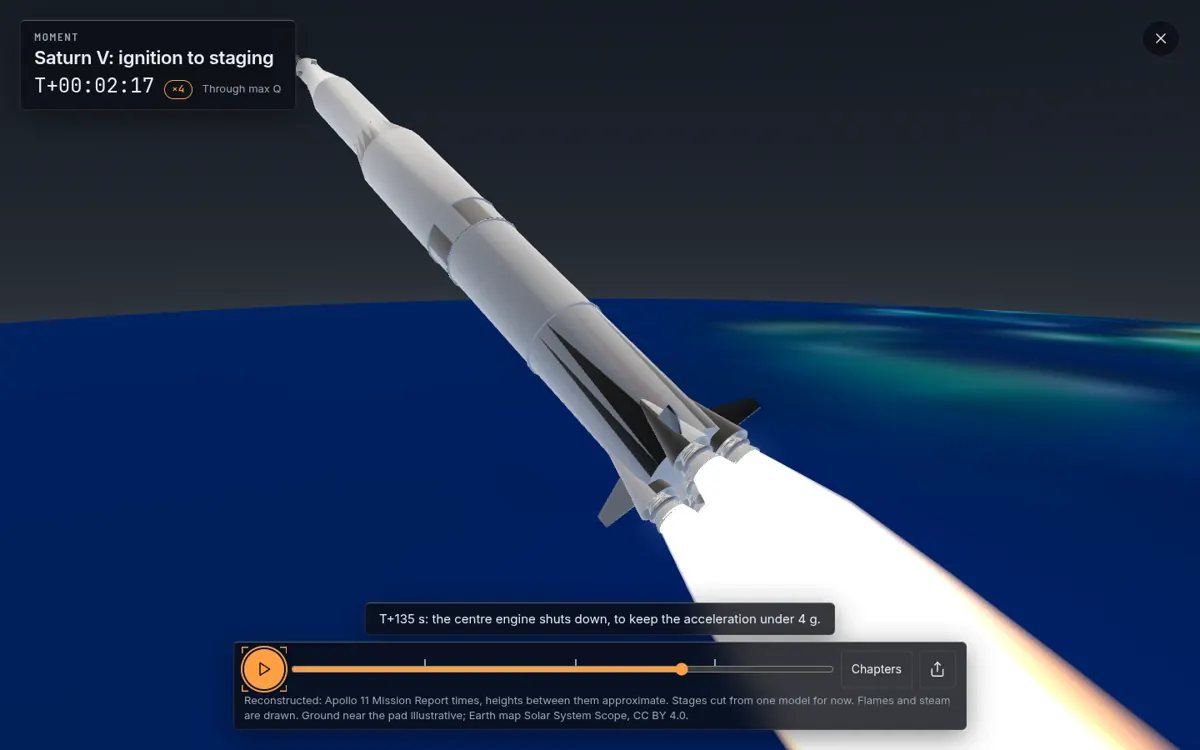
Release 1.5.0 adds a new kind of tour, a Moment, and its first demonstration: Apollo 11's Saturn V from ignition to the jettison of the escape tower.
Curiosity’s Landing: The Seven Minutes of Terror, Step by Step
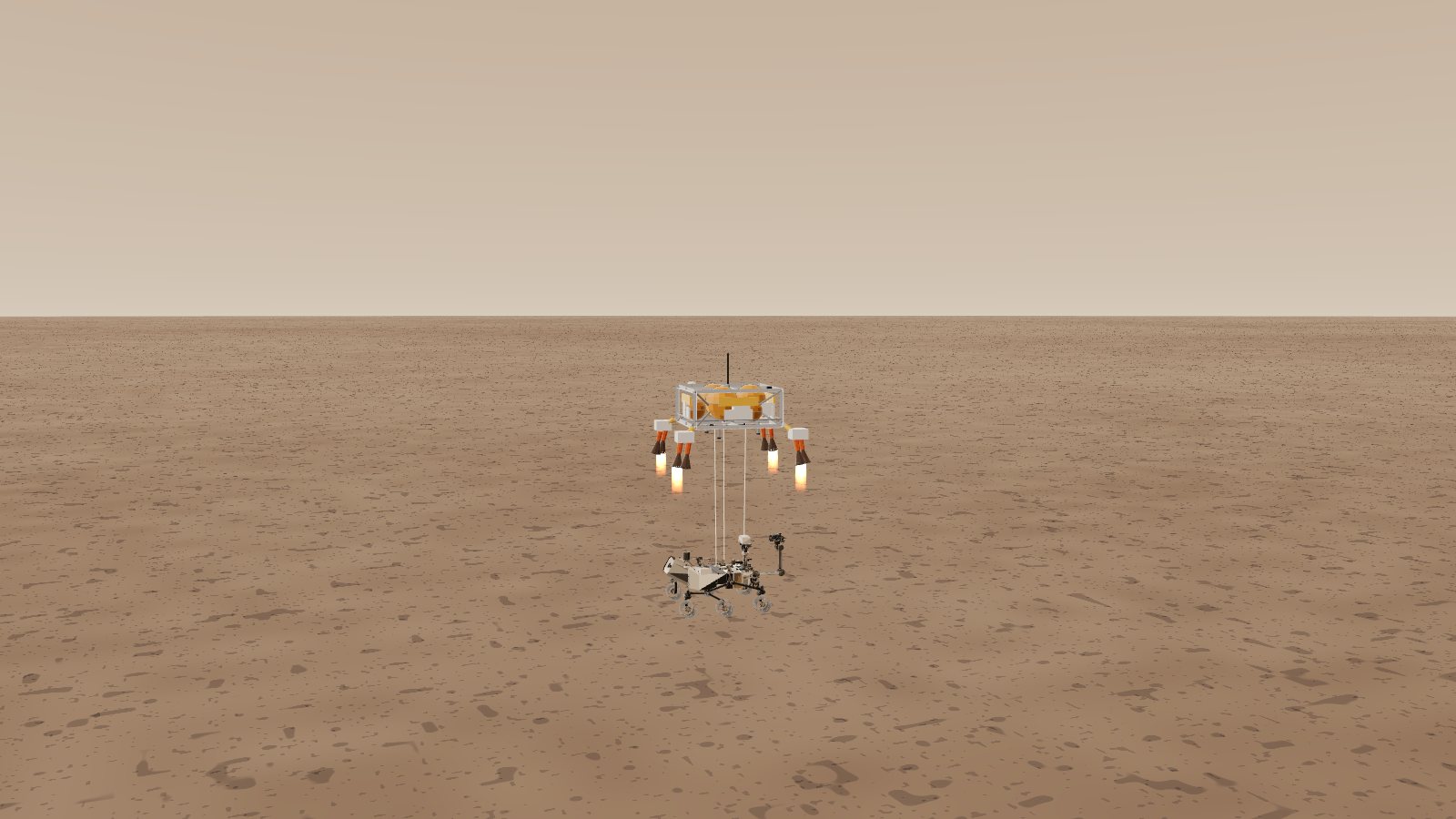
Curiosity’s entry, descent and landing took 7 minutes 11 seconds on 6 August 2012. Here is the clock JPL published, the heights and speeds NASA gave, and what a 3D replay has to fill in between them.
Sixty more craft with shapes of their own
Release 1.4.0 takes the map from 165 models to 225, so that a weather satellite, a spy satellite and a spent stage no longer look the same.