
Curiosity’s Landing: The Seven Minutes of Terror, Step by Step
Curiosity’s entry, descent and landing took 7 minutes 11 seconds on 6 August 2012. Here is the clock JPL published, the heights and speeds NASA gave, and what a 3D replay has to fill in between them.
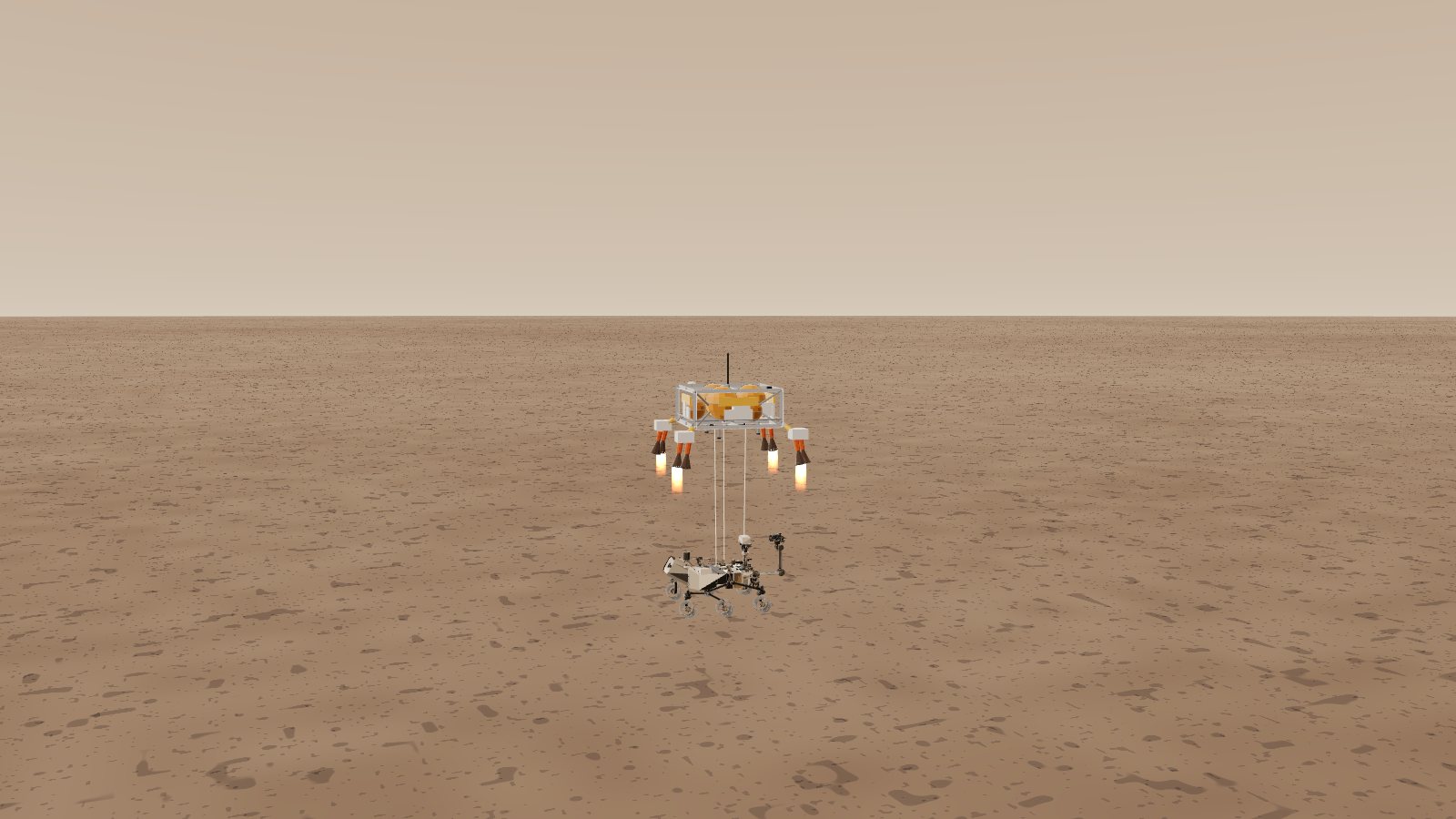
The sky crane, 420 seconds after entry: the descent stage holds itself in the air on its landing engines and lowers the rover on cords. A frame of Space Radar’s Moment, drawn from NASA’s model of the rover.
Curiosity’s landing on Mars lasted 7 minutes 11.6 seconds, from the first touch of the Martian air at 05:10:45.7 UTC to touchdown at 05:17:57.3 UTC on 6 August 2012, and it earned the name “the seven minutes of terror” because the vehicle had to slow itself from 5.9 km/s to about 0.75 m/s with nobody able to help it. A radio signal took 13 minutes 48 seconds to reach the Earth, so the news that Curiosity had even entered the atmosphere arrived about six and a half minutes after it had either landed or been lost.
The name comes from a NASA video released before the landing, “Curiosity’s Seven Minutes of Terror”. This post walks through those seven minutes with the figures NASA and JPL published, and says plainly which parts of Space Radar’s replay of them are the app’s own reconstruction. The replay is a Moment, “Curiosity: seven minutes to Mars”, added in release 1.7.9.
The five times JPL published#
JPL’s timeline of the landing gives five event times, and everything else hangs from them. All are UTC on 6 August 2012, which was the evening of 5 August in California. The replay’s clock counts seconds from the first of them.
- 05:10:45.7, atmospheric entry. The replay’s clock reads 0 s.
- 05:15:04.9, the parachute opens. 259.2 s after entry.
- 05:15:24.6, the heat shield is released. 278.9 s.
- 05:17:38.6, the rover lets go of the descent stage. 412.9 s.
- 05:17:57.3, touchdown. 431.6 s after entry.
Those are times at Mars. The same events reached the Earth 13 minutes 48 seconds later: JPL’s table has touchdown arriving at 10:31:45.4 pm Pacific time, which is 05:31:45.4 UTC. The replay ends on the line the room heard then, “Touchdown confirmed. We’re safe on Mars!” (Allen Chen, JPL). No sound plays in the replay, because no recording of the room has a clear free licence; the words are captions.
The heights and speeds are NASA’s typical case#
JPL’s page lists times only. The heights and speeds come from NASA’s Mars Science Laboratory press kit, which describes a typical case rather than a recording of this flight:
- Entry: 131 km above the height of the landing site’s ground, at 5.9 km/s. The entry point is far upstream of the site.
- Parachute: 11 km up, at 405 m/s.
- Heat shield off: 8 km up, at 125 m/s.
- Back shell off: 1.6 km up, at 80 m/s, with the eight landing engines lit.
- Sky crane: the rover lets go about 20 m up. Wikipedia’s article on the mission gives the bridle as 7.6 m long.
- Touchdown: about 0.75 m/s, in Gale crater.
Nothing between those points is in the press kit. That gap is where a replay has to say what is its own.
Entry: what the app works out between the numbers#
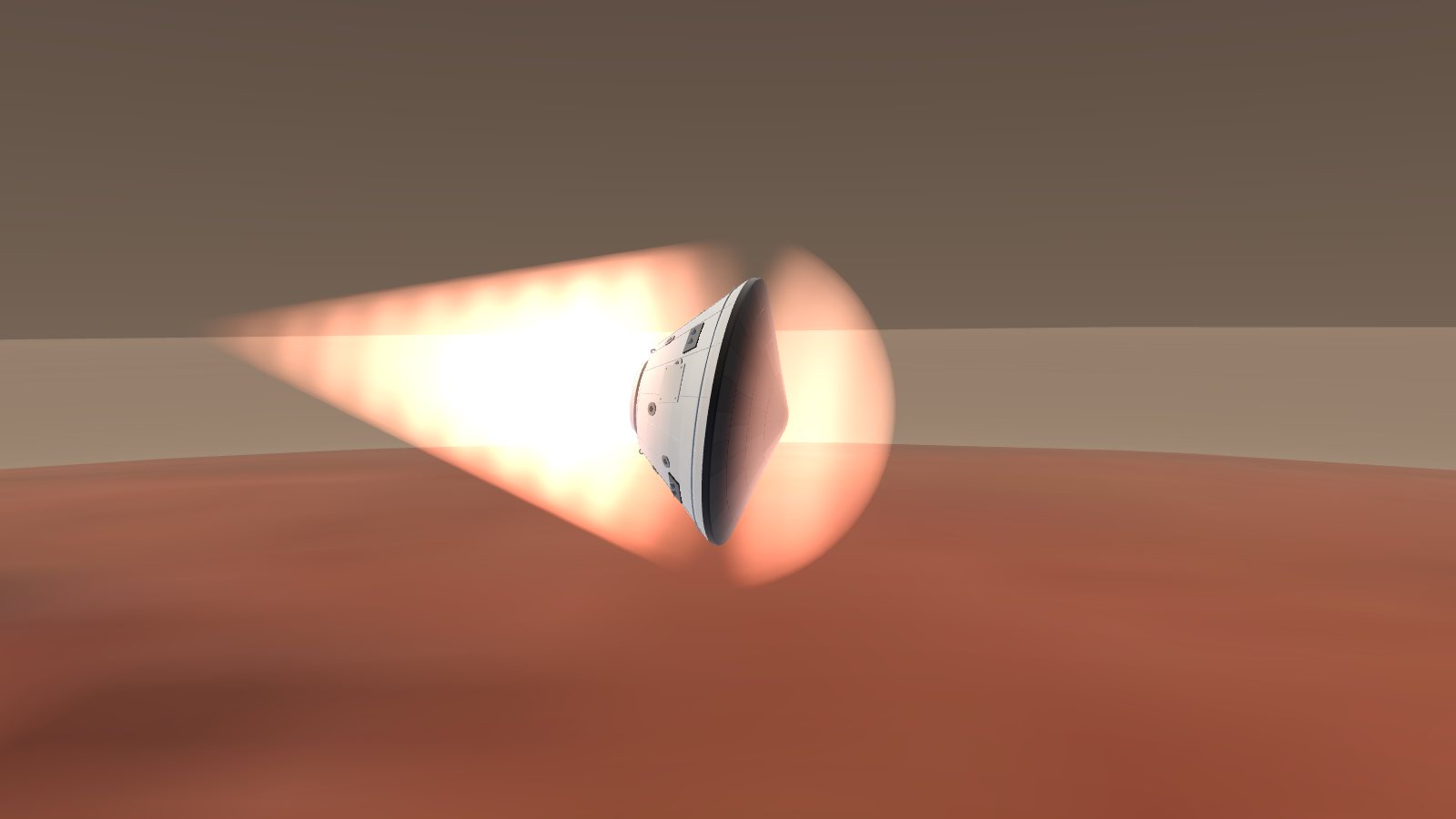
For the entry the Moment flies a point mass over a round Mars. A generator searches for an entry angle and a lift until the vehicle is at the published height and speed at the published second. It finds an entry angle of 15.2 degrees, the figure the mission reports, and a peak deceleration of 9.7 g at 85 s after entry. The press kit puts the peak about 90 s in, so the two differ by a few seconds. The compass heading of the path is the app’s own choice.
The replay’s caption for about 80 s in gives some 2,100 degrees C on the face of the heat shield at peak heating. More than nine tenths of the slowing before the parachute is done by the air itself, not by any rocket. The vehicle flies tilted, with some lift, and small thrusters on the back shell steer it in S-curves toward the target; those are in the caption and not drawn.
Under the parachute#
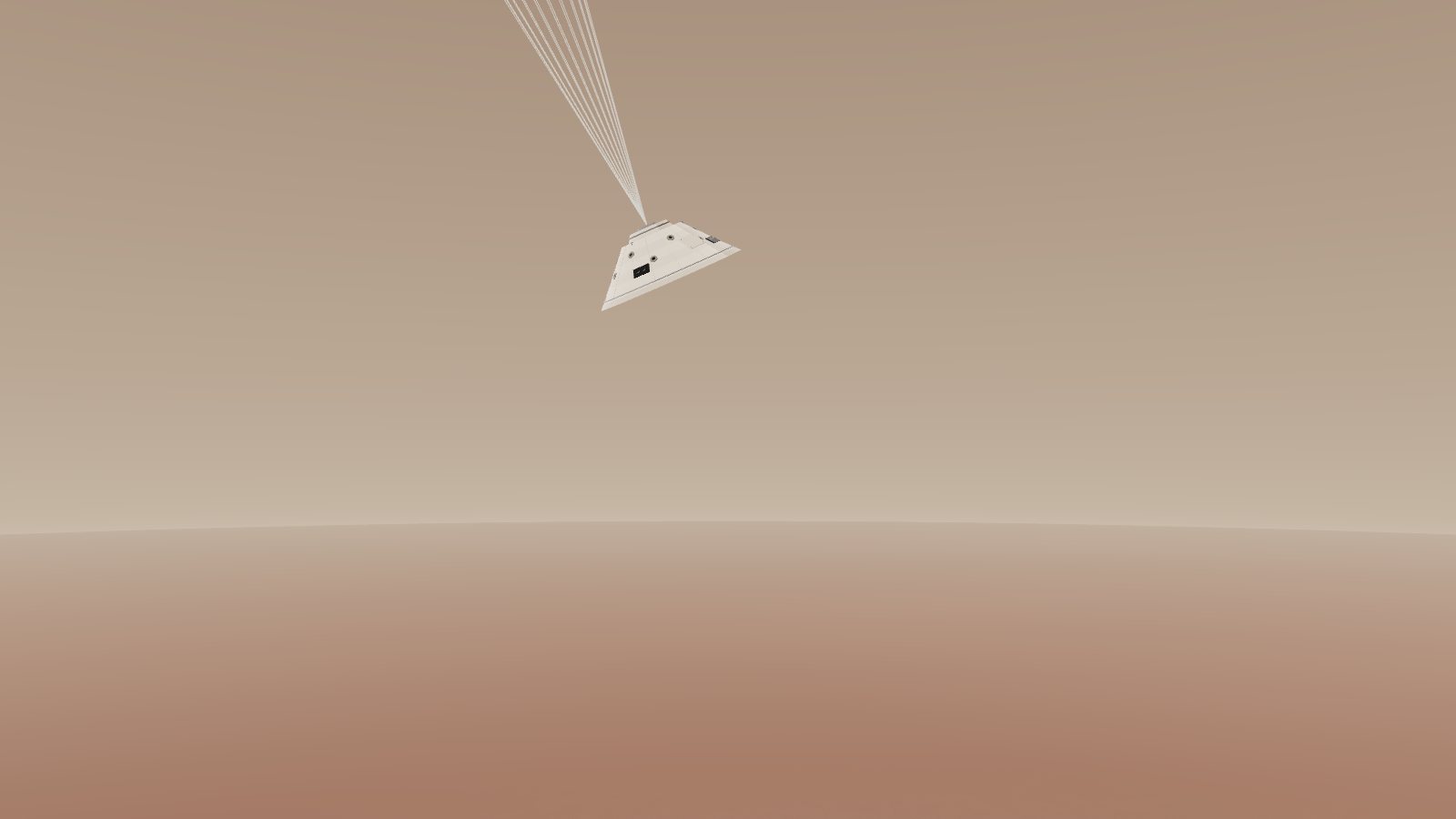
At 259.2 s the parachute opens, 11 km up at about 405 m/s. In the replay it is a canopy 16 m across on lines more than 50 m long. Twenty seconds later, at 278.9 s, the heat shield is released, at 8 km and 125 m/s, and it falls away. The rover’s descent camera starts to film the ground and the stage’s radar starts to read it. The fall of the shield, and the drift of the back shell on its canopy after the rover leaves it, are illustrative: no path of theirs was found in what the project read.
The rocket backpack and the sky crane#
About 80 seconds after the shield, at 358.9 s, some 1.6 km up and at 80 m/s, the back shell lets go of the rover and its rocket backpack, and all eight landing engines (each between 400 and 3,100 N) light. The descent stage dives clear and makes a 300 m manoeuvre to stay away from the back shell and the parachute, a figure taken from a NASA technical paper the project cites. It then slows to about 0.75 m/s.
At 412.9 s, about 20 m up, the rover lets go of the stage, and four of the eight engines are shut off. The stage lowers the rover on a bridle of three cords while the wheels pop into place. Touchdown is at 431.6 s. The rover waits two seconds, sensing its weight on its wheels, then fires the pyrotechnics that cut the cords, and the stage throttles up and flies away to crash some 650 m off, so that it does not fall on the rover. The replay’s version of that flyaway is illustrative.
- 7 min 11.6 sFrom atmospheric entry to touchdown, by JPL’s clock: 431.6 seconds.
What the replay does not draw, and what it only estimates#
- The cruise stage was let go ten minutes before entry, so it is before the first frame.
- The ballast. Nine minutes before entry the vehicle shed two tungsten blocks of 75 kg to set its centre of mass off the axis for the lifting flight, and about 20 s before the parachute it dropped six blocks of 25 kg. Both are in the captions and neither is drawn.
- The rover’s wheels are drawn down all the way. NASA’s model of the rover is one pose; the real wheels were folded until just before touchdown.
- The aeroshell and the descent stage are built in code from NASA’s numbers and from photographs. NASA publishes no model of either, and the project’s notes say the shapes are illustrative to about ten per cent. The rover itself is NASA’s own model.
- The parachute is a drawn 16 m canopy, not a copy of the flight one’s pattern.
Where it came down#
The landing site was Gale crater, and the replay moves its scene to Bradbury Landing there as the descent ends. Touchdown was 2.4 km from the middle of the target ellipse, according to the replay’s caption. NASA’s page on the mission gives a launch on 26 November 2011, a landing on 6 August 2012, a rover of about 899 kg on Earth and about the size of a small SUV, and a goal of finding out whether Mars ever had conditions that could support microbial life. Curiosity is still climbing the slope of Mount Sharp inside the crater.
How to watch it#
Open the Moment and press play. It runs about six minutes: the clock is printed on screen with the speed-up beside it, so it is always clear when time is compressed. The long coast after peak heating plays at ×3, the parachute descent at ×1 to ×1.5, and the sky crane at real time. Jump to a step with the chapters, or link to a second: the parachute and the sky crane each open the player paused on that second. The camera is yours at any time; drag and the director steps back.
The screenshots are Space Radar 1.7.9 (MIT licence) frames rendered by the app itself. The times are JPL’s, the heights and speeds are NASA’s, and the paths between them are Space Radar’s reconstruction, as the line under the player says.
Questions people ask
Why is Curiosity’s landing called the seven minutes of terror?
Because the landing, from the first touch of the Martian air to touchdown, took about seven minutes (431.6 seconds by JPL’s clock), the vehicle had to do every step by itself, and a radio signal needed 13 minutes 48 seconds to reach the Earth. By the time controllers heard that it had entered the atmosphere, it was already on the ground or lost. The phrase comes from a NASA video released before the landing.
How long did Curiosity’s landing take?
From atmospheric entry at 05:10:45.7 UTC to touchdown at 05:17:57.3 UTC on 6 August 2012 is 431.6 seconds, 7 minutes 11.6 seconds. In California it was the evening of 5 August.
What is the sky crane?
It is the descent stage that carried Curiosity for the last part of the landing. About 20 m above the ground the rover let go of it and the stage, holding itself up on its landing engines, lowered the rover on a 7.6 m bridle of three cords. After touchdown the cords were cut and the stage flew away to crash some 650 m off.
Could mission control steer Curiosity down?
No. The signal took 13 min 48 s each way to reach the Earth, longer than the whole landing, so the vehicle’s own computer flew the entry, the parachute, the rocket descent and the sky crane. The first word that the landing had begun reached JPL about six and a half minutes after the rover had touched down.
Sources
- Timeline of Major Mission Events During Curiosity’s Landing jpl.nasa.gov The five event times, at Mars and as received on the Earth.
- Mars Science Laboratory press kit (NASA) commons.wikimedia.org Entry, parachute, heat shield and back shell heights and speeds; a NASA work in the public domain.
- Curiosity Mars rover mission page science.nasa.gov Launch and landing dates, mass, size, mission goal.
- Curiosity before Mars: seven minutes of terror (Astronomy Picture of the Day, 31 July 2012) science.nasa.gov
- Powered Flight Design and Reconstructed Performance Summary for the Mars Science Laboratory Mission (AAS 13-424) ntrs.nasa.gov Cited by the replay for the 300 m divert manoeuvre.
- Mars Science Laboratory en.wikipedia.org Cited by the replay for the 7.6 m bridle, the engines and the stage’s crash site.
- Space Radar spaceradar.ai The replay is the Moment curiosity-edl, added in release 1.7.9.
Explore on Space Radar
Keep reading
Moments: a mission replayed in 3D on one clock
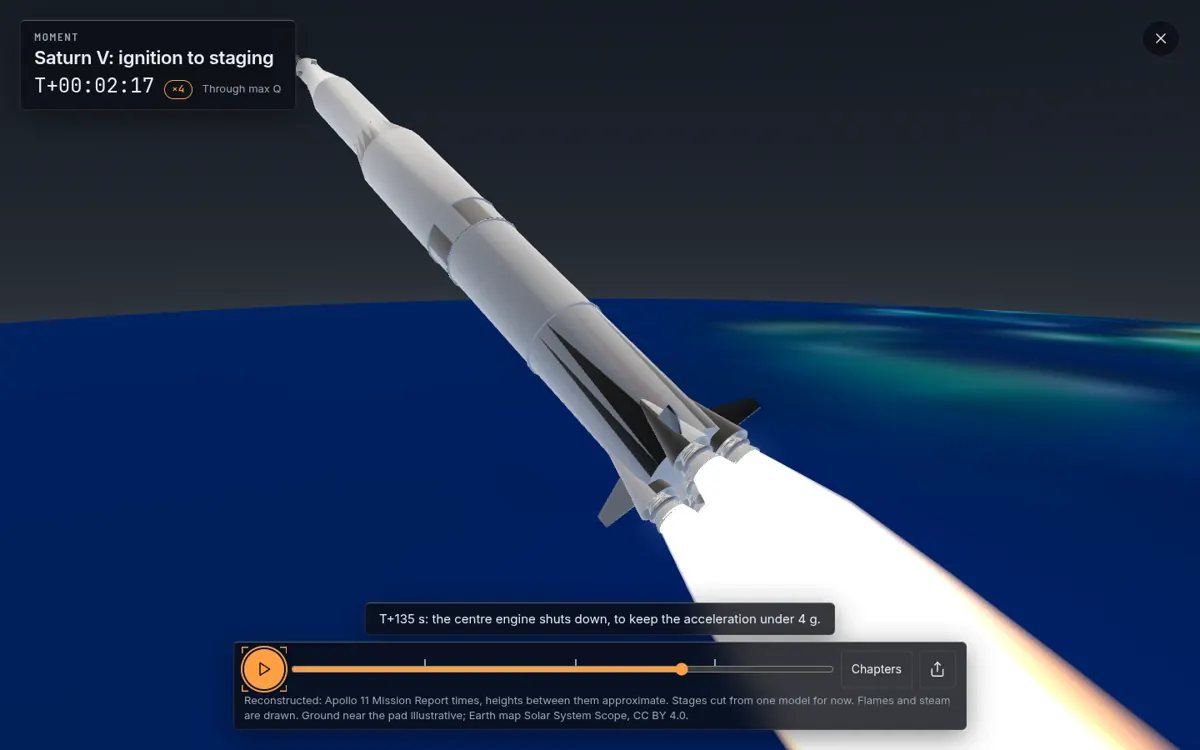
Release 1.5.0 adds a new kind of tour, a Moment, and its first demonstration: Apollo 11's Saturn V from ignition to the jettison of the escape tower.
Where is the ISS right now? Two addresses in the sky
Ten people live off the planet this week, in exactly two homes. What their days are like, why the stations fly where they do, how to watch one cross your own street, and what happens when the bigger one comes down.
Stars with no distance, 4 383 pulsars and the farthest galaxy
Release 1.5.0 fills the sky with what the catalogues know, and says on every card how a distance was found, or that it never was.